
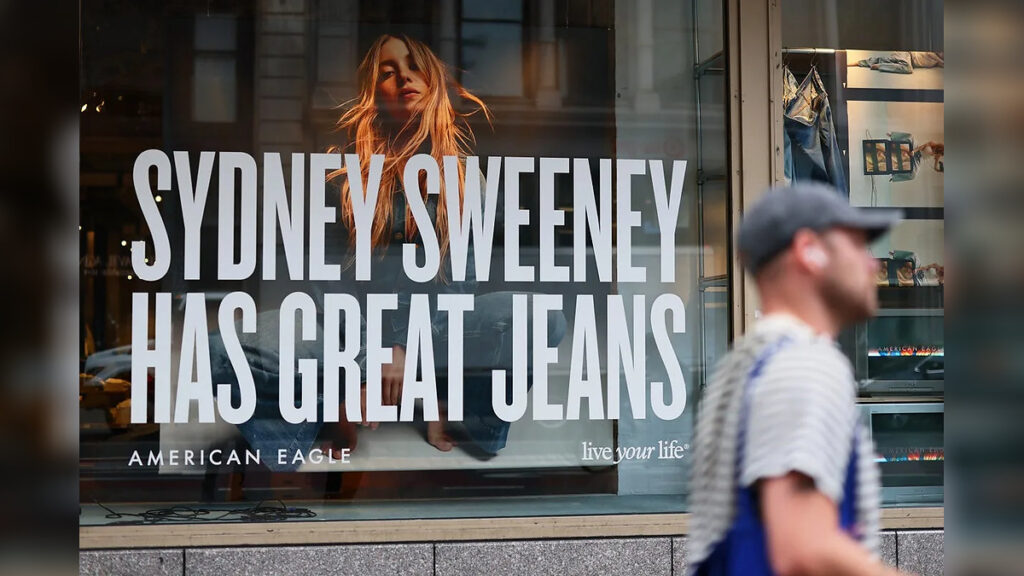
American Eagle is facing a reality check after riding a wave of viral marketing success tied to Hollywood actress Sydney Sweeney.
What once looked like a breakthrough celebrity partnership is now colliding with softer sales in a key part of the business.
The retailer has reported that comparable sales at its flagship American Eagle brand slipped by 2 percent in the latest quarter.
The decline was largely driven by weaker demand in women’s bottoms—the same category the company heavily promoted through its high-profile denim campaigns.
For a brand that had recently enjoyed renewed investor enthusiasm, the reversal has raised fresh questions about whether social media hype is translating into consistent retail performance.
From Wall Street Excitement to Cooling Momentum
Just months earlier, the mood was dramatically different.
American Eagle shares had surged after the launch of campaigns featuring Sweeney, with investors betting that her global popularity could reignite growth for the teen-focused apparel chain, American Eagle Outfitters.
The first major collaboration, branded the “Great Jeans” campaign, became one of the company’s most successful marketing pushes in years.
It reportedly drew in around one million new customers, while featured items sold out within days.
The campaign also generated more than 150 million social media views and helped lift the company’s stock through the second half of last year.
At one point, the momentum was so strong that American Eagle’s valuation more than doubled into the holiday season, with investors treating the Sweeney partnership as a turning point.
Follow-Up Campaign Sparks Fresh Optimism—Then Doubt
The company tried to build on that success earlier this year with a second rollout titled “Syd for Short,” again featuring Sweeney in beachside denim imagery.




The market response was immediate: shares jumped nearly 9 percent following the launch as optimism returned.
However, that excitement has not been matched by underlying sales performance.
The latest figures suggest that while the campaigns continue to generate attention online, converting that attention into sustained demand remains a challenge.
American Eagle President and Chief Creative Officer Jen Foyle acknowledged the disappointing results, saying the company was “not satisfied” with quarterly performance, especially in its women’s segment, and that internal teams were already working on corrections and new inventory strategies.
Inventory Issues and Shifting Consumer Demand
Analysts have pointed to deeper operational problems behind the slowdown.
Research from TD Cowen suggests the issue is not just weakening consumer demand but also a mismatch in product planning.
According to the firm, American Eagle may have misjudged which styles customers actually wanted, leaving gaps in popular fits and silhouettes.
Combined with weaker in-store conversion rates, markdown pressure, and even unfavorable weather patterns, these factors have weighed on results.
The pressure has been most visible in women’s bottoms, despite that category being central to the brand’s recent celebrity-led marketing strategy.
Controversy Shadows a Viral Success Story
The marketing push has also not been without controversy.
The original “Great Jeans” campaign triggered online backlash after some viewers criticized its messaging around genetics, sparking widespread debate across social media platforms.
The conversation grew large enough that it crossed into mainstream political commentary, with U.S. President Donald Trump even joking about the ad during public remarks, adding to its notoriety.
Despite the criticism, the campaign still delivered strong commercial outcomes at the time, helping reposition American Eagle as a more culturally relevant brand in a crowded retail market.
A Bright Spot in a Mixed Earnings Picture
Not all divisions struggled.
The company’s intimates and activewear label Aerie delivered a standout performance, posting a 25 percent rise in comparable sales.
Its growth has increasingly been supported by its Offline activewear expansion, which continues to attract younger shoppers.
Analysts at UBS noted that investors may still be underestimating the long-term potential of the segment, which currently operates more than 100 stores and could expand further.
Overall, American Eagle Outfitters reported revenue of $1.2 billion for the quarter, marking a 10 percent increase year over year.
Yet despite the stronger headline revenue, the weakness in women’s denim—the category tied most closely to its celebrity marketing push—has become the focal concern for investors watching whether viral fame can truly sustain retail growth.
