
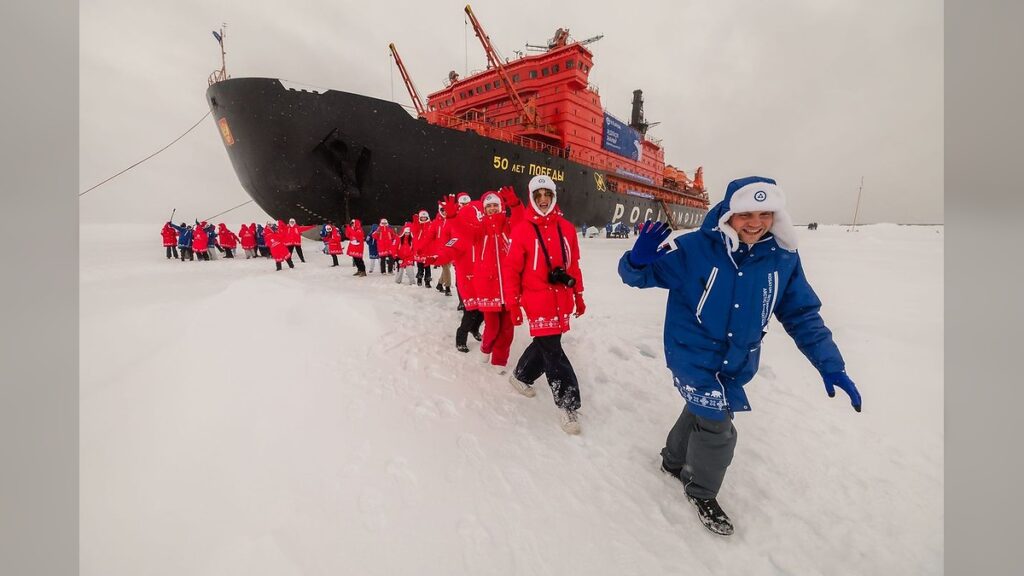
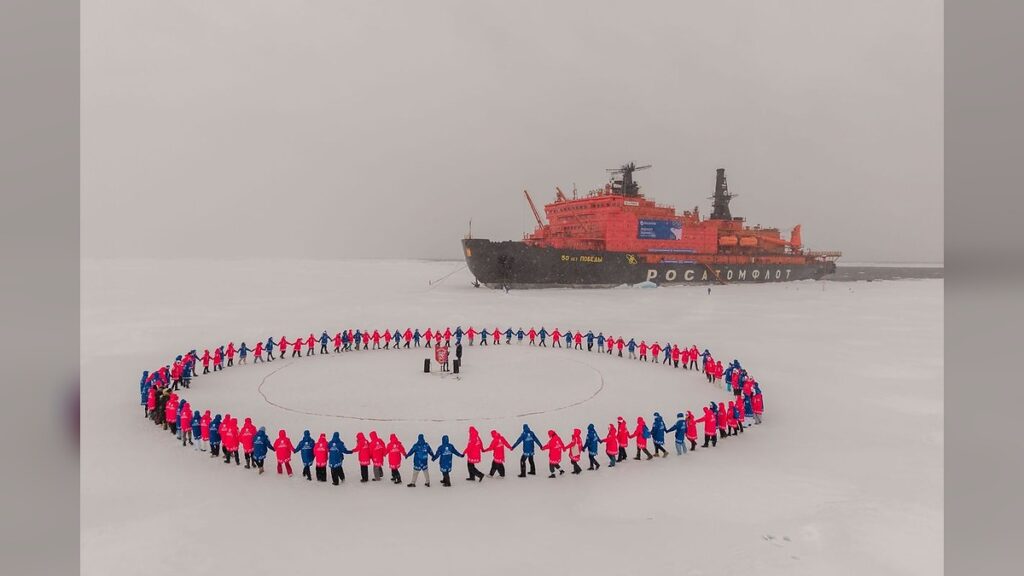
Rosatom’s seventh International Scientific and Educational Expedition, known as the “Icebreaker of Knowledge,” has returned to Murmansk after a 10-day journey through some of the Arctic’s most remote and challenging environments.
The expedition brought together 68 talented school and college students representing all of Russia’s federal districts as well as 22 countries.
Nuclear Icebreaker Carries Students to the North Pole
The participants travelled aboard the nuclear-powered icebreaker 50 Let Pobedy, following a route from Murmansk to the North Pole and Franz Josef Land before returning to Murmansk.
The expedition combined Arctic exploration with scientific education, giving young participants the opportunity to work alongside researchers and gain practical experience in conducting experiments in extreme conditions.
Voyage Marks Major Arctic Milestone
The expedition also achieved a notable place in Arctic exploration history, becoming the 200th expedition by a surface vessel to reach the North Pole.
The milestone added a historic dimension to a programme designed primarily to encourage young people to pursue careers in science, technology and research.



Students Participate in Arctic Research
A dedicated aerospace laboratory formed part of this year’s educational programme, allowing participants to contribute directly to scientific experiments during the voyage.
Working with scientists, the students helped prepare and conduct two experimental projects focused on improving the monitoring and communications capabilities available in the Arctic.
Radiosonde Experiment Targets Remote Arctic Communications
One of the experiments involved launching a radiosonde at the North Pole. The project is intended to contribute to research into communications in remote Arctic territories and along routes used by vessels travelling the Northern Sea Route.
The experiment provided participants with practical exposure to atmospheric and communications research in one of the world’s most demanding environments.
Recoverable Stratospheric Platform Tested
The expedition also featured testing of what Rosatom described as the world’s first recoverable stratospheric platform for Arctic monitoring.
The technology is designed to support observation and monitoring activities in the Arctic, highlighting the growing role of aerospace systems in gathering information from the region.
Science and Exploration Combined
Rosatom said the expedition demonstrated how Arctic exploration can be combined with hands-on scientific education, giving young researchers an opportunity to participate in projects with potential applications beyond the voyage itself.
The return of the Icebreaker of Knowledge to Murmansk marks the conclusion of another international educational mission aimed at inspiring the next generation of scientists and engineers while advancing research in the Arctic.
