
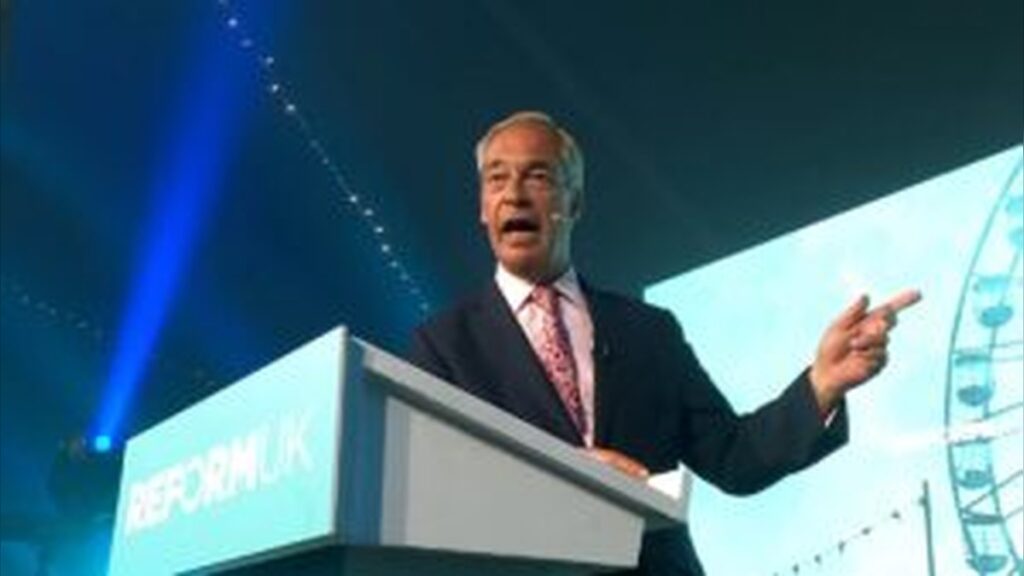
Nigel Farage has retained the Clacton parliamentary seat after defeating a field that included the flamboyant Count Binface, but the result has done little to silence the questions surrounding Reform UK and its leader.
Farage won 22,239 votes, an increase of 1,014 from his previous result.
His victory ensured that he remained in Parliament, while Count Binface surprised observers by securing 9,455 votes — enough to finish second and retain his deposit.
The result was nevertheless far removed from the overwhelming political breakthrough Farage had hoped would reshape the national conversation around his leadership.
Count Binface Turns the Election Into a Spectacle
The campaign attracted considerable attention because of the presence of Count Binface, the satirical candidate known for appearing in a distinctive bin-themed costume.
Broadcaster and prominent Farage supporter Adam Brooks had attacked voters who might choose the novelty candidate, describing such support in highly disparaging terms.
Yet thousands of Clacton voters did precisely that.
Count Binface’s 27 per cent share of the vote turned the contest into an unexpected political spectacle and provided a striking contrast to the conventional campaign surrounding Farage.
Victory Comes Without the Expected Celebration
Farage’s victory was also notable for what happened after the polls closed.
The Reform leader and his supporters did not attend the count, despite the contest having been framed as a major test of his political future.
Farage later said the absence followed advice from Essex Police, although the force said it had not issued such advice to any candidate.
A victory speech that had reportedly been planned for 10.30am was also cancelled.
Rather than projecting triumph, the events surrounding the count contributed to the impression that Reform was relieved simply to have avoided defeat.
Harborne Investigation Remains a Problem
One of Farage’s central motivations for contesting Clacton was reportedly connected to the ongoing parliamentary investigation into an undeclared £5 million gift linked to British-Thai cryptocurrency businessman Christopher Harborne.
Farage’s apparent strategy was to demonstrate that his constituents continued to support him and, in doing so, make it politically harder for parliamentary authorities to pursue the matter or for opponents to demand further action.
However, that calculation is unlikely to succeed.
The standards investigation is expected to resume when Parliament returns from its summer recess.
Sources cited in the original account also claimed that Farage’s advisers had misunderstood the effect of resigning as an MP on the investigation.




Political Rivals Show No Sign of Backing Down
Farage also appears unlikely to persuade his political opponents to abandon the possibility of another electoral contest.
The decision by major parties not to field candidates against him in the by-election had been interpreted by some in Reform as evidence that opponents were reluctant to challenge him directly.
But Conservative figures are now reportedly preparing for the possibility of another contest if circumstances lead to a recall petition and fresh by-election.
One Tory source described the Clacton contest as a crisis of Farage’s own making and indicated that Conservatives would be prepared to make Reform’s financial controversies a central issue in any future campaign.
Reform Faces Questions Over Its Finances
The election has also intensified scrutiny of Reform’s finances.
Reports that businessman Arron Banks, a close Farage ally, had hired private investigators to examine journalists investigating the party’s finances have added another layer to the controversy.
The stated explanation was that Reform believed sensitive financial information was being leaked to the media by government agencies, including the National Crime Agency.
However, according to the account, some people within Reform instead suspect that information is being leaked by individuals inside the party who are seeking to damage Farage’s position.
The resulting tensions have the potential to deepen divisions within an organisation already facing internal disputes.
Zia Yusuf Comes Under Pressure
Reform’s internal conflict has also increasingly focused on Zia Yusuf, one of Farage’s senior lieutenants.
Concerns over Yusuf’s conduct reportedly intensified after he launched a fierce attack on former Conservative defence secretary Ben Wallace over arrangements for Afghan nationals who had worked alongside British forces.
A Reform insider reportedly argued that Yusuf had gone too far and suggested his position within the party could soon become untenable.
Such tensions could prove particularly damaging as Reform attempts to present itself as a credible alternative to Britain’s established political parties.
Farage’s Personal Ratings Raise a Bigger Concern
Perhaps the most significant challenge facing Farage is not the result in Clacton itself but his deteriorating standing among voters nationally.
An Ipsos survey published as Clacton voters prepared to cast their ballots found that only 26 per cent of respondents said they liked Farage, while 65 per cent said they disliked him.
That produced a net approval rating of minus 39 percentage points.
For a politician whose appeal has historically relied on his ability to command strong loyalty while provoking equally strong opposition, the figures represent a serious warning.
A Victory That May Not Change the Bigger Picture
Farage can point to one undeniable achievement: he remains the MP for Clacton.
But the broader political problems that existed before the by-election have not disappeared.
The parliamentary investigation remains, questions about Reform’s funding continue, internal disputes are intensifying and Farage’s personal approval ratings remain deeply negative.
His victory may therefore prove less a political reset than a temporary reprieve.
From Political Triumph to Political Stagnation?
The comparison with Jeremy Corbyn is difficult to ignore.
Corbyn won convincingly as an independent in Islington North at the 2024 general election after being rejected by Labour, producing a dramatic personal victory that briefly revived his political profile.
Yet that success did not translate into a wider national resurgence.
Farage now faces a similar test. His Clacton victory demonstrates that he retains a powerful electoral base, but it does not necessarily prove that he has regained momentum across Britain.
For now, the numbers tell a more complicated story: Farage has secured another term in Parliament, but the controversies that drove him to contest Clacton remain firmly in place.
And, in one of the election’s most striking statistics, he finished just 12,784 votes ahead of a man wearing a bin costume.

