
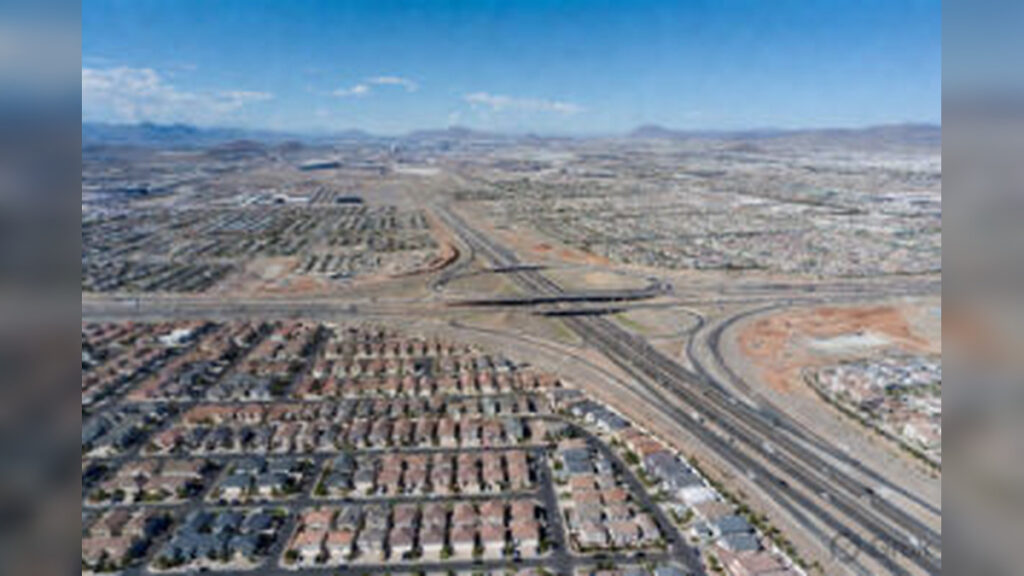
Nevada has experienced one of the fastest population expansions in the United States over the past two decades, fundamentally changing the state’s transportation network, infrastructure demands and the cost of owning a vehicle.
Since 2000, more than 1.25 million people have moved to the state, pushing Nevada’s population growth to nearly 62%—far exceeding the national increase during the same period.
Even during the economic downturn of the Great Recession, Nevada’s population continued to climb without recording a single year of decline.
That steady influx has placed mounting pressure on highways, public services and the insurance industry, creating challenges that continue to evolve as more residents arrive each year.
Most New Residents Are Settling in Two Major Regions
Although Nevada covers a vast geographic area, population growth has been concentrated overwhelmingly in two counties.
Clark County, home to Las Vegas, now accounts for roughly three-quarters of the state’s 3.27 million residents and continued expanding in 2024 with growth that significantly outpaced national averages.
Washoe County, anchored by Reno, remains the state’s second-largest population hub.
The concentration of people in these metropolitan areas has intensified traffic along major corridors including Interstate 15, the 215 Beltway and U.S. Highway 95—roadways originally designed for much smaller populations.
Billions Invested to Expand Highway Capacity
To keep pace with demand, Nevada transportation officials have launched numerous large-scale highway improvement projects throughout the Las Vegas Valley.
Current work includes widening sections of Interstate 15, expanding the 215 Beltway, reconstructing the Henderson Interchange and upgrading several other heavily traveled routes.
Collectively, these projects represent hundreds of millions of dollars in public investment.
Since 2010 alone, improvements along the I-15 corridor have attracted more than $1.8 billion in funding, highlighting the scale of infrastructure upgrades required to accommodate sustained population growth.
Rail Projects Signal a New Transportation Strategy
State planners increasingly acknowledge that adding more traffic lanes alone will not solve long-term congestion.
As a result, Nevada is investing in alternative transportation systems designed to reduce dependence on automobiles.
Construction continues on Brightline West, the high-speed rail project linking Las Vegas with Southern California.
Once completed, the 218-mile route is expected to transport approximately 11 million passengers annually at speeds exceeding 186 miles per hour.



Meanwhile, the Vegas Loop, developed by The Boring Company, continues expanding beneath the Las Vegas Strip and convention district, providing another option for easing traffic in one of the city’s busiest tourist corridors.
Together, these projects represent a broader shift toward transit solutions typically associated with much larger metropolitan regions.
More Vehicles Mean Greater Insurance Risks
The state’s population surge has also reshaped Nevada’s automobile insurance market.
With more drivers using increasingly congested roads, accident frequency has risen alongside traffic volumes.
Clark County alone records more than 20,000 vehicle crashes annually, contributing to growing insurance costs across the state.
Nevada has also experienced substantial premium increases in recent years, with hundreds of thousands of policyholders seeing their insurance rates climb between 2024 and 2026.
Industry analysts point to several contributing factors, including heavier traffic, higher repair costs, legal expenses and increasing claims activity.
Uninsured Drivers Add to Rising Premiums
Another challenge affecting insurance prices is Nevada’s relatively high number of uninsured motorists.
Estimates suggest that between one in ten and nearly one in four drivers may lack adequate insurance coverage, depending on the methodology used.
When uninsured motorists are involved in collisions, insurance companies often recover costs through higher premiums charged to insured customers, further increasing the financial burden for responsible drivers.
Nevada also reports attorney involvement in more than three-quarters of auto insurance claims, a figure considerably higher than the national average and another factor that contributes to rising claim costs.
New Residents Often Encounter Unexpected Costs
Many newcomers relocating to Nevada—particularly those arriving from California—discover that automobile insurance works differently than they expected.
Unlike some states with stricter consumer protection rules, Nevada allows insurers to consider an applicant’s credit history when calculating premiums.
Drivers whose credit profiles have changed during a move or who have limited credit histories may receive higher quotes than anticipated.
Insurance specialists advise new residents to compare multiple insurers, as some companies place less emphasis on credit-based pricing than others.
Experts also recommend considering uninsured motorist coverage, which remains optional under Nevada law but can provide valuable financial protection given the state’s elevated uninsured driver rate.
Reno Faces Its Own Infrastructure Demands
While Las Vegas receives much of the attention, northern Nevada is undergoing its own transformation.
Washoe County has attracted growing investment from technology firms, logistics companies and manufacturers seeking proximity to California without the state’s higher taxes and operating costs.
This economic expansion has accelerated population growth around Reno, increasing demand for housing, transportation and airport infrastructure.
The ongoing $1.6 billion MoreRNO expansion at Reno-Tahoe International Airport reflects the region’s continued growth and its effort to accommodate rising passenger volumes.
Growth Expected to Continue for Years
Population forecasts suggest Nevada’s expansion is far from over.
Clark County alone is projected to welcome more than half a million additional residents over the next two decades, meaning transportation systems, road construction and insurance markets will likely remain under pressure.
For motorists, that could translate into continued highway upgrades, persistent traffic congestion and insurance premiums that remain among the highest in the country.
As Nevada evolves into an even larger metropolitan state, understanding how rapid growth influences infrastructure, accident risks and insurance costs may become increasingly important for both longtime residents and newcomers alike.

