
A recent analysis from crypto analytics firm Glassnode has brought renewed attention to a long-discussed but often underestimated risk in the Bitcoin ecosystem: what happens if quantum computers eventually become powerful enough to break modern cryptographic protections.
The report doesn’t claim this is an immediate threat.
Instead, it maps out how much of Bitcoin’s supply could theoretically become vulnerable under a future scenario where so-called cryptographically relevant quantum machines exist.
How Much Bitcoin Could Be Exposed?
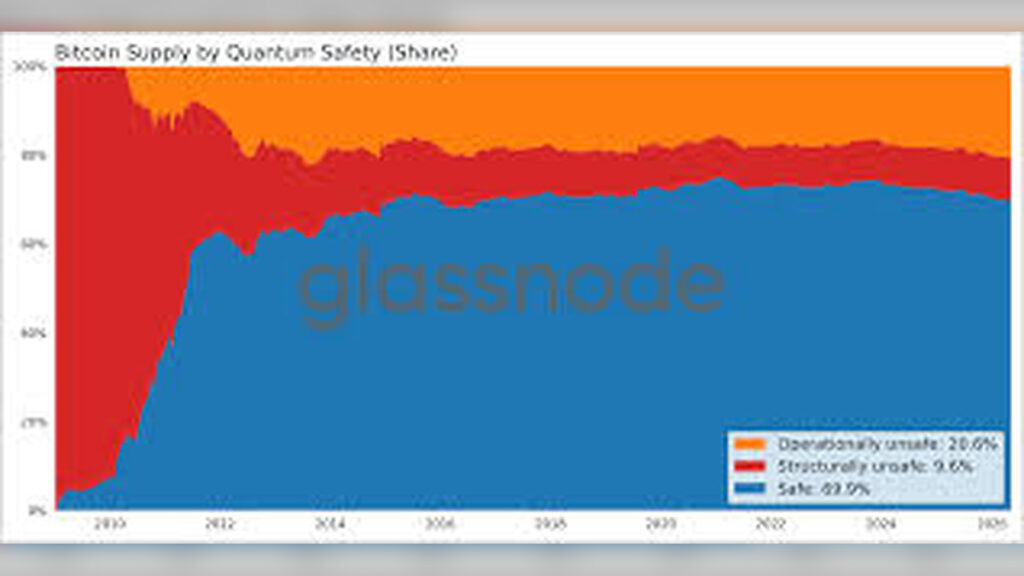
Glassnode’s findings suggest that roughly 6.04 million BTC—about 30.2% of all mined supply—falls into an “at-rest exposure” category.
This doesn’t mean these coins are currently at risk in practice.
It simply means their on-chain structure shows public-key information in a way that could matter in a future quantum attack model.
On the other side, around 13.99 million BTC (nearly 70%) appears to have no visible public-key exposure under the same model, making it less theoretically vulnerable.
Structural Exposure vs Operational Exposure
The report splits the risk into two different categories that behave very differently.
Structural exposure refers to Bitcoin outputs where the design itself reveals public keys.
These include older transaction formats like early P2PK outputs, legacy multisig setups, and even some modern script types such as Taproot in certain contexts.
Operational exposure is more behavioral.
It happens when users unintentionally reveal public keys through actions like address reuse or partial spending.
Even if the original wallet was secure, the way it has been used over time can expose cryptographic data.
In numbers, structural exposure accounts for about 1.92 million BTC (9.6% of supply), while operational exposure is significantly larger at 4.12 million BTC (20.6%).




A notable portion of that—around 1.63 million BTC—is linked to exchange holdings.
Why Quantum Computing Changes the Conversation
The concern comes from a theoretical capability: a sufficiently advanced “cryptographically relevant quantum computer” running algorithms such as Shor’s algorithm.
In simple terms, if such a machine existed at scale, it could potentially derive private keys from exposed public keys.
That’s where the distinction made by Glassnode becomes important.
If a public key is already visible on-chain, the coin could be considered exposed under this model.
If it is not visible, it remains unexposed—even in a quantum scenario.
Exchange Holdings and Uneven Exposure
One of the more striking parts of the report is how exposure is distributed across major exchanges.
Some platforms show relatively low levels of exposed funds, while others appear heavily concentrated in operationally unsafe categories. The report suggests that:
- Coinbase-linked balances show relatively low exposure (~5%)
- Binance-linked balances appear much higher (~85%)
- Bitfinex-related balances are described as fully exposed in the operational category
These differences largely reflect custody practices, address reuse behavior, and internal wallet structures.
Country-Level Findings
Interestingly, the report notes that Bitcoin holdings tied to jurisdictions such as the United States, the United Kingdom, and El Salvador show no quantum exposure under the model used.
This doesn’t mean those holdings are uniquely secure in a real-world sense—it simply reflects how their coins are structured on-chain.
Impact and Consequences
If quantum computing ever reaches the level required to break elliptic curve cryptography, the implications for Bitcoin would be significant.
Some possible consequences include:
- Long-dormant coins with exposed public keys could become targets
- Exchange wallets could face heightened security pressure
- Address reuse would become far more dangerous than it already is
- Market confidence could be shaken even before any real attack occurs
Even without an actual quantum breakthrough, the narrative alone could influence long-term security planning and investor sentiment.
What’s Next?
For now, the issue remains theoretical, but it is already influencing how researchers and developers think about future upgrades.
Potential future responses in the Bitcoin ecosystem could include:
- Migration toward quantum-resistant cryptography
- Stronger discouragement (or elimination) of address reuse
- Gradual protocol upgrades or soft forks
- Improved wallet-level privacy defaults
None of these changes are imminent, but the industry is increasingly aware that cryptography is not static—it evolves alongside computing power.
Summary
Glassnode’s analysis highlights that a meaningful portion of Bitcoin supply could be theoretically exposed under a future quantum computing scenario.
The risk is split between structural design choices and operational behaviors like address reuse.
While no immediate threat exists today, the findings are shaping long-term discussions about cryptographic resilience.
Bulleted Takeaways
- About 30.2% of Bitcoin supply shows potential “at-rest” public-key exposure
- 69.8% remains unexposed under the study’s model
- Structural exposure = 1.92M BTC (design-based exposure)
- Operational exposure = 4.12M BTC (usage-based exposure)
- Exchange holdings form a major part of exposed coins
- Quantum risk depends on future breakthroughs in cryptographically relevant quantum computers
- Address reuse remains a key weakness even in current systems
- No immediate security threat exists, but long-term protocol evolution is likely to continue

