
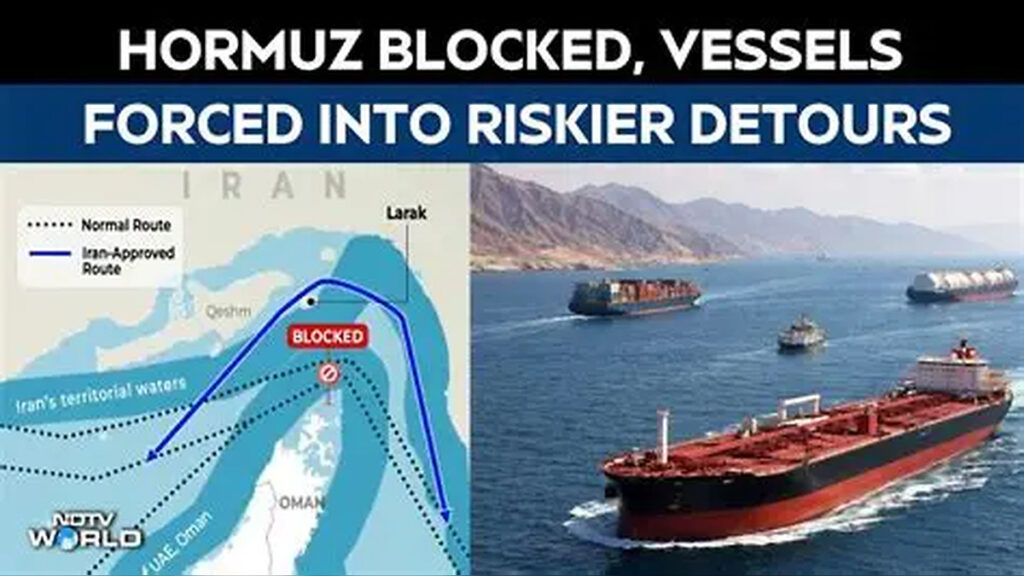
The growing prospect of Iran imposing charges on vessels using the Strait of Hormuz is fueling fears that a major principle of international maritime commerce could be permanently weakened.
Energy and geopolitical analysts warn that if Tehran succeeds in establishing a tolling system, other countries controlling strategically important waterways could seek to follow suit.
The potential consequences could extend from the Strait of Malacca and Strait of Gibraltar to waterways affected by Russia’s war in Ukraine, adding another layer of costs to an already fragile global trading system.
Michelle Brouhard, head of policy and geopolitical risk at energy intelligence company Kpler, argues that the traditional concept of freedom of navigation is entering an uncertain new era.
“I think that the ‘freedom of the seas’ is dead,” Brouhard said, describing the transformation as potentially expensive and inflationary while also encouraging companies to move more manufacturing and supply chains closer to home.
Iran’s proposed fees could reshape maritime economics
Iran has been pushing for a system under which ships transporting oil through Hormuz would pay a service charge.
Proposals discussed by analysts include fees equivalent to 5% or 7% of the value of oil transported, potentially generating billions of dollars each year.
Estimates have suggested the revenue could approach $20 billion annually from oil alone.
Additional charges on liquefied natural gas, petrochemicals, fertilizer, helium and containerized cargo could make the potential revenue considerably larger.
The size of the proposed charges remains heavily disputed, and several analysts doubt that Iran would ultimately impose the most aggressive version of the system.
Nevertheless, the possibility of any formalized payment arrangement is causing concern because of what it could mean for other strategic waterways.
A precedent other countries could exploit
Brouhard believes Iran’s actions could create a precedent for governments controlling other maritime chokepoints.
The Strait of Malacca, linking the Indian and Pacific oceans, is particularly important because it carries a huge volume of global energy and commercial traffic.
Indonesia and Malaysia have already raised the possibility of introducing charges, although both countries have indicated that they do not currently intend to impose tolls.
The Strait of Gibraltar could become another potential flashpoint, with Morocco among the countries that could theoretically benefit from a new charging model.
“If Iran said they were going to charge a fee—if they charge a toll—then everyone is going to charge a toll,” Brouhard argued, suggesting that control over strategically located waterways could become a new source of national revenue.
Under such a system, maritime geography itself could become a valuable economic asset for countries controlling narrow passages between major bodies of water.
Analysts disagree over what Iran actually wants
Not everyone believes Iran intends to establish permanent, heavy-handed tolls.
Bob McNally, a former White House energy adviser and founder of Rapidan Energy Group, views the threat primarily as a negotiating tool.
In his assessment, Tehran could ultimately accept relatively small voluntary service payments in exchange for broader economic concessions, particularly sanctions relief.
McNally compared the idea with arrangements already associated with the Strait of Malacca and argued that the most punitive version of an Iranian toll system is unlikely to become the long-term model.




Gregory Brew, a senior analyst specializing in Iran and energy at Eurasia Group, has offered another possibility: Gulf Cooperation Council states could effectively finance continued access to Hormuz through payments to Iran.
Rather than individual vessels being charged substantial amounts, Gulf states could provide funds intended to cover the cost of managing the waterway and maintaining access.
Such an arrangement, however, could still involve substantially more money than the relatively modest voluntary payments associated with Malacca.
The legal principle under pressure
The controversy goes beyond shipping costs. At its core is the long-established principle that international maritime routes should remain open to commercial and civilian navigation.
The idea of freedom of the seas has deep historical roots and was prominently championed by U.S. President Woodrow Wilson in his Fourteen Points after World War I.
Modern international maritime rules, including those reflected in the United Nations Convention on the Law of the Sea, have continued to underpin the principle.
Brouhard believes the current geopolitical environment is putting that framework under unprecedented strain.
She described the post-World War II international order as effectively collapsing, arguing that growing geopolitical competition and the return of regional power politics are accelerating a transformation that was already underway.
Russia’s war offers another controversial example
The debate also raises questions about how maritime access could be used as an economic weapon during conflicts.
Brouhard suggested that the United States and its allies could have considered working with Turkey and other countries to impose costs on Russian shipping through the Bosporus Strait following Moscow’s invasion of Ukraine.
Instead, Western governments pursued measures including price restrictions on Russian oil and gas exports.
Her argument is that restricting access or making transportation substantially more expensive could, in certain circumstances, impose a greater burden on an aggressor than measures that leave discounted commodities available to major buyers such as China.
Such an approach, however, would itself challenge the traditional principle of freedom of navigation and could accelerate the very transformation now causing concern.
A world of maritime tolls could fuel inflation
If tolls become commonplace, the economic effects would extend far beyond oil.
Shipping companies would face additional costs every time vessels crossed strategic chokepoints.
Those expenses would ultimately be incorporated into freight rates and, potentially, the prices paid by consumers and businesses.
Insurance could also become more complicated.
Shipping and insurance companies have already indicated opposition to involuntary fees, with concerns that vessels paying disputed tolls could face difficulties obtaining coverage.
The result could be higher transportation costs for everything from energy and raw materials to manufactured products and food.
Global supply chains face a new vulnerability
Approximately 90% of global trade by volume is transported by sea, meaning the consequences of widespread maritime tolling would reach virtually every major economy.
Brouhard argues that the change could accelerate investment in domestic manufacturing and shorter supply chains as companies attempt to reduce dependence on vulnerable international routes.
That could strengthen local industrial capacity, but it would come at a price.
Higher shipping expenses would feed into the cost of imported goods, while companies rebuilding supply chains domestically could face significantly higher production costs.
The geopolitical price of controlling chokepoints
The central question is therefore no longer simply whether Iran can charge ships to cross Hormuz.
It is whether such a move could establish a precedent that fundamentally changes how countries view strategically important waterways.
If governments begin treating maritime chokepoints as revenue-generating assets, access to global trade could become increasingly dependent on political agreements, security arrangements and payments.
That would represent a dramatic departure from the traditional vision of open seas.
Brouhard argues that freedom of navigation made more sense in an international system characterized by cooperation.
In a world defined by rivalry among major powers, regional conflicts and strategic competition, she questions whether the old model can survive unchanged.
The danger, analysts warn, is that once one major chokepoint becomes commercialized, others could follow.
What begins as a dispute over the Strait of Hormuz could therefore evolve into a much broader restructuring of global maritime trade—with higher costs, new geopolitical bargaining chips and potentially lasting inflationary consequences.

