
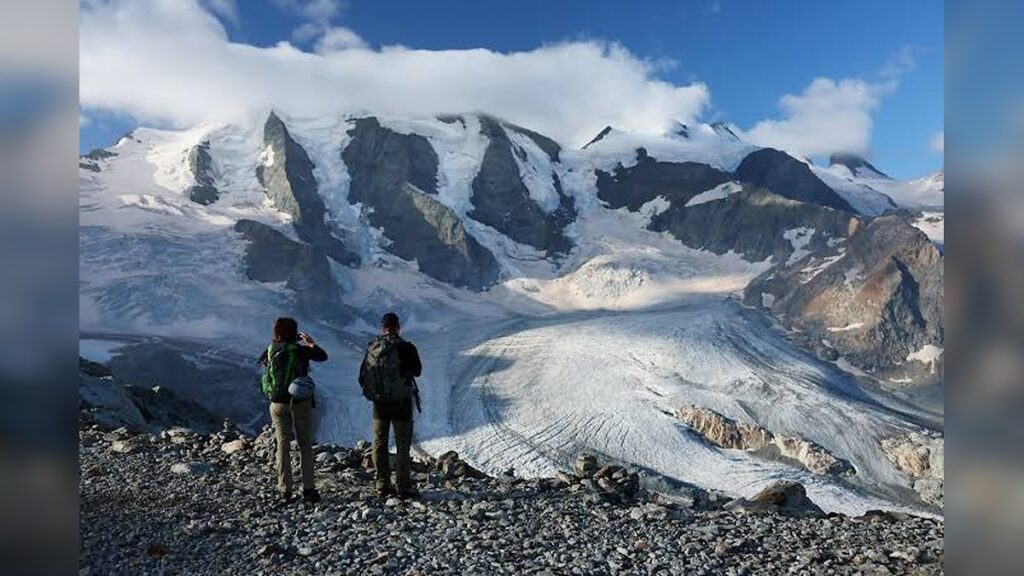
Switzerland’s glaciers are rapidly losing ice as an intense European heatwave accelerates melting across the Alps, raising fresh concerns about the long-term future of the country’s frozen landscapes.
Scientists monitoring the glaciers say this year’s “glacier loss day”—the point when all snow accumulated over winter has completely melted—is expected to arrive by Monday.
From that moment until autumn, every additional day of melting will reduce the glaciers’ overall ice mass.
The milestone will be the second-earliest ever recorded since consistent measurements began in 2000, surpassed only by the extraordinary melt season of 2022.
Experts Warn Conditions Are Months Ahead of Normal
Matthias Huss, who heads Switzerland’s Glacier Monitoring Network (GLAMOS), described the pace of melting as exceptionally severe.
According to Huss, glaciers across the Alps are experiencing unusually high rates of snow and ice loss, leaving the region nearly three months ahead of what scientists would consider a healthy seasonal cycle.
Historically, glacier loss day has typically arrived around the middle of August during this century.
Even that timeline reflects glaciers already under pressure from a warming climate, making this year’s early arrival particularly concerning.
Heatwave Produces Dramatic Ice Loss
The current spell of extreme temperatures has intensified an already difficult year for Switzerland’s glaciers.
During a recent inspection of the Rhone Glacier, Huss observed that approximately one metre of ice had disappeared vertically within just ten days—a striking illustration of how rapidly the ice is melting.
While individual heatwaves can temporarily increase melting, he explained that prolonged periods of unusually warm weather are far more damaging.
Sustained high temperatures leave glaciers with little opportunity to stabilize, resulting in continuous and significant ice loss.
Multiple Factors Have Combined to Worsen the Situation
Scientists say the ongoing crisis cannot be blamed solely on the current heatwave.
The glaciers entered summer after another winter with below-average snowfall, leaving less protective snow covering the ice.




Adding to the problem, warm weather in May caused snow to disappear earlier than usual.
Another contributing factor came in March, when dust carried from the Sahara Desert settled across Alpine snowfields.
The darker particles reduced the snow’s ability to reflect sunlight, allowing it to absorb more heat and melt faster.
Together, these conditions have created one of the most challenging years for Swiss glaciers in recent memory.
Less Snow Means Faster Melting
Measurements indicate that snowfall replenishing Swiss glaciers this winter was roughly 25 percent lower than the average recorded between 2010 and 2020.
As the seasonal snow layer disappears, darker glacier ice becomes exposed.
Unlike bright white snow, bare ice absorbs much more solar energy, triggering even faster melting in a self-reinforcing cycle.
Researchers say this process creates a feedback effect, where melting itself accelerates further ice loss throughout the summer months.
2026 Showing Troubling Similarities to 2022
Glaciologists are drawing comparisons between this year and 2022, widely regarded as the most destructive year ever recorded for Alpine glaciers.
According to Huss, the pattern of limited snowfall followed by persistent heat closely resembles the conditions that produced record-breaking melt rates four years ago.
Although the full extent of this year’s damage will not be calculated until September, scientists already expect another significant reduction in glacier volume before the melting season ends.
Centuries of Ice Are Gradually Disappearing
Swiss glaciers have been retreating for roughly 170 years, but the pace of decline has accelerated dramatically over recent decades as global temperatures continue to rise.
Between 2000 and 2024 alone, the total volume of Switzerland’s glaciers fell by approximately 38 percent.
The country has also witnessed the disappearance of around 1,200 glaciers over the past half-century.
While many were relatively small, researchers say they played an important role in the Alpine environment and local water systems.
Today, only about 1,300 glaciers remain across Switzerland.
Vital Water Resources Under Threat
The shrinking glaciers have consequences extending well beyond mountain scenery.
They provide an important source of water feeding major European rivers, including the Rhine and the Rhone, supporting ecosystems, agriculture and communities downstream.
Continued glacier retreat could eventually alter seasonal water supplies and increase pressure on regions that depend on Alpine meltwater.
Scientists Fear Only Small Ice Remnants Will Survive
Researchers warn that unless global warming slows significantly, Switzerland’s glaciers will continue to disappear throughout the century.
Huss said the current trajectory suggests that by 2100 only isolated patches of ice may remain in the Alps, marking a dramatic transformation of one of Europe’s most iconic natural landscapes.
The ongoing heatwave has once again highlighted how quickly climate conditions can reshape the mountains, reinforcing concerns that future generations may inherit only fragments of the glaciers that once dominated the Swiss Alps.

