
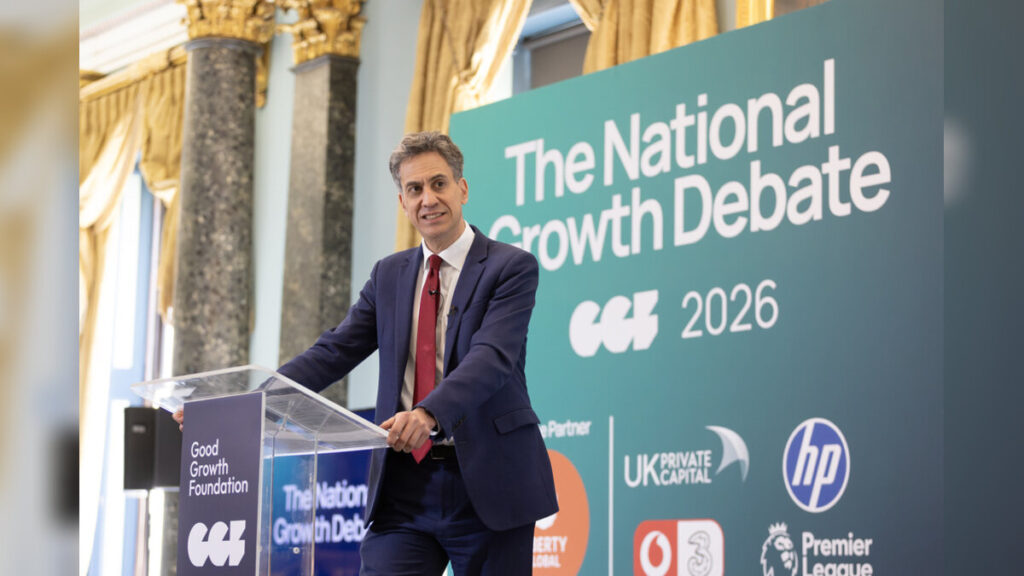
Ed Miliband used a major platform at the National Growth Debate to deliver a message that goes far beyond routine policy updates.
His speech framed clean energy not just as an environmental goal, but as the backbone of economic stability, national security, and long-term growth in an increasingly unpredictable world.
Speaking to business leaders and policymakers, he argued that the global energy landscape has shifted permanently—and governments must respond with urgency.
Why Fossil Fuel Stability Is No Longer Reliable
A key theme running through the speech was the idea that the world is now experiencing its second major fossil fuel shock in less than five years.
From the fallout of Russian invasion of Ukraine to tensions affecting oil supply routes like the Strait of Hormuz, global events continue to push up energy prices.
Miliband stressed that Britain’s heavy dependence on gas and oil leaves households and businesses vulnerable.
With gas still setting electricity prices much of the time, and most homes and industries relying on fossil fuels, international crises quickly translate into higher bills at home.
His conclusion was blunt: relying on fossil fuels in a volatile world is no longer a viable path to stability.
Clean Energy as the New Security Strategy
Rather than treating renewable energy as optional, the government now views it as essential infrastructure.
Wind, solar, and nuclear power—being domestically sourced—are far less exposed to geopolitical disruptions.
Miliband pointed out that renewable energy has already helped cushion the UK economy.
Since 2010, clean sources have grown to supply over half of electricity, reducing wholesale prices and limiting the impact of gas volatility.
He also highlighted how other countries are adapting:
- Spain expanding wind and solar capacity
- France boosting electrification investments
- Pakistan experiencing rapid solar growth
This global shift, he argued, signals the arrival of a new era—one defined by “clean energy security.”
Government Push to Accelerate the Transition
The UK government is not slowing down—in fact, it plans to move faster.
Miliband outlined several initiatives already underway:




- Contracts signed for small modular nuclear reactors
- Approval of the largest solar project in UK history
- Major investments in hydrogen and offshore wind
- Reforms to planning and grid infrastructure
A new push will also unlock public land—such as railway sites and unused government property—for renewable energy projects, potentially delivering up to 10GW of additional capacity.
The message was clear: delays in clean energy development are now seen as risks to national security.
Electrification: The Next Big Step
Beyond generating clean electricity, the government is focusing on how energy is used.
That means accelerating the shift to electric technologies across homes, transport, and industry.
Demand is already rising:
- Solar panel installations are surging
- Heat pump adoption is increasing rapidly
- Electric vehicle sales are hitting record highs
For the first time, electric cars are becoming cheaper than petrol vehicles to buy, marking a major tipping point.
To support this shift, policies include:
- Mandatory solar panels and clean heating in new homes
- Expanded funding for home upgrades through the Warm Homes Plan
- Increased grants for heat pumps, especially for rural households
- Faster rollout of EV charging infrastructure
Miliband emphasized that these technologies are not ideological—they are practical solutions to rising costs and insecurity.
Breaking the Link Between Gas and Electricity Prices
One of the more technical but crucial parts of the plan involves reforming how electricity prices are set.
Currently, gas often determines electricity prices—even when renewable energy is being used.
This system means that spikes in gas prices can still drive up electricity bills.
The government now aims to “delink” electricity pricing from gas by:
- Expanding fixed-price contracts for renewable generators
- Moving older low-carbon energy sources onto stable pricing systems
- Adjusting taxes to encourage participation in these schemes
The goal is to shield consumers from future fossil fuel shocks and stabilize energy costs over time.
A Balanced Approach to North Sea Oil
Miliband also addressed the politically sensitive issue of North Sea oil and gas.
Rather than adopting extreme positions, the government is pursuing a middle path:
- Existing oil and gas fields will continue operating
- New large-scale exploration licenses are being limited
- Transition plans will support workers and industry shifts
He rejected two opposing arguments:
- Stopping all fossil fuel production immediately
- Expanding drilling in hopes of lowering prices
According to the government’s analysis, increased drilling would neither reduce energy bills nor significantly improve energy security, given global pricing dynamics and declining reserves.
Impact and Consequences
If successfully implemented, this strategy could reshape the UK economy:
- Reduced exposure to global energy shocks
- Lower and more stable energy bills over time
- Growth in green industries and job creation
- Improved national security through energy independence
However, the transition will require significant investment, infrastructure upgrades, and public buy-in.
Short-term costs and political resistance remain potential challenges.
What’s Next?
The government is expected to:
- Accelerate renewable energy auctions and project approvals
- Introduce new electricity market reforms within the next year
- Expand electrification incentives before the next winter
- Continue international cooperation on climate and energy goals
Further policy details—especially around pricing reforms and investment frameworks—are likely to emerge soon.
Summary
Miliband’s speech signals a decisive shift in how the UK approaches energy.
Clean energy is no longer just about emissions—it is about resilience, affordability, and national strength in a volatile world.
The government’s stance is firm: the future lies in accelerating the transition, not retreating to fossil fuels.
Bulleted Takeaways
- Fossil fuel dependence is now seen as a major economic and security risk
- Clean energy offers price stability and protection from global crises
- The UK is accelerating renewable energy and electrification efforts
- New policies aim to break the link between gas prices and electricity bills
- A balanced transition plan will maintain existing oil production while limiting expansion
- Rising adoption of EVs, heat pumps, and solar signals a major energy shift
- Clean energy is positioned as the foundation for future growth and national security
