
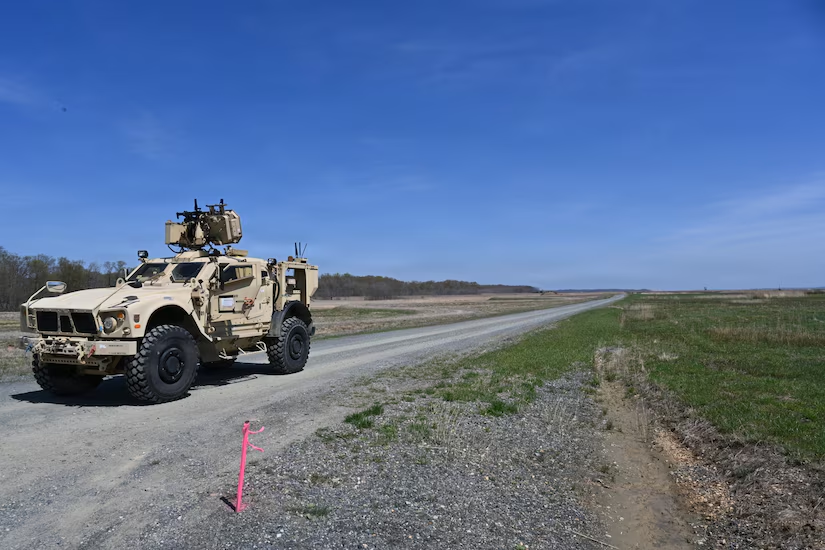
The U.S. Army has successfully demonstrated a new counter-drone capability designed to improve the military’s ability to detect, track, and engage unmanned aerial systems while on the move.
The project, led by the U.S. Army Combat Capabilities Development Command Armaments Center, focuses on enhancing fire control technology so remotely operated weapon systems can accurately target and defeat small drones without requiring vehicles to stop before engaging.
Officials say the effort is part of a broader push to address the growing threat posed by small unmanned aircraft on modern battlefields.
Technology Builds on Existing Weapons Systems
At the heart of the project is an advanced fire control solution developed through the Army’s Science and Technology Integration Office.
Engineers adapted the Armaments Center’s Gunslinger fire control technology, which was originally created for the Future Attack Reconnaissance Aircraft program, to support ground-based air defense missions.
The upgraded system combines targeting software with data collected from vehicle sensors, allowing operators to receive real-time information needed to accurately track and engage moving aerial targets.
Successful Testing Conducted in Maryland
The technology underwent testing in April at Aberdeen Proving Ground in Maryland, where developers evaluated its ability to engage drones under realistic operating conditions.
According to project officials, the trials demonstrated the system’s potential to strike small unmanned aircraft while the host vehicle remained in motion, a capability considered increasingly important in fast-moving combat environments.



The testing marked an important milestone for the program as engineers continue refining the technology for future operational use.
Modular Design Aims to Benefit the Wider Army
One of the key features of the new capability is its modular architecture, which allows the software to be shared and adapted across different Army platforms.
Developers say the open-system approach will make it easier to integrate future upgrades and enhancements while improving interoperability throughout the service.
As the technology matures, military planners expect it to increase engagement accuracy and reduce the number of rounds required to neutralize drone threats, potentially lowering operational costs and improving battlefield efficiency.
Developers Plan More Demanding Evaluations
Following the encouraging results from April’s testing, the development team is preparing additional trials designed to further challenge the system.
Future evaluations are expected to involve faster-moving vehicles and drones, allowing engineers to measure performance under increasingly complex scenarios.
Officials believe the additional testing will help fine-tune the algorithms responsible for tracking and engaging aerial targets in real time.
Early Results Encourage Program Leaders
Project leaders described the initial outcomes as a promising step forward in the Army’s efforts to strengthen counter-drone defenses.
Nick Cascia, the project’s officer, said the initiative was launched in response to the rapidly evolving threat posed by small unmanned aircraft and was driven by the need for a more advanced fire control capability.
He credited the development team for the progress achieved so far, noting that successful drone engagements during testing demonstrated that months of preparation and technical work were producing tangible results.
Growing Focus on Countering Unmanned Threats
As drones continue to play an increasingly significant role in conflicts around the world, militaries are investing heavily in technologies designed to detect and defeat them.
The Army’s latest demonstration reflects that growing focus, showcasing how advances in software, targeting systems, and vehicle integration can improve battlefield protection against emerging aerial threats.
Officials say the project remains under development, but the successful testing has provided a strong foundation for future improvements and expanded capabilities.
