
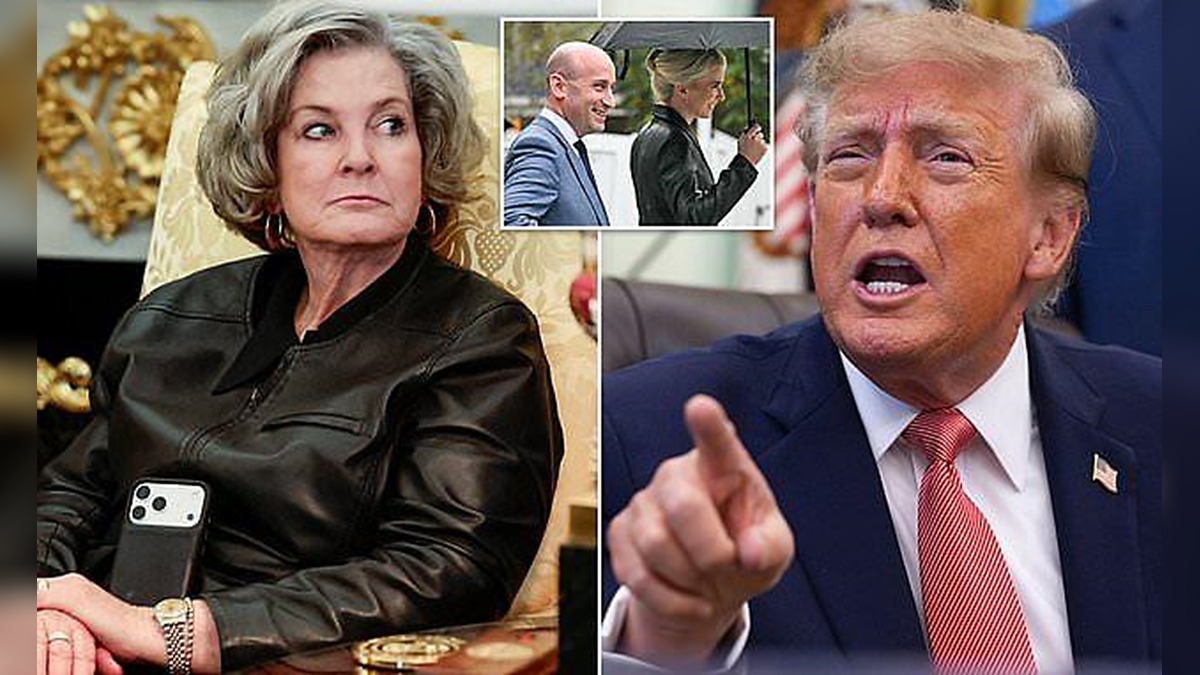
President Donald Trump has removed Susie Wiles as White House chief of staff following a heated confrontation in the Oval Office over the Republican Party’s disappointing performance in the midterm elections.
Wiles, 69, reportedly left the meeting on Thursday afternoon while Trump was still shouting at her, according to four sources familiar with the incident who spoke to the Daily Mail.
The confrontation took place in front of other senior White House officials, with Trump reportedly blaming Wiles for the party’s significant electoral losses.
One source close to the president said Trump “exploded at her”, while another White House source said he continued shouting until she left the room.
Two other sources described the incident as Trump ordering her out of the meeting.
However, a White House official disputed the accounts, insisting that Trump had not raised his voice at Wiles.
“He would never yell at Susie,” the official said.
Wiles Resigns After Learning She Could Be Fired
The breakdown in the relationship unfolded over approximately 72 hours, bringing an end to Wiles’s position as one of Trump’s most trusted advisers.
According to sources, Wiles had already been warned that her job was at risk following the election results.
She subsequently met with Trump on Thursday evening and submitted her resignation before he could formally dismiss her.
She reportedly requested permission to remain in the position until February to oversee a transition. However, Trump did not agree to the proposed arrangement.
A White House official said the president initially told her they would discuss the resignation later, without immediately accepting it.
By Friday morning, Wiles returned to the Oval Office and told him that a decision had to be made.
Her final day was subsequently confirmed as Friday.
The White House official attributed her departure to exhaustion, saying she was tired of continuing the internal battles.
“She didn’t want to keep fighting,” the official said.
Disputed Camp David Meeting Raised Questions About Her Exit Plans
Wiles’s departure came amid reports that she had been preparing an alternative strategy to remain influential within the administration after the midterm elections.
According to a source close to Trump, she had arranged an offsite meeting at Camp David for Saturday, with invitations extended to White House officials and aides considered loyal to her.
The meeting was reportedly intended to discuss how she could navigate the political fallout from the election and retain her position.
However, the gathering was postponed and subsequently cancelled.
The source also challenged the suggestion that Wiles had voluntarily stepped aside because she was exhausted, pointing to the planned Camp David meeting as evidence that she had been working to preserve her influence.
Hegseth Became a Target in the Search for Responsibility
Another development surrounding Wiles’s final days involved efforts by her allies to shift responsibility for the Republican losses towards Defence Secretary Pete Hegseth.
Three sources told the Daily Mail that Wiles’s supporters had been attempting to make Hegseth the public explanation for the party’s poor electoral performance.
Their argument focused on his role in leading the Iran war, which has contributed to rising living costs.




Trump himself acknowledged that the conflict had damaged Republican electoral prospects, saying voters were unwilling to accept the short-term consequences of higher petrol prices.
A senior Pentagon official alleged that Wiles had been trying to remove Hegseth to redirect blame for the election outcome.
“Susie was trying to push out Pete,” the official said.
Sources also claimed that Trump had received repeated warnings from close advisers that members of Wiles’s team were leaking information about Hegseth to journalists to divert attention from her own position.
A former Trump administration official made a similar accusation, describing Wiles as a major source of leaks.
The allegations reportedly contributed to the president’s growing frustration with his chief of staff.
Election Losses Intensified Pressure on the Chief of Staff
Wiles had remained beside Trump on election night as Democrats secured control of both the House and Senate.
While donors and senior administration officials were reportedly discussing her responsibility for the results, she remained with the president at his private residence.
Her critics pointed to the financial cost of the Republican political operation, which reportedly spent close to half a billion dollars without preventing the party from losing both chambers of Congress.
A senior administration official said Wiles had also been confident about the party’s prospects, claiming she had predicted a Republican victory as recently as six weeks before the elections.
By Friday afternoon, news of her departure had prompted celebrations among some former Trump officials and political figures in Washington.
One former administration official, now working at a lobbying firm, said colleagues were celebrating her removal and accused her leadership team of self-interest and corruption.
However, Wiles also had supporters within the administration.
A senior official said some of those opposed to her were unhappy because she controlled the information reaching Trump and prevented certain individuals from pursuing their preferred actions.
Trump Appoints Stephen Miller as Her Replacement
Trump announced on Friday that Stephen Miller, 41, would replace Wiles as White House chief of staff, with the appointment taking effect on Monday.
Miller previously served as Wiles’s deputy and played a central role in developing the administration’s hardline immigration policies.
In announcing the change on Truth Social, Trump praised Wiles’s performance, describing her work as outstanding and saying she would move to the Trump Political Operation.
Shortly afterwards, Wiles confirmed her departure in a public statement.
“Serving President Trump in the White House has been the honor of a lifetime,” she wrote, adding that Friday was her final day in the position.
Miller was among several figures considered for the role.
Others reportedly discussed included Director of National Intelligence Jay Clayton, Environmental Protection Agency Administrator Lee Zeldin, Federal Housing Finance Agency Director Bill Pulte and Ambassador to India Sergio Gor.
Trump ultimately selected Miller, who has worked alongside him since the 2016 presidential election.
According to one source, Miller had also promised to help bring the Iran war to an end.
Miller’s Appointment Raises Questions About Immigration Policy
Miller’s elevation comes as Wiles’s departure highlights disagreements within the administration over immigration enforcement.
A source familiar with internal discussions said Wiles had advocated for a narrower deportation strategy, limiting removals primarily to individuals convicted of violent offences or wanted in connection with such crimes.
She reportedly warned colleagues that the administration’s mass deportation programme was costing Republicans electoral support.
Her replacement, however, has been one of the principal architects of the administration’s aggressive immigration crackdown.
A Trump administration official at the State Department described Miller as firmly positioned on the right of the immigration debate.
The official also said Miller maintained working relationships with Secretary of State Marco Rubio, who serves as national security adviser, but suggested that Miller was primarily focused on serving Trump rather than belonging to any particular political faction.
Trump Departs for Florida Without Wiles
Trump publicly praised Wiles when speaking to reporters at the White House on Friday, saying she had done a very good job.
However, her absence was noticeable when the president departed for Florida later that day.
Trump boarded Marine One alongside Rubio, close aide Natalie Harp and his incoming chief of staff, Miller.
Wiles was not among those accompanying him.
As reporters questioned him about the Republican election defeat on the South Lawn, Trump turned and walked towards the waiting helicopter.
The departure marked the end of Wiles’s tenure as the president’s chief of staff, a position she had held after helping orchestrate his successful 2024 presidential comeback.
She had worked alongside Trump since 2016 and was widely regarded as one of the most influential figures in his administration.
