
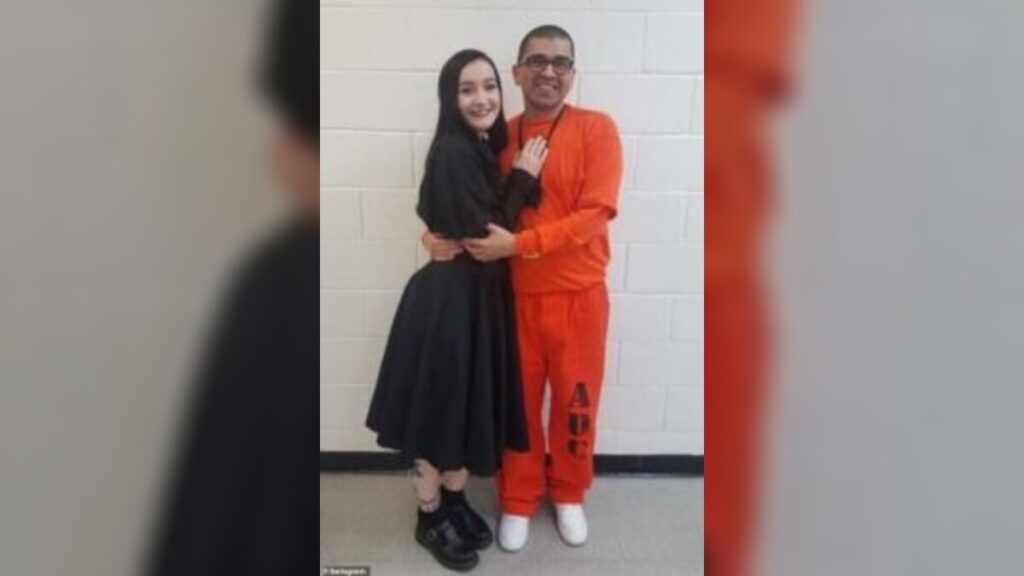
Across the Atlantic, a quietly unsettling trend has been unfolding for years: British women forming romantic relationships with men sentenced to death in the United States.
These relationships, often beginning through prison pen pal schemes, have led to marriages inside maximum-security prisons, emotional attachments to convicted killers, and in some cases, heartbreak at execution chambers.
The most recent case involves British law graduate Tiana Krasniqi, who married death row inmate James Broadnax in Texas, only to witness his execution weeks later while screaming that she loved him.
Her story is just one in a growing list that continues to divide opinion between those who see devotion and those who see danger.
From Letters to Lifelong Bonds Inside American Prisons
Many of these relationships begin in a surprisingly ordinary way: letters.
Prison pen pal programmes in the US connect inmates with people outside, often framed as rehabilitation or emotional support schemes.
Over time, some exchanges evolve into deeply personal relationships.
For women like Tracy Cope, affection developed gradually through years of correspondence with inmate James Lewis Morgan, eventually leading her to relocate to the United States and marry him inside Central Prison in Raleigh.
In another case, Rebecca Short, a trainee dentist from Oxfordshire, secretly married death row inmate Manuel Ovante Jr inside Arizona’s Eyman Prison after initially telling friends she was simply on holiday in America.
Weddings Held Under Maximum Security Conditions
These ceremonies are unlike traditional weddings in every sense.
Inside prison facilities, couples are often separated by glass, monitored by guards, and allowed only brief physical contact—if any at all.
Clothing, food, and rituals are heavily restricted.
Rebecca Short even brought a wedding cake reading “Till death do us part” into the prison, a phrase that later became hauntingly literal given her husband’s sentence for a double murder.
Similarly, British law graduate Tiana Krasniqi’s wedding to James Broadnax took place with a barrier between them, limiting physical interaction while marking a legally binding marriage inside a Texas prison.
The Crimes That Sit Behind the Romance
Behind every relationship lies a court record.
Manuel Ovante Jr was convicted for a 2008 double murder in Arizona, while James Broadnax was sentenced for the shooting deaths of two men outside a Dallas music studio in 2008.




In Morgan’s case, he was convicted of murdering Patrina Lynette King in 1997, though his later re-sentencing shifted him to life without parole instead of execution.
These details often become emotionally secondary for the women involved, who describe focusing instead on personality, letters, and emotional connection rather than criminal history.
Public Backlash and Family Shock
The relationships have consistently sparked disbelief among families and wider society.
Some relatives struggle to understand how educated women, including professionals and graduates, become emotionally attached to convicted killers on death row.
Critics argue the relationships romanticise violent offenders and ignore the suffering of victims’ families.
Others insist the women are exercising personal freedom in choosing who they love, no matter how controversial.
There is also a long-running statistic often cited in media coverage: more than 100 British women were reportedly engaged or married to American death row inmates as far back as the early 2000s.
Emotional Toll Inside and Outside Prison Walls
While the relationships may begin with optimism, the emotional reality is often intense and painful.
Contact is restricted to short weekly calls or limited visits.
Physical affection is rare, and the looming possibility of execution creates constant emotional strain.
In the most extreme cases, like that of Tiana Krasniqi, the relationship ends at the execution chamber itself, where grief becomes public and immediate.
Others, like Sandie Blanton, experienced repeated emotional trauma through witnessing executions and enduring years of uncertainty while supporting inmates through appeals and legal battles.
Impact and Consequences
These relationships raise difficult ethical and psychological questions.
For participants, the emotional consequences can be severe—grief, trauma, and long-term mental health challenges are common outcomes, especially when executions occur.
For prison systems, the phenomenon highlights how emotional connections can form even in highly controlled environments, raising questions about rehabilitation programmes and pen pal access.
Publicly, these stories fuel debate about whether love can be separated from criminal history or whether such relationships blur moral boundaries too far.
What’s Next?
Death row relationships are unlikely to disappear.
Prison pen pal programmes remain active, and digital communication makes cross-border relationships easier than ever.
However, increasing media attention may lead to tighter scrutiny of correspondence systems and more public debate around ethical safeguards.
In the UK, these cases also continue to spark discussion about why some individuals are drawn into relationships with incarcerated offenders abroad.
Summary
A series of British women have formed relationships—and in some cases marriages—with men on death row in the United States, beginning through prison correspondence and evolving into deeply emotional bonds.
While participants describe love, loyalty, and connection, critics highlight the violent crimes behind these relationships and the emotional devastation that often follows executions.
The stories remain some of the most controversial intersections of romance, crime, and incarceration.
Bulleted Takeaways
- British women have entered relationships with US death row inmates through prison pen pal schemes.
- Tiana Krasniqi married James Broadnax shortly before his execution in Texas.
- Rebecca Short secretly married inmate Manuel Ovante Jr inside an Arizona prison.
- Tracy Cope married James Lewis Morgan while he was incarcerated in North Carolina.
- Sandie Blanton formed relationships with multiple death row inmates, including Reginald Blanton and Charles Mamou.
- These inmates were convicted of serious crimes including murder and aggravated assault.
- Relationships often involve restricted contact, prison-supervised weddings, and emotional hardship.
- The phenomenon has sparked ongoing debate about love, morality, and the prison system.

