
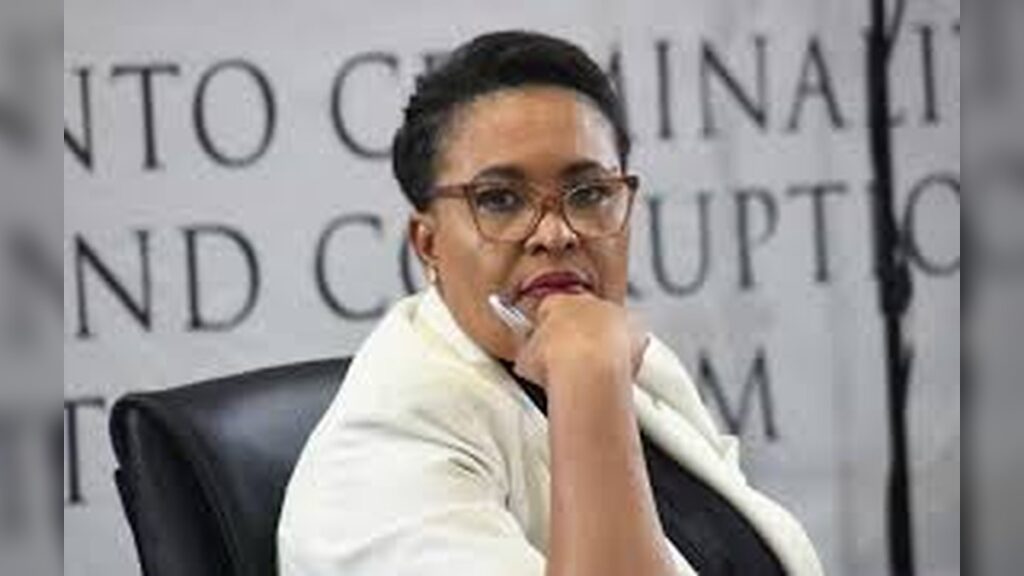
The head of the Investigating Directorate Against Corruption (IDAC), Andrea Johnson, has publicly retracted a major claim she previously made about Crime Intelligence official Brigadier Dineo Mokwele while giving evidence before the Madlanga Commission of Inquiry.
After two days of intensive cross-examination, Johnson acknowledged that her earlier assertion describing Mokwele as an “unqualified civilian” for an engineering-related role within the South African Police Service (SAPS) was incorrect.
She apologised for the statement, admitting it was based on inaccurate information supplied to her by investigators.
Commission Examines Mokwele’s Academic Background
The admission came after commission member Sandile Khumalo carefully reviewed Mokwele’s educational credentials during the hearing.
The documents presented showed that Mokwele holds a Bachelor of Technology (B-Tech) in Industrial Engineering, a qualification in mechatronics—which matched the requirements listed in the advertised position—as well as several additional certificates.
Reacting to the evidence, Khumalo said the impression initially created was that Mokwele had been appointed despite lacking relevant expertise.
However, after reviewing the records, he concluded that her qualifications not only met but exceeded the advertised requirements.
Johnson accepted the correction, confirming that the statement contained in her affidavit was inaccurate and formally withdrawing it before the commission.
Error Could Affect Corruption Case Against Crime Intelligence Boss
Johnson’s concession may have significant implications for the corruption case against Crime Intelligence chief Lieutenant-General Dumisani Khumalo, which is currently under review by the National Prosecuting Authority (NPA).
One of the central allegations in the investigation was that Mokwele had been improperly appointed because she lacked the qualifications required for the engineering-related position.
Although Johnson conceded that this particular allegation could no longer stand, she maintained that investigators are still examining whether Mokwele possessed the necessary experience for the role, alongside broader allegations concerning what has been described as the “system capture” of the Crime Intelligence unit.



IDAC Also Admits Jurisdiction Mistake
The commission also questioned whether IDAC had the legal authority to launch its investigation in the first place.
Johnson admitted that she had been mistaken in concluding that the complaint against Khumalo fell within the directorate’s investigative mandate.
The investigation originated from a complaint submitted by National Coloured Congress Member of Parliament Fadiel Adams.
During questioning, Johnson acknowledged that the original complaint lacked sufficient factual detail to establish reasonable grounds for suspected corruption, as required under the National Prosecuting Authority Act.
Commissioner Sesi Baloyi criticised the process, arguing that the directorate had relied on a weak initial complaint before gathering additional evidence through a preliminary investigation to strengthen its case.
Johnson accepted that her office’s handling of the complaint did not comply with the required legal procedures.
Growing Pressure on IDAC Leadership
The developments add to mounting scrutiny surrounding IDAC, a specialised anti-corruption body established only two years ago.
The directorate has already faced criticism after KwaZulu-Natal Police Commissioner Lieutenant-General Nhlanhla Mkhwanazi accused it of operating outside its legal mandate.
The handling of the Adams complaint has now led to further pressure on Johnson, who is expected to face an investigation by the directorate’s oversight judge. There have also been calls for President Cyril Ramaphosa to suspend her while allegations of improper conduct are investigated.
Contradictory Testimony Raises Perjury Concerns
Johnson’s evidence before the commission has also drawn attention because it appears to contradict testimony she previously gave to Parliament.
In November last year, while appearing before Parliament’s ad hoc committee investigating criminal infiltration within the justice system, Johnson said she did not recall receiving correspondence from then-Police Minister Senzo Mchunu’s office regarding Adams’ complaint.
However, during this week’s commission hearings, Johnson testified that the investigation into Khumalo and other Crime Intelligence officials had in fact been initiated after her office received a letter from Mchunu’s office concerning Adams’ allegations.
The conflicting versions, both given under oath, have prompted concerns that Johnson could face allegations of perjury if investigators conclude that the statements were intentionally false.
MK Party Signals Legal Action
The contradiction has already sparked a political response.
MK Party MP David Skosana told Parliament’s ad hoc committee that his party intends to open a perjury case against Johnson.
He also accused her of failing to submit documents that she had undertaken to provide to the committee while giving sworn evidence.
As the commission continues its work, Johnson’s admissions are expected to intensify scrutiny of both the Crime Intelligence investigation and the procedures followed by South Africa’s anti-corruption directorate.

