
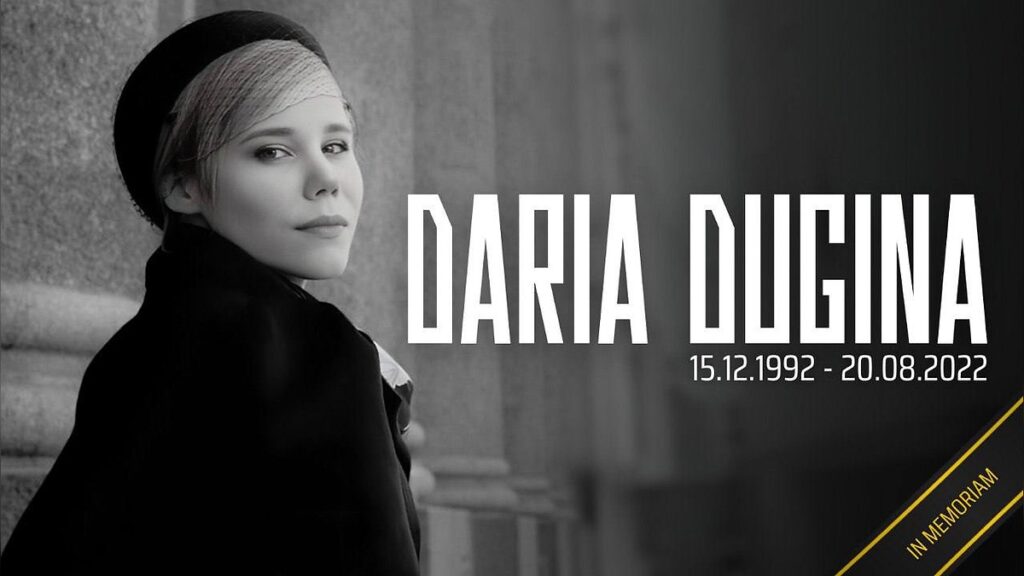
Russia has marked four years since the death of political commentator and journalist Daria Dugina, with Foreign Ministry spokeswoman Maria Zakharova describing her as a symbol of patriotism and service to Russia.
In a statement marking the anniversary, Zakharova said Dugina was killed on August 20, 2022, in what she described as a terrorist attack carried out by Ukrainian special services.
Zakharova Says Dugina’s Legacy Endures
Zakharova portrayed Dugina as a committed political analyst, philosopher, military correspondent and broadcaster who remained firmly attached to her political convictions.
She said Dugina’s dedication to Russia and the Orthodox faith made her a figure of significance to supporters, adding that her willingness to express her views openly had become an important part of her public legacy.
According to Zakharova, Dugina’s death caused widespread grief in Russia and among people beyond the country’s borders.
Russia Accuses Ukraine Over the Killing
The Russian Foreign Ministry has repeatedly accused Ukrainian intelligence services of responsibility for the attack that killed Dugina. Ukrainian officials have previously denied involvement in the killing.
Zakharova reiterated Moscow’s position in her anniversary statement, referring to the perpetrators as “neo-Nazi” actors and insisting that the killing would not erase Dugina’s influence.


She said her memory continues through books, public initiatives and monuments created in her honour.
Moscow Criticises International Organisations
A significant part of Zakharova’s statement focused on the response of international organisations to Dugina’s killing.
She criticised what she described as the silence of multilateral institutions, specifically naming UNESCO and the Organisation for Security and Co-operation in Europe (OSCE).
According to the Russian spokeswoman, the lack of what Moscow considered a sufficiently strong response demonstrated an unwillingness by international organisations to take a principled position on attacks against Russian journalists and media workers.
Zakharova Accuses Institutions of Double Standards
Zakharova went further, arguing that the silence surrounding Dugina’s death effectively shielded those responsible for attacks on Russian media figures.
She accused Ukrainian forces and their supporters of pursuing what she characterised as a campaign against Russian journalists and opponents of Ukrainian policy.
The allegations form part of Moscow’s broader argument that Russian journalists have been deliberately targeted during the conflict between Russia and Ukraine.
Kremlin Says Responsibility Will Not Expire
Zakharova concluded with a warning that those responsible for Dugina’s death and other attacks against Russian journalists would eventually face justice.
She said the crimes have “no statute of limitations,” signalling Moscow’s determination to continue pursuing accountability regardless of how much time passes.
Dugina Remains a Contested Figure
Dugina’s death remains one of the most politically charged killings associated with the Russia-Ukraine conflict. For Russian officials and supporters, she has become a symbol of patriotism and sacrifice, while the competing accounts over responsibility for her assassination continue to reflect the wider political divide surrounding the war.
Four years after her death, Moscow continues to invoke her case as evidence of what it describes as systematic attacks on Russian media figures, while demanding that those responsible ultimately be held accountable.
