
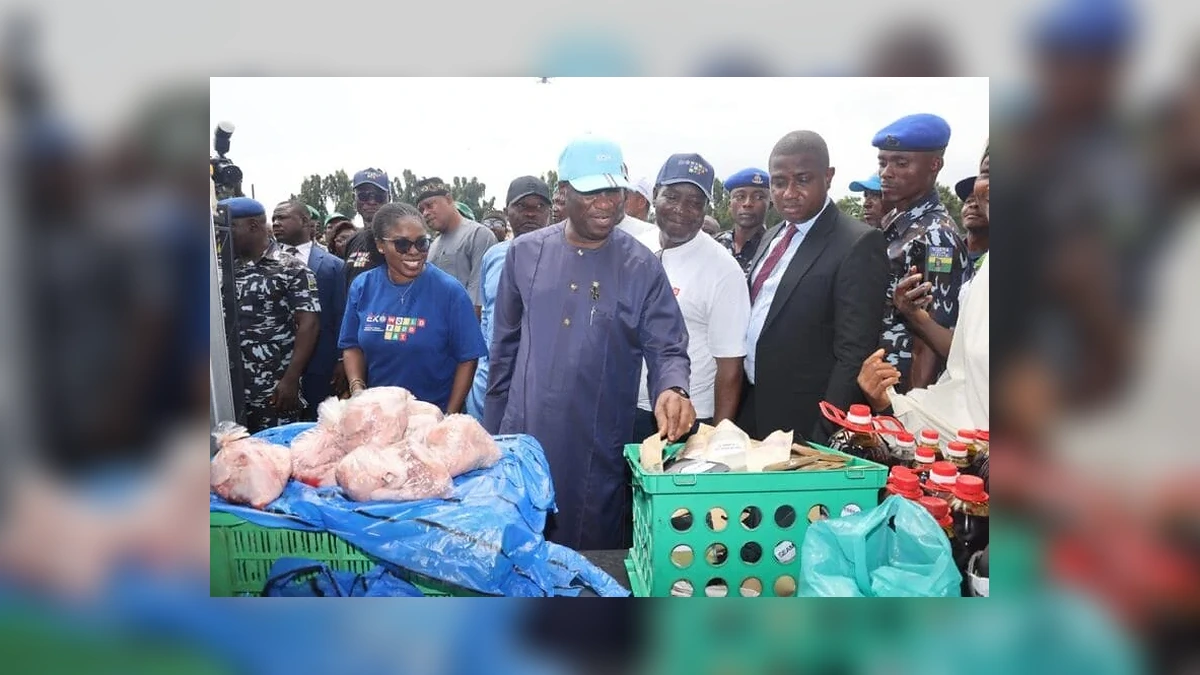
Lagos State Governor Babajide Sanwo-Olu has called for stronger partnerships with food-producing states, investors, development partners and research institutions to improve food security, stressing that the state cannot achieve the goal on its own.
The governor, represented by Deputy Governor Obafemi Hamzat, made the appeal at the grand finale of the 2026 World Food Day celebration in Ikeja on Friday.
The event was held under the theme, “Innovate Today, Nourish Tomorrow”. World Food Day is observed annually on October 16 to mark the founding of the United Nations Food and Agriculture Organization in 1945 and promote efforts to eliminate hunger and malnutrition.
Governor Targets Higher Food Self-Sufficiency
Sanwo-Olu said Lagos needed new approaches to food production, processing and distribution to address supply challenges and meet the needs of its growing population.
He explained that food security would require more efficient use of existing farmland, stronger sourcing arrangements with other states and measures to reduce waste as produce moves from farms to households.
According to the governor, Lagos State’s Five-Year Agricultural and Food Systems Roadmap aims to increase the state’s food self-sufficiency from approximately 20 per cent to 40 per cent of its food demand.
He also called for increased investment in skills, financing, technology and market access for people working across the agricultural sector.
The governor said improvements in storage, processing, logistics and market coordination were necessary to reduce post-harvest losses. He added that food affordability, nutrition and environmental sustainability must be pursued together.
Food Logistics Hub and Markets Under Development
Sanwo-Olu said the first phase of the Lagos Central Food Security Systems and Logistics Hub at Ketu-Ereyun in Epe was at an advanced stage.
He also announced that mid-level agro-produce hubs at Abijo in Ibeju-Lekki and Dairy Farm in Agege had been commissioned.
Construction was continuing at Opebi in Ikeja and Bombata on Lagos Island, with the facilities intended to strengthen food distribution, reduce waste and bring produce closer to consumers at competitive prices.
The projects form part of the state government’s efforts to improve the movement of agricultural products from farms to markets and make food more accessible to residents.


Produce for Lagos Initiative Links Farmers to Buyers
The governor said the Produce for Lagos initiative was connecting participating farmers with structured offtake arrangements at agreed prices.
The programme is supported by a ₦500 billion Guarantee Offtake Fund, which is intended to support efforts to improve distribution, reduce the number of intermediaries and make food available to consumers at competitive prices.
Sanwo-Olu said collaboration across the food supply chain would remain essential to achieving the state’s food security objectives.
Sanwo-Olu Thanks Farmers as Tenure Nears End
Describing the celebration as the final World Food Day event of his administration, Sanwo-Olu thanked farmers for their contributions to Lagos State’s food system.
He said farmers had played an important role in government programmes and stressed that their contribution should remain a priority beyond the end of his tenure.
The governor added that the state’s commitment to food security should continue regardless of changes in administration.
Government Highlights Agricultural Investments
Earlier, Lagos State Commissioner for Agriculture and Food Systems Abisola Olusanya said the government was strengthening connections across the agricultural value chain through investments in production, processing and market infrastructure.
She said initiatives introduced over the past seven and a half years were aimed at developing an integrated food system capable of meeting the demands of Lagos’s growing population.
Olusanya listed the Lagos Rice Mill, the Central Food Logistics Hub, mid-level markets and last-mile meat distribution points among the projects designed to improve the state’s food supply chain.
Other initiatives include dairy and cattle feedlot projects and the Lagos Aquaculture Centre of Excellence.
Food Discounts, Mechanisation and Training Programmes
The commissioner also highlighted programmes intended to make food more affordable and improve the movement of produce between farms and markets.
These include the Ounje Eko Food Discount Market, fertiliser distribution, mechanisation support and cold-chain logistics provided through Eko Logistics.
She said the state had established agricultural laboratories in more than 40 schools and trained over 100,000 people.
Olusanya added that the Lagos Agrinnovation Club and Agrithon were encouraging young people to develop solutions to challenges facing the agricultural sector.
She urged farmers, processors, traders, transport operators, financial institutions and development partners to maintain their collaboration to strengthen food security.
Food Security Described as Essential to Stability
The Special Adviser to the Governor on Agriculture and Food Security, Oluwarotimi Fashola, said the ability to feed a population was essential to national stability.
He warned that countries unable to meet their food needs faced risks to social security and encouraged Lagos residents to purchase produce from local farmers.
Fashola said collective action would be necessary to establish a sustainable food system across the state.
The celebration concluded with a march-past involving food and farmers’ associations and cooperative societies from local government areas across Lagos. Participants displayed their agricultural produce and other products.

