
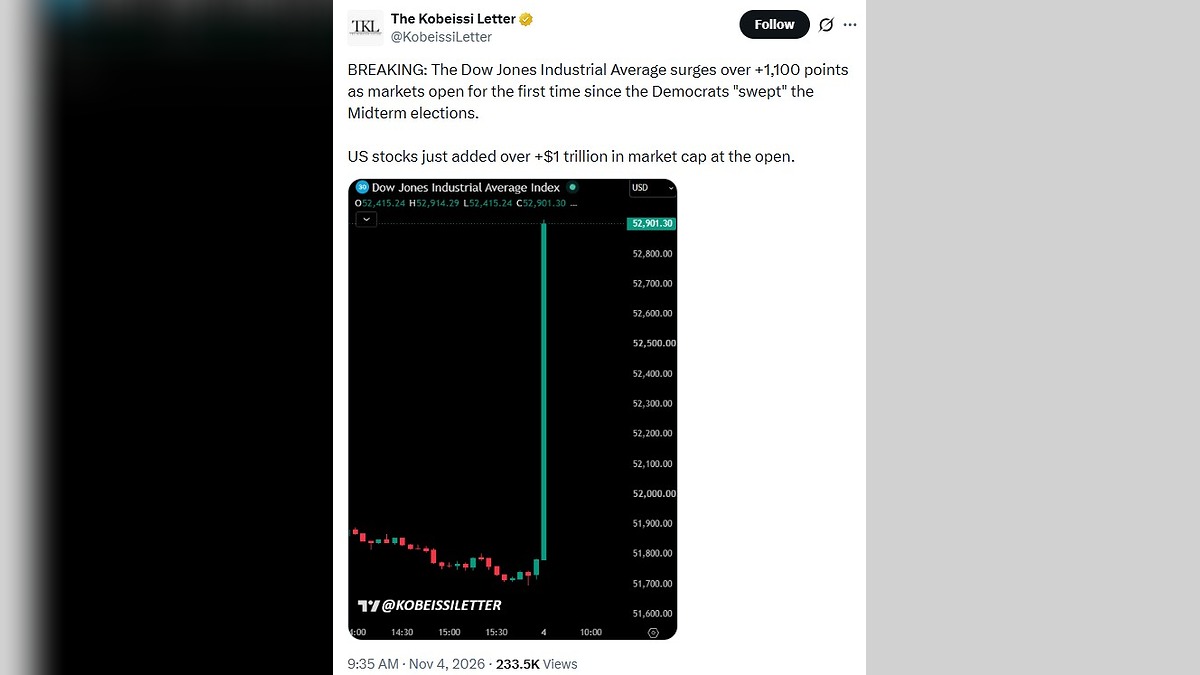
Wall Street recorded broad gains on Wednesday after Democrats secured control of Congress in Tuesday’s midterm elections, with the Dow Jones Industrial Average climbing more than 1,000 points.
The Dow rose 1,024 points, equivalent to approximately 2%, during the session, according to CNBC. The S&P 500 advanced 1.5%, while the technology-heavy Nasdaq Composite gained 2%.
The rally followed significant Republican losses, with the party losing its majorities in both the House of Representatives and the Senate. Democrats also won several governorships, including Texas.
Trump’s Response Helps Ease Election Uncertainty
Investors responded to signs that President Donald Trump would accept the election outcome and work with the incoming Democratic congressional majorities.
Trump told The New York Times that he was “absolutely willing” to accept the results. He also indicated to The Wall Street Journal that Republicans would cooperate with Democrats.
Jay Woods, chief market strategist at Freedom Capital Markets, said the president’s initial reaction contributed to the market recovery.
“The rebound was in part due to the president’s initial tone and reaction to the results,” Woods said.
He added that uncertainty remained but argued that the prospect of political gridlock had historically been favourable for financial markets.
Investors Welcome Prospect of Divided Government
Democratic victories in both chambers of Congress created the prospect of a divided government, with Trump retaining his presidential powers and the ability to veto legislation.
The arrangement could make it harder for either party to introduce sweeping policy changes, a development some investors believe could provide greater predictability for businesses.
Andrew Slimmon of Morgan Stanley Investment Management discussed the issue on CNBC’s Squawk Box Europe, saying markets generally preferred political gridlock to excessive power being concentrated in one party.
“Markets like gridlock — they don’t like a party with too much power,” Slimmon said.




Retail, Banking and Healthcare Shares Advance
Several major companies recorded gains as the broader market recovered.
Walmart shares rose approximately 3%, while Bank of America gained 2.5%.
Healthcare stocks also advanced as investors considered how Democratic control of Congress could affect federal policy in the sector. Molina Healthcare climbed 5%, while Centene and HCA Healthcare each gained around 7%.
Renewable energy companies recorded some of the strongest gains. The Invesco Solar ETF surged 8% amid expectations that Democrats could pursue policies supporting the industry.
Data Centre Companies Face Pressure Over Potential Restrictions
Not all sectors benefited from the election outcome, with companies involved in artificial intelligence infrastructure coming under pressure.
Investors raised concerns that Democratic lawmakers could introduce tougher restrictions on data centre development.
The concerns intensified following Gina Hinojosa’s victory in the Texas gubernatorial election. Hinojosa has proposed an immediate moratorium on new data centre projects.
CoreWeave shares declined during Wednesday’s trading, while Elon Musk’s SpaceX also traded lower.
Oil Prices Fall as Investors Monitor Iran Negotiations
Oil prices provided another source of relief for financial markets, with US West Texas Intermediate crude futures falling approximately 2% to around $94 per barrel.
The decline came as investors monitored the possibility of progress in negotiations aimed at ending the war with Iran.
Oil prices have been a major economic concern during the conflict, contributing to inflationary pressures and complicating the Federal Reserve’s efforts to manage interest rates.
Slimmon said a diplomatic breakthrough could help reduce some of those pressures.
He noted that elevated oil prices had affected the Federal Reserve’s inflation outlook and contributed to higher interest rates.
Trump Faces New Legislative Challenges
The Democratic takeover of Congress presents additional obstacles for Trump’s legislative agenda, which has focused on tax cuts, deregulation and domestic energy production.
Although Democrats will control both chambers, the president retains his veto power and existing executive authority.
The election results could therefore limit the passage of additional Republican-backed legislation without automatically allowing Democrats to implement all their priorities.
Wednesday’s market rally was attributed by strategists to reduced election uncertainty, expectations of legislative gridlock and falling oil prices rather than a preference for either political party.
With Washington preparing for two years of divided government, major US stock indexes recorded substantial gains in the immediate aftermath of the election.

