
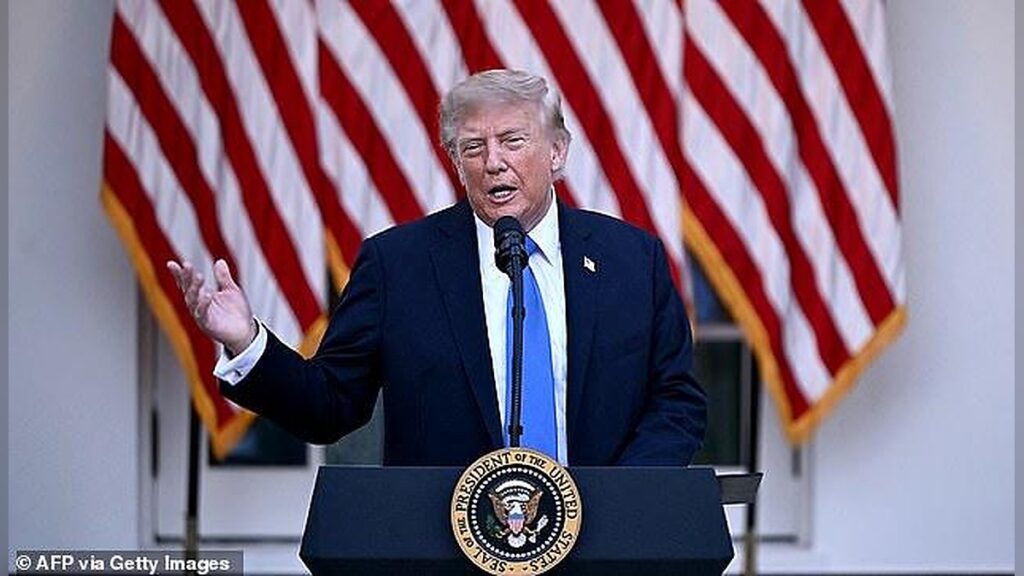
Donald Trump has raised fresh questions over whether the United States would support Britain if Argentina attempted to seize the Falkland Islands again, suggesting that London’s decision not to provide greater military assistance during the conflict with Iran could influence Washington’s position.
The US president made the remarks while criticising Britain’s recent military cooperation, arguing that the country had failed to support America when it was needed.
Trump’s comments come at a sensitive moment for relations between Britain and Argentina, with Argentine President Javier Milei preparing to make a televised address centred on his country’s long-running claim to the islands, which Argentina calls the Malvinas.
Trump Points to Britain’s Role During Iran Conflict
Asked by GB News whether Washington would come to Britain’s assistance if Argentina launched another invasion of the Falklands, Trump recalled Britain’s victory in the 1982 war but appeared reluctant to offer a firm commitment for any future conflict.
He praised Britain’s conduct during the original war, saying the country had “comported yourself very well” and had successfully retaken the islands.
But he then shifted his focus to Britain’s response to the recent conflict involving Iran.
Trump said Britain was “not doing well” and pointed to the country’s reliance on oil passing through the Strait of Hormuz.
He added that Britain had “not been there to help me”, repeating the criticism as he questioned the level of support provided by the UK.
Britain Kept Its Distance From Trump’s Iran Campaign
The dispute is rooted partly in Britain’s cautious approach to the US-Israeli military offensive against Iran.
During Keir Starmer’s premiership, Britain initially declined to participate directly in the offensive.
The government later authorised British forces to assist with defensive operations, including efforts aimed at countering threats such as missile launchers.
London nevertheless rejected Trump’s request for the Royal Navy to take part in an operation to reopen the Strait of Hormuz after Iran blocked the strategically important waterway.
The strait is a crucial international shipping route through which roughly a fifth of the world’s oil and gas supplies normally pass.
Trump responded angrily, accusing Starmer of being “no Churchill”.
He also claimed that he had rejected a British offer to deploy an aircraft carrier because the proposal came too late.
British ministers disputed that account and said no such offer had been made.




Washington’s Longstanding Falklands Position Under Scrutiny
The United States has traditionally maintained a neutral position over the sovereignty dispute between Britain and Argentina.
Trump has, however, recently suggested that America’s position could be reconsidered, prompting speculation that the issue may be being used as leverage to encourage greater British military cooperation.
Britain’s government has remained firm that sovereignty over the Falkland Islands is not negotiable.
Islanders themselves overwhelmingly backed remaining under British sovereignty in a 2013 referendum.
Some 99.8 per cent voted to retain British status, with turnout reaching 92 per cent.
Milei Prepares New Address on the Malvinas
Trump’s comments coincide with a renewed push from Milei over Argentina’s claim to the disputed territory.
The Argentine president, a close political ally of Trump, announced that he would address the “sacred issue” of the Malvinas in a televised speech.
Milei previously described the Falklands issue as being directly connected to Argentina’s “vital interests”, underlining the emotional and political importance the dispute continues to hold in the country.
Argentina attempted to take control of the islands in 1982, triggering a war with Britain.
Then-prime minister Margaret Thatcher dispatched a naval task force to reclaim the territory.
The conflict ended with Argentina’s defeat and left 649 Argentines, 255 Britons and three islanders dead.
New Legal Challenge Targets Falklands Oil Project
The territorial dispute has also spilled into the energy sector, with Argentine groups announcing legal action against a British-Israeli oil development near the Falklands.
The Sea Lion oil project involves Britain’s Rockhopper Exploration and Israel’s Navitas Petroleum, which are seeking to develop a major offshore oil operation roughly 137 miles from the islands.
Argentine war veterans and environmental lawyers have launched a lawsuit seeking to stop the project.
The plaintiffs argue that the development conflicts with a United Nations resolution calling for unilateral actions to be avoided while a territorial dispute remains unresolved.
Although the project is located in an area controlled by Britain, the campaigners believe legal proceedings could potentially interfere with its development.
Lawyer Enrique Viale told AFP that the lawsuit seeks to prevent the companies from starting or continuing work, as well as from extracting or exploiting hydrocarbons.
Falklands Dispute Remains Deeply Emotional
The sovereignty dispute continues to resonate strongly in Argentina, extending beyond politics and into popular culture and sport.
During a World Cup semi-final against England in July, Argentine players were reported to have displayed a banner declaring that the Falklands were Argentine after their side defeated England 2-1.
The gesture prompted a response from Downing Street, which made Britain’s position clear with a pointed remark: “the World Cup might not be ours, but the Falkland Islands definitely are.”
Trump Meeting Could Become More Complicated
The renewed tensions could create an awkward backdrop for Trump’s next encounter with British political leadership.
The Prime Minister is expected to travel to New York later this month for the United Nations General Assembly and has indicated that he could use the trip to press Trump for stronger American backing for Ukraine.
It remains uncertain whether Trump will attend the UN gathering himself or whether the British leader could instead make a separate visit to Washington.
Against the backdrop of the Falklands dispute, the disagreements over Iran and the Strait of Hormuz could make Britain’s relationship with the Trump administration increasingly difficult to navigate.
