
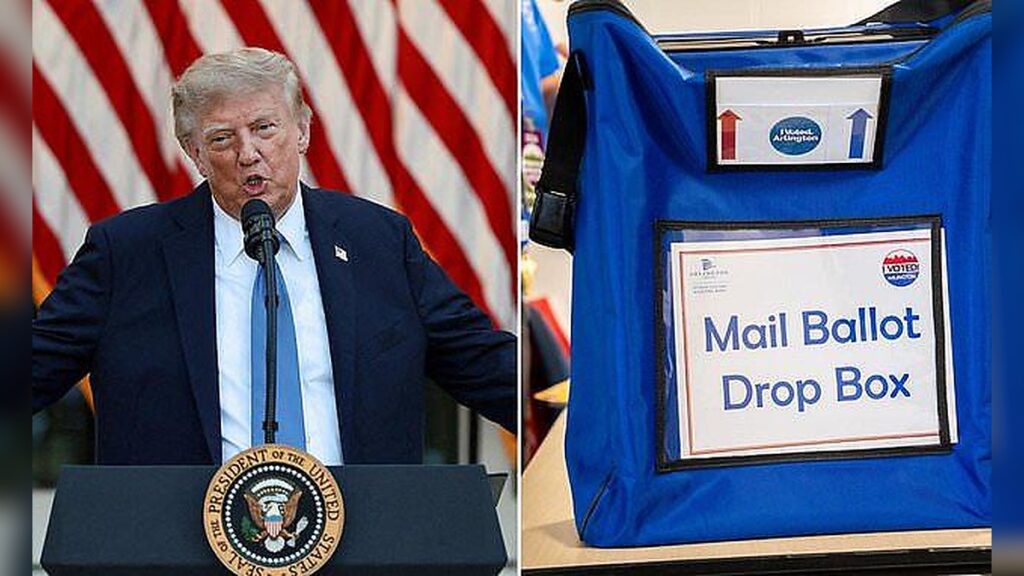
President Donald Trump’s administration has made another urgent appeal to the US Supreme Court, asking the justices to clear the way for new Postal Service rules that would place tighter controls on mail-in ballots ahead of November’s midterm elections.
The emergency request, filed Sunday, seeks to overturn a lower court ruling that temporarily prevented the new rules from being implemented.
It marks the third occasion on which the administration has asked the Supreme Court to intervene in the escalating legal dispute.
New Postal Rules at the Center of the Dispute
The measures stem from an executive order Trump issued in March targeting mail-in voting.
Under the proposed system, the US Postal Service would compare information on mail-in ballots with a centralized database of registered voters maintained by individual states.
The rules could also enable postal officials to reject ballots associated with voters whose information does not appear in the relevant database.
Supporters of the changes argue that the measures are intended to strengthen election procedures.
Opponents, however, say they could interfere with voting systems traditionally administered by individual states.
Administration Attacks Lower Court Injunction
Solicitor General D. John Sauer has strongly criticized the preliminary injunction issued Friday by US District Judge Indira Talwani, describing it as unjustified and warning that continued litigation could leave voters and election officials uncertain about what procedures they should follow.
Sauer told the Supreme Court that every additional day the injunction remains in place could increase confusion because it makes certain preparations optional rather than compulsory.
The administration is therefore pressing the justices to act quickly, arguing that an immediate pause would remove what it calls an unnecessary layer of uncertainty before election officials finalize their preparations.
Democrats Warn of Election Disruption
Democrats and voting-rights advocates have responded with alarm, particularly because the rules are being introduced so close to the election.
Critics argue that states could be left with very little time to adjust their systems and warn that voters who rely on absentee and mail-in ballots could face complications if their information fails to match government databases.
Around one-third of American voters typically cast their ballots by mail, meaning any nationwide change to the process could affect a substantial share of the electorate.



States Already Preparing Mail Ballots
The legal battle comes as states are beginning the process of distributing ballots for the November election.
North Carolina became the first state to send out mail-in ballots last week, while six additional states are expected to begin sending ballots later this week or next week.
That timetable has added urgency to the Supreme Court case, with election officials facing the prospect of having to respond to potentially changing federal requirements while voting preparations are already underway.
ACLU Challenges Federal Authority
Sophia Lin Lakin, director of the American Civil Liberties Union’s Voting Rights Project, argued that the Postal Service does not have constitutional or statutory authority to determine how states administer mail voting.
She accused the administration of attempting to establish a new federal bureaucracy that could interfere with state election systems and potentially prevent eligible voters from having their ballots counted.
The dispute therefore extends beyond the mechanics of postal processing and raises a broader constitutional question over how much authority the federal government can exercise over elections traditionally administered by states.
Concerns Grow Over Postal Service Technology
Questions have also been raised about whether the Postal Service is technically prepared to carry out the proposed verification system.
A whistleblower report released last week reportedly identified problems across multiple stages of the agency’s effort to develop the technology needed to scan and verify mail-in ballots.
Federal officials also acknowledged in court earlier this month that they were uncertain whether the system was fully operational.
Those concerns have given opponents another argument against implementing the changes so close to Election Day.
Constitutional Fears From Critics
Former Democratic Kentucky lawmaker John Yarmuth described the Supreme Court’s eventual ruling as potentially one of the most serious constitutional disputes involving elections.
Yarmuth warned that allowing the Postal Service to determine whether voters could participate would fundamentally alter the relationship between election administration and constitutional protections.
The comments reflect wider Democratic fears that the administration’s efforts could establish a precedent for greater federal involvement in election procedures.
Trump and the Push Against Mail Voting
The dispute forms part of Trump’s broader campaign to reduce reliance on mail-in voting and increase federal influence over election administration.
The president has repeatedly criticized mail voting despite having used the method himself.
Earlier this year, Trump also attracted criticism after suggesting during an appearance on former deputy FBI Director Dan Bongino’s podcast that Republicans should consider “nationalizing” elections.
The proposal has intensified concerns among Democrats and voting-rights groups that the administration is seeking to shift significant election authority away from states and toward Washington.
Supreme Court Faces a Tight Election Deadline
The justices must now decide whether to intervene with less than two months remaining before the November elections.
The court has previously permitted major election-related changes relatively late in an electoral cycle.
Earlier this year, it allowed a Republican-backed effort involving congressional redistricting to proceed despite the timing.
The latest case could therefore become another significant test of how the Supreme Court handles emergency election disputes when legal uncertainty collides with rapidly approaching voting deadlines.
