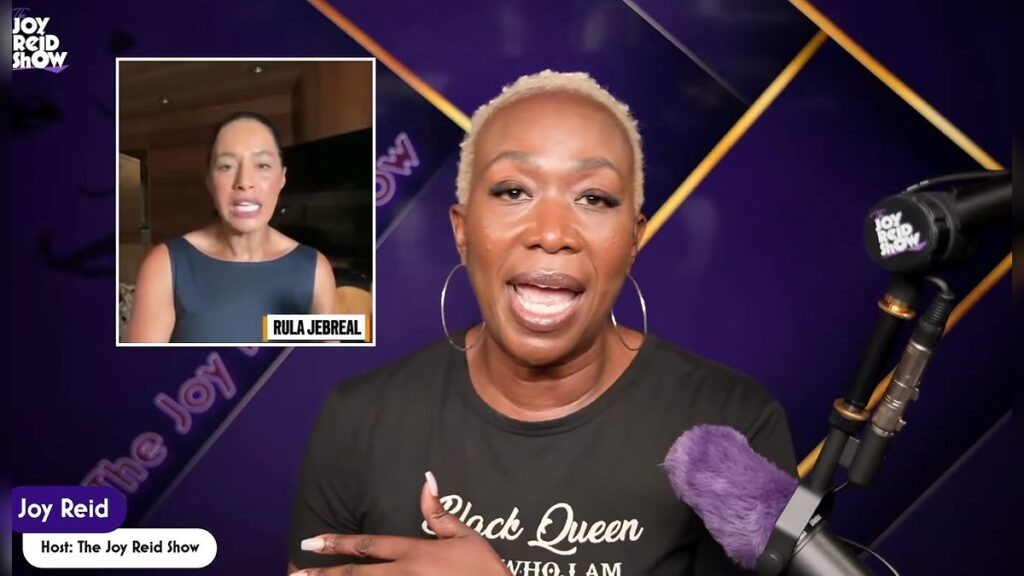
Joy Reid has defended Palestinian journalist and foreign policy commentator Rula Jebreal after she came under fire for describing House Minority Leader Hakeem Jeffries as a “monkey” and an “errand boy” for the American Israel Public Affairs Committee.
During her web show over the weekend, Reid characterized Jebreal’s language as a poorly expressed political argument rather than an intentionally racist attack.
The discussion followed a September 1 appearance in which Jebreal made the controversial comments during an episode of The Left Hook Podcast hosted by Wajahat Ali.
Reid Says Cultural Differences Help Explain the Controversial Language
Reid, 57, introduced Jebreal as a “dear friend” before playing the clip that had quickly circulated online.
She suggested that people who were not born and raised in the United States might not fully appreciate the historical and cultural implications of certain language directed at Black Americans.
“Sometimes even our friends can get it wrong,” Reid said, explaining that people can struggle to make a political point when there is a “cultural disconnection” that causes their argument to go “askew.”
She specifically referenced the nuances surrounding criticism of Black political leaders in America.
Jebreal, 53, was born in Israel and has lived in the United States for nearly two decades.
She previously appeared as a commentator on MSNBC, where Reid also worked before leaving the network.
Jebreal Accused Jeffries of Being Too Close to AIPAC
The controversy began when Jebreal criticized Jeffries over his relationship with AIPAC and his position on the Israel-Palestinian conflict.
During the podcast discussion, she described the Democratic leader as a “bought-and-paid-by-AIPAC monkey” and called him an “errand boy” for the influential pro-Israel lobbying organization.
The remarks triggered widespread criticism, particularly because Jeffries is Black and the word “monkey” has a long history as an explicitly racist insult against Black people.
Jebreal attempted to distinguish her political criticism from racism during the original exchange, adding that she did not mean the terminology “in a racist way.”




Jebreal Issues an Unconditional Apology
Reid said Jebreal contacted her shortly after the controversy erupted and expressed shock over how her words had been received.
Jebreal also published an apology acknowledging that one of the terms she used was inappropriate and offensive.
“I am disgusted and horrified that Hakeem Jeffries is taking money from AIPAC amidst Israel’s genocide in Palestine,” Jebreal wrote, while acknowledging that the language she used to describe him “should never have been used.”
She concluded the statement by saying she apologized unconditionally.
Jebreal Appears on Reid’s Show to Address the Fallout
The discussion then took an unexpected turn when Jebreal and Ali appeared on Reid’s program.
Reid again raised the cultural dimension of the controversy, telling Jebreal that there was an important distinction between someone who had grown up in the United States and someone who had not, particularly when it came to African-American history and language.
Jebreal responded with another apology and rejected any suggestion that she had a justification for the wording.
“Thank you, Joy, and I love you,” Jebreal said, adding that she had heard from friends in the African-American community and wanted to apologize again.
She emphasized that the words were “offensive” and “inappropriate” and accepted responsibility for what she described as a major mistake.
Democratic Lawmakers Condemn the Remarks
Jebreal’s apology came amid criticism from several Democratic lawmakers.
Members of Congress, including Ayanna Pressley, Ritchie Torres and Shontel Brown, publicly condemned the remarks.
Other Democratic lawmakers also spoke out against the language used against Jeffries.
The Congressional Black Caucus was particularly direct in its response, arguing that there was no acceptable interpretation of calling a Black man a “monkey” or an “errand boy.”
The organization warned that anti-Black racism should be rejected regardless of whether it comes from the political right or left.
Its statement also criticized what it described as increasingly low standards in political discourse, arguing that such rhetoric can become normalized when people are repeatedly allowed to use it without consequence.
Wajahat Ali Responds After the Appearance
Ali, who hosted the original discussion involving Jebreal, also addressed the controversy after the unexpected appearance on Reid’s program.
The New York Times contributor and former Daily Beast columnist encouraged his audience to watch the exchange and subsequently published his own discussion of the dispute.
Ali’s podcast, The Left Hook, was launched in 2024 and has since attracted more than 121,000 subscribers.
The episode and its aftermath have placed renewed attention on the boundaries of political criticism, particularly when debates over Israel and Palestine intersect with race and the history of anti-Black language in the United States.
