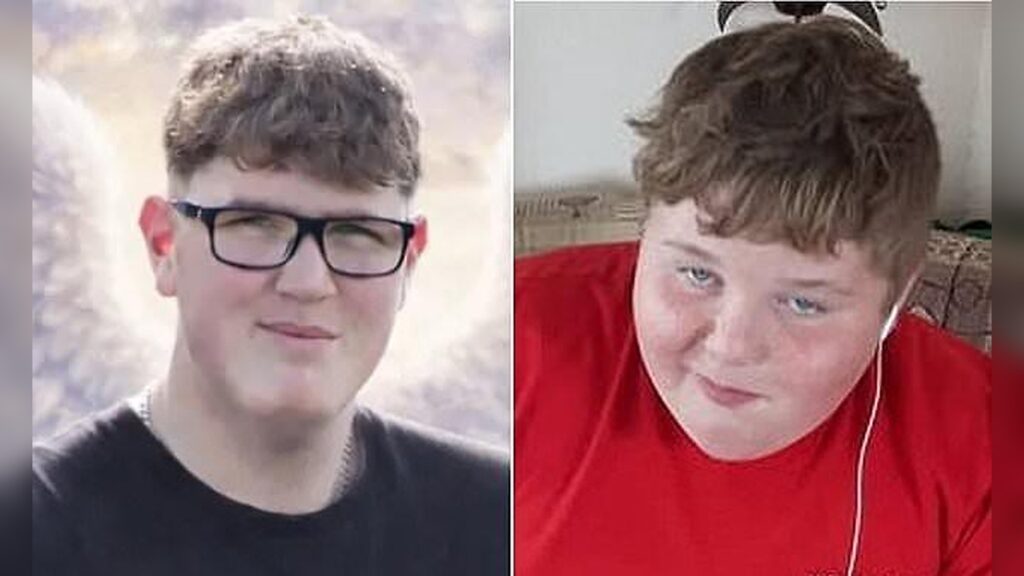
Joshua Johnson’s family endured an agonising three-week vigil at a hospital bedside, believing the critically injured teenager was their son — before discovering that Joshua had actually died at the crash scene.
The devastating mistake meant the family were initially led to believe that 18-year-old Joshua had survived the collision and was fighting for his life in hospital.
In reality, the unconscious teenager they had been visiting was 17-year-old Trevor Wynn.
Joshua’s father, Lee Johnson, 53, described the experience as feeling as though his family had suffered two separate deaths.
“It felt like as a family we’d had two deaths,” Mr Johnson said in a statement read at the inquest into his son’s death.
He added that he felt he had been deprived of the opportunity to properly grieve when Joshua actually died.
Police delivered the wrong news
The tragedy began in the early hours of December 2025 when a Toyota carrying three teenagers crashed on Todwick Road near Rotherham, South Yorkshire.
The car was being driven by 17-year-old Summer Scott, who died in the collision alongside one of her passengers.
The other passenger survived with serious injuries and was taken to hospital.
Joshua’s parents were contacted by South Yorkshire Police at around 8am and told that two teenagers had died while their son had survived but was in an induced coma.
For the following weeks, Lee and his wife Hannah remained convinced that the unconscious teenager receiving treatment was Joshua.
“We never wanted him to be alone,” Joshua’s family later said, describing the hours they spent at the hospital with the boy they believed was their son.
The shocking truth emerged when the patient woke
The extraordinary error was finally uncovered on January 4 when the surviving teenager began regaining consciousness.
Hospital staff and police discovered that the patient was not Joshua Johnson but Trevor Wynn — the teenager whose family had originally been told he had died.
Trevor’s parents had been preparing to bury their son while Joshua’s family had been keeping vigil beside their own son, unaware that he had already died.
Joshua’s identity was subsequently confirmed through dental records, leaving his family to confront the devastating reality that he had been pronounced dead at the crash scene.
Trevor was eventually discharged from hospital and has been described as making an “amazing recovery”.
Personal belongings contributed to the confusion
The inquest heard that belongings belonging to both teenagers were recovered from the crash scene.
Among the items were a telephone case containing Joshua’s driving licence, as well as another phone and a bank card bearing Trevor Wynn’s name.
Police used the information available to identify the victims. Trevor’s mother, Charlotte, also supplied a college identification card, a description of her son’s physical build and details of the footwear he was wearing.
An officer later booked the body into Rotherham mortuary and, after comparing the available identification, became satisfied that it was Trevor.
Meanwhile, the surviving teenager was transported to Northern General Hospital in Sheffield by ambulance, accompanied by another police officer.



He was sedated during treatment and underwent CT scans. Medical staff were also satisfied, based on the photograph on the driving licence, that the patient was Joshua.
The consequences of those mistaken identifications continued for 22 days before the truth emerged.
Joshua’s family describe an unimaginable ordeal
Speaking through a statement read by the coroner, Joshua’s father explained how difficult it had been to process the discovery.
Mr Johnson said learning that the teenager they had spent weeks caring for was actually Trevor was “a huge shock” that his family struggled to comprehend.
“I felt I had missed out on the initial grieving part of the process,” he said.
Joshua’s family later described him as a “loveable, gentle giant” with a “massive heart”.
They said that although he had been 18 and beginning to experience greater independence, he remained deeply caring towards his parents, brother, grandparents, extended family and friends.
The family also spoke about his lifelong passion for stock car racing, saying some of their happiest memories were connected to the sport.
They recalled taking him to his first stock car meeting when he was just six weeks old and said the hobby eventually helped the family build a large circle of friends.
The crash unfolded at an extreme speed
The inquest also examined the circumstances surrounding the fatal collision.
Accident investigator Peter Gallagher told Doncaster Coroner’s Court that Summer Scott had been driving the Toyota at a speed believed to have reached about 95mph.
The 17-year-old, who had not passed her driving test, was travelling along unlit country roads in a 19-year-old Toyota.
As she approached a sweeping left-hand bend, she braked and reduced the vehicle’s speed to approximately 85mph. The car then lost stability, with its rear end swinging out before it left the road.
The Toyota crashed through a hedge, travelled through a field and struck a tree.
Mr Gallagher told the hearing that even a Formula One driver would have been unable to negotiate the bend safely at that speed.
All three occupants were believed to have been wearing seatbelts, while investigators found no mechanical defect with the vehicle.
Coroner rules Joshua was unlawfully killed
Rotherham coroner Nicola Mundy concluded that Joshua had been unlawfully killed.
She found that Summer’s driving contained “all the elements” of gross negligence manslaughter, pointing to the speed at which she was travelling and the fact that she was driving on unlit country roads.
The coroner had previously concluded that Summer herself died as a result of the road traffic collision.
Her family described her as loving, caring and funny, while also remembering her as “fierce and sassy”.
They said she had developed a longstanding passion for cars.
Police face continuing scrutiny over the identification failure
The Independent Office for Police Conduct remains responsible for investigating how the extraordinary identification error occurred.
The watchdog previously said it was clear that “something has gone very wrong” and acknowledged the devastating consequences for the two families, who were not previously known to one another.
The IOPC has now said its investigation into the circumstances surrounding the misidentification is at an advanced stage.
South Yorkshire Police Assistant Chief Constable Colin McFarlane offered condolences to Joshua and Summer’s families and acknowledged the distress suffered by Trevor and his relatives.
He said the force recognised the “shock and significant distress” caused by the identification error and its consequences.
Police have also reviewed their identification procedures and adopted new national guidance issued in August.
Joshua’s family asks for privacy as they grieve
Joshua’s relatives said they were only beginning to come to terms with his death after an ordeal they described as unimaginable.
They said their family and loved ones had spent countless hours in hospital because they believed Joshua was there and did not want the teenager to be alone.
“Neither us nor Josh’s brother can imagine life without him,” they said.
The family asked for privacy as they began adjusting to life without Joshua and started the grieving process that had been delayed by the devastating identification error.
They said they would continue to treasure memories of family holidays, time spent with friends and Joshua’s enthusiasm for stock car racing — experiences they described as an important part of his life and theirs.
