
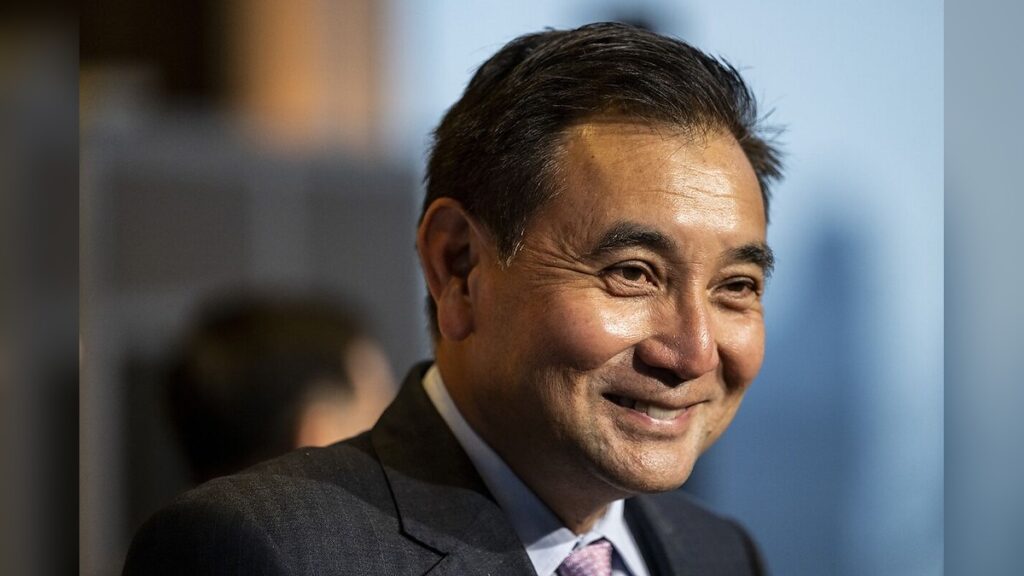
Taking charge of a family business is never simple, especially when the transition happens unexpectedly.
For Parithad Petampai, becoming the chief executive of Muangthai Capital came sooner than he had imagined after his father, company co-founder Chuchat Patcharachai, was declared legally incapacitated by a court last August.
Although he had spent more than a decade working alongside his father, Parithad admitted he often questioned whether he was prepared to lead the country’s biggest microlending company.
Looking back, however, he says the shift into the CEO role happened more naturally than he expected, comparing it to finally taking control of a vehicle he had long been watching from the passenger seat.
A Family Legacy Built From Humble Beginnings
Muangthai Capital traces its roots back to 1992, when Chuchat Patcharachai and his wife, Daonapa Petampai, launched a small motorcycle financing business known as Muangthai Leasing.
Their journey was shaped by modest beginnings, with the family descending from Chinese immigrants who settled in Thailand seeking better opportunities.
Over the years, the business steadily expanded. A major milestone came in 2014 when the company went public on Thailand’s stock exchange, raising roughly 3 billion baht through its initial public offering.
The fresh capital allowed the lender to grow beyond its traditional markets in central and northern Thailand before extending operations into the country’s eastern regions.
The company later rebranded as Muangthai Capital in 2018 and has since grown into a nationwide lender operating more than 9,000 branches.
Today, it ranks among Southeast Asia’s largest companies, generating annual revenue of over 30 billion baht.
Leadership Changes Following Personal Loss
Parithad officially assumed leadership months before his father passed away in April.
While the company continues to be guided by family members, responsibilities are now shared across generations.
His mother remains managing director, while his brother, Suksit, serves on the board.
Despite the continuity, Parithad acknowledges that introducing change has not always been easy.
He describes frequent differences in management style between himself and his parents, recalling that it took nearly two years to persuade his mother to replace paper-based processes with digital systems for staff operations.
Returning Home After Banking Experience Abroad
Before joining the family enterprise, Parithad gained experience in the financial sector through positions at Goldman Sachs in London and Kasikornbank in Thailand.
He officially joined Muangthai in 2015, bringing international banking experience that would later shape his approach to modernizing the company while maintaining its focus on serving underserved communities.




Providing Credit to Thailand’s Underserved Communities
Parithad insists that the company’s primary purpose extends beyond making profits.
He says his greatest motivation comes from seeing the positive effect financial access can have on people’s lives rather than simply increasing earnings.
Muangthai focuses heavily on lending to low-income borrowers who often struggle to secure financing through traditional banks.
According to Parithad, these customers depend on small loans for essential needs such as purchasing farming supplies, covering school expenses for their children, or paying emergency medical bills.
Thailand’s microfinance industry has experienced rapid growth, with forecasts suggesting the market could reach approximately 273 billion baht by 2027.
Alongside Muangthai, companies such as Srisawad Corporation and Thai Credit Bank also play significant roles in serving borrowers who have limited access to mainstream banking services.
An Industry Facing Tough Questions
Despite its social mission, the microlending sector continues to face criticism over the cost of borrowing.
Annual interest rates commonly range between 28% and 33%, leading consumer advocates to argue that vulnerable households can become trapped in long-term debt.
Concerns have been particularly visible in neighboring Cambodia, where rising borrowing levels have drawn international scrutiny.
Reports have highlighted growing repayment difficulties among borrowers, with watchdog organizations raising concerns about lending practices and whether sufficient attention is paid to customers’ ability to repay their loans.
Parithad acknowledges these concerns but believes profitability and social responsibility can coexist.
In his view, financial institutions need sustainable earnings to continue expanding access to credit, though profits should remain within reasonable limits.
He argues that helping customers improve their financial situation ultimately benefits both sides.
As borrowers become more financially secure, they may require larger loans for bigger purchases, allowing the business and its customers to grow together over time.
Seeking Greater Support at Home
While Muangthai has attracted substantial backing from international financial institutions, Parithad believes domestic support remains limited.
He points to partnerships with organizations including the Asian Development Bank, the International Finance Corporation, Germany’s investment development institutions, and Japan’s international cooperation agencies as examples of foreign confidence in the business.
In 2024, Muangthai also completed a landmark $335 million social bond listing on the Singapore Exchange, with JPMorgan acting as the sole global coordinator.
Parithad says international banks stepped in when local financing options became more challenging, adding that the company has also secured funding from Japanese, Taiwanese and Chinese lenders.
He argues that many institutions within Thailand continue to view microfinance companies as competitors rather than partners capable of strengthening financial inclusion.
Economic Optimism Under Thailand’s New Government
Looking ahead, Parithad believes Thailand is entering a more promising economic period following recent political changes.
He says investor confidence has improved under the country’s new administration, pointing to strong gains in Thailand’s stock market as well as Moody’s decision to revise the nation’s credit outlook from negative to stable.
Beyond domestic reforms, he also sees opportunities arising from global trade tensions between the United States and China.
As companies diversify supply chains and investment destinations, Parithad believes Thailand could attract greater foreign investment and advanced technology.
He expects Southeast Asia to play an increasingly important role in the global economy, particularly as electric vehicle manufacturing and other emerging technologies expand across the region.
For Parithad, that shift could create new opportunities not only for Thailand’s economy but also for the communities his company serves every day.

