
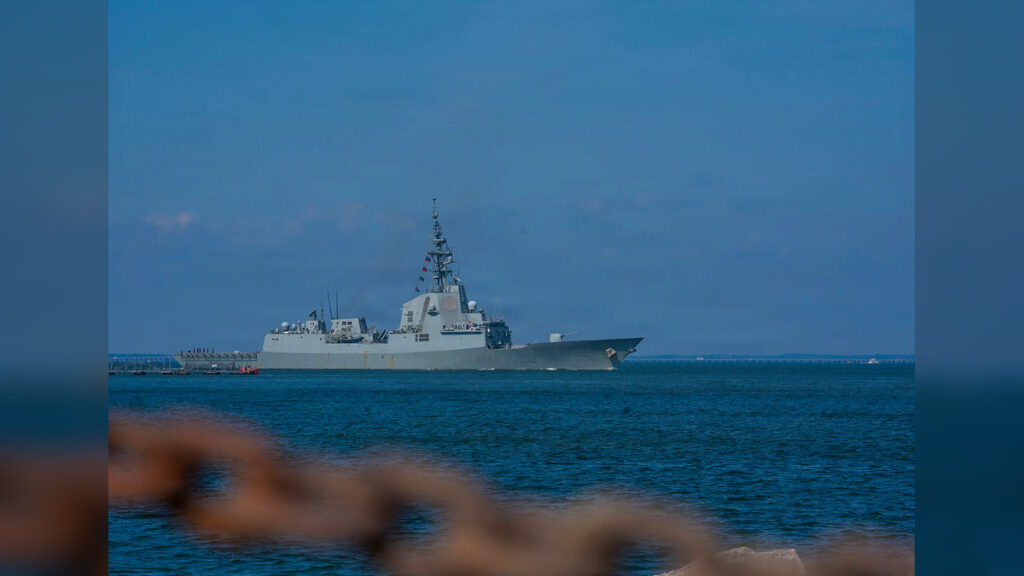
The Spanish Navy has officially assumed command of NATO’s Atlantic maritime task force, taking responsibility for overseeing the alliance’s naval operations across the strategically critical North Atlantic until June 2027.
According to NATO, Spain’s leadership period, running from July 2026 through June 2027, will include five Spanish naval vessels, a Spanish Marine Corps landing force, and eight additional warships contributed by allied nations.
The multinational force will focus on safeguarding vital sea routes while enhancing cooperation among NATO members.
Strategic Mission Covers North Atlantic Security
Commander Task Force Atlantic (CTF-AT) operates under NATO’s Joint Force Command (JFC) Norfolk, which is responsible for protecting the alliance’s North Atlantic area stretching from North America’s eastern coastline across Greenland, Iceland, the United Kingdom, and Norway.
The task force also directs NATO maritime formations operating within the region, including Standing NATO Maritime Group 1 (SNMG1) and Standing NATO Mine Countermeasures Group 1.
NATO describes the area as essential to transatlantic security because it contains major shipping lanes, undersea communications cables, and energy infrastructure linking Europe and North America.
Spain Becomes Third Nation to Lead the Atlantic Force
The Atlantic command is one of five regional maritime task forces NATO established in 2024, alongside commands for the Baltic, Black Sea, Mediterranean, and Northern regions.
The initiative was introduced to strengthen the alliance’s ability to coordinate maritime security across multiple operational theaters.
The United Kingdom became the inaugural leader of the Atlantic task force, focusing on ensuring reinforcement shipping could safely reach Europe. Italy succeeded Britain in July 2025, with Spain now becoming the third nation to assume the command.
Vice Adm. Juan Bautista Pérez Puig Heads Multinational Force
Leadership of the task force has been entrusted to Spanish Navy Vice Adm. Juan Bautista Pérez Puig, commander of the Spanish Maritime Forces Headquarters (SPMARFOR).
Under his command, more than 3,000 military personnel from 14 NATO member states will participate in operations. Contributing countries include Spain, Portugal, Latvia, Turkey, the United States, Italy, France, the Netherlands, Belgium, Norway, Lithuania, Poland, the United Kingdom, and Germany.




Operations Focus on Surveillance, Training, and Allied Integration
Immediately after assuming command, the force will begin conducting surveillance patrols, deterrence missions, and multinational training activities throughout the Atlantic Ocean.
NATO said the deployment will also include cooperation with partner navies, including Japan, as part of broader efforts to improve interoperability, operational readiness, and collective defense capabilities.
These activities form part of the alliance’s long-term program of exercises designed to strengthen high-end warfighting skills and multinational coordination.
Spanish Expeditionary Combat Group Continues Atlantic Deployment
A central component of Spain’s contribution is the Dédalo Expeditionary Combat Group, led by the amphibious assault ship and flagship ESPS Juan Carlos I (L61).
The deployment also includes amphibious transport dock ESPS Castilla (L52), frigates ESPS Blas de Lezo (F103) and ESPS Reina Sofía (F84), as well as fleet oiler Patiño (A14). Supporting the naval force is an embarked air wing and a reinforced battalion of Spanish Marines.
The Marine contingent is currently visiting Canadian Forces Base Halifax during the closing phase of its 60-day Atlantic Deployment 26, following participation in the U.S. Navy’s FLEETEX 250 exercise along the U.S. East Coast.
Standing NATO Maritime Group Expands Allied Presence
Standing NATO Maritime Group 1 continues operations in the Atlantic with vessels from several alliance members. The force includes Germany’s frigate FGS Sachsen, Dutch frigate HNLMS Van Amstel and support ship HNLMS Den Helder, Norway’s HNoMS Fridtjof Nansen, and Turkey’s TCG Oruçreis.
Canada is also increasing its participation. After taking part in FLEETEX 250 and conducting replenishment-at-sea operations with Spain’s expeditionary group, HMCS Ville de Québec has departed Halifax to begin a six-month deployment alongside SNMG1.
Japan Joins Multinational Maritime Drills
International cooperation has extended beyond NATO membership. On July 8 and 9, the Japan Maritime Self-Defense Force conducted joint exercises off the coast of New York using training ship JS Kashima and destroyer JS Yamagiri alongside the Spanish expeditionary group and Dutch frigate Van Amstel.
The drills reflected NATO’s continuing efforts to strengthen partnerships with like-minded naval forces in support of maritime stability.
U.K. Carrier Strike Group Prepares for Neptune Strike Exercise
Separately, the United Kingdom’s Carrier Strike Group is preparing to participate in Neptune Strike 2026-3, the third edition this year of NATO’s enhanced Vigilance Activity.
The deployment features aircraft carrier HMS Prince of Wales (R09), destroyer HMS Duncan (D37), and fleet tanker RFA Tidespring (A136). The strike group recently completed a port visit to Iceland, where final preparations were carried out before the exercise.
Neptune Strike is designed to demonstrate NATO’s ability to coordinate carrier strike groups and expeditionary maritime forces under a unified command structure while enhancing command-and-control procedures during high-end naval operations.
Neptune Strike Builds on Earlier Mediterranean Exercises
The upcoming exercise follows two previous Neptune Strike events conducted in the Mediterranean earlier in 2026.
The first iteration featured French and Italian carrier strike groups alongside Spain’s Juan Carlos I, while the second exercise was led by the French Carrier Strike Group.
Although the U.S. Navy’s George H.W. Bush Carrier Strike Group had initially been expected to participate, it instead deployed to U.S. Central Command after sailing around Africa rather than entering the Mediterranean.
