
Foreign nationals working in Switzerland do not all face the same language requirements when applying for residence permits, according to information provided by Swiss immigration officials.
The issue has attracted attention following the case of Thai twin chefs Vilai and Virat Kanjan, who were reportedly forced to leave Switzerland after failing to meet German-language requirements. Authorities in the canton of Nidwalden revoked their work permits, explaining that recognised proof of language proficiency was required when linguistic integration formed part of the authorisation process.
However, information from the State Secretariat for Migration (SEM) and several cantonal authorities indicates that language requirements vary according to an applicant’s nationality, profession, education and personal circumstances.
What Switzerland Requires From Foreign Nationals
The SEM identifies knowledge of a Swiss national language as an important requirement for integration into working and social life.
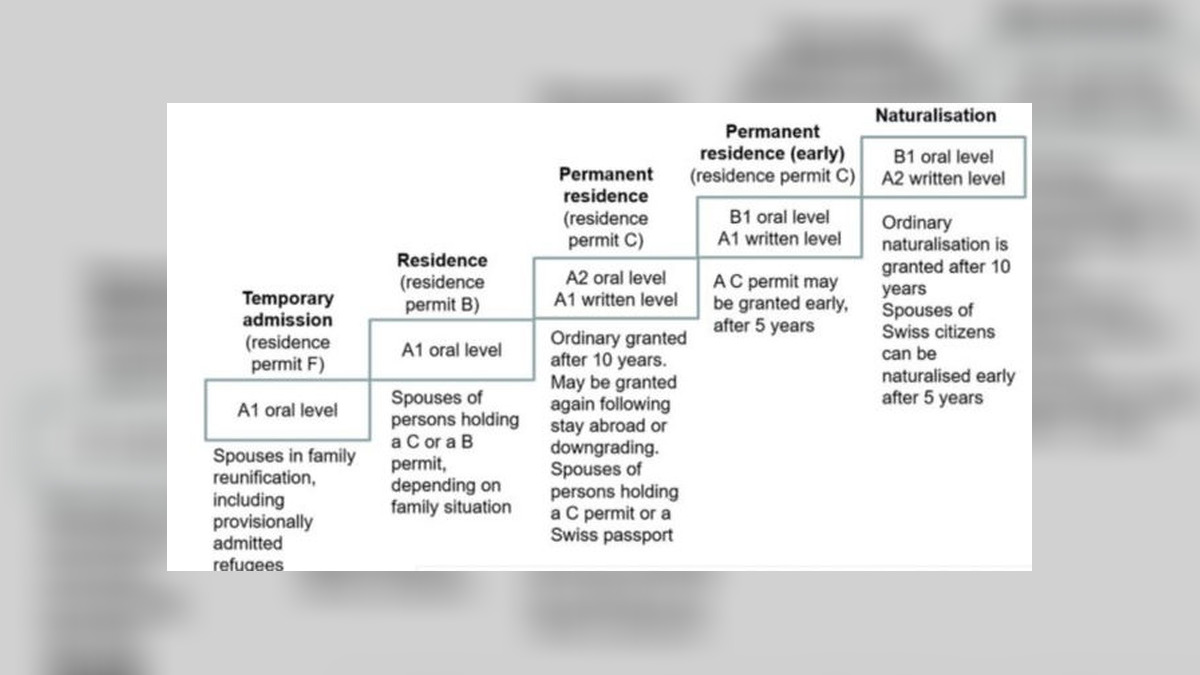
Foreign nationals applying for family reunification, residence or permanent residence permits, as well as regular or early Swiss naturalisation, may be required to demonstrate proficiency in a national language.
The required level depends on the type of application, with different standards applying to spoken and written communication.
The language proficiency framework ranges from A1 and A2 for beginners, through B1 and B2 for intermediate users, to C1 and C2 for advanced speakers.
However, the requirements are not applied identically to every category of foreign worker.
EU and EFTA Citizens Benefit From Different Rules
Nationals of European Union countries and the European Free Trade Association (EFTA), which includes Norway, Iceland and Liechtenstein, are among the groups exempt from the language requirement when obtaining a B residence permit under the free movement arrangements.
Although citizens of countries such as Germany, France, Italy and Austria already speak a Swiss national language, the exemption also covers nationals of other EU and EFTA states who may not speak German, French or Italian.
The language requirement can apply later if these residents seek a C settlement permit or Swiss citizenship.
Certain non-EU nationals also benefit from exemptions, depending on their profession and circumstances.
Some Highly Skilled Foreign Professionals Receive Exemptions
Swiss media reports have highlighted cases involving American and British bankers, IT specialists, consultants, researchers and cryptocurrency professionals who may receive more flexible treatment under arrangements for highly skilled workers from outside the EU and EFTA.
For some professionals working in international environments, proficiency in English may be considered sufficient instead of requiring knowledge of a Swiss national language.
The SEM has explained that legislation does not establish a universal language requirement for every employed foreign national.




Spokesperson Samuel Wyss told The Local that the requirements are often determined by individual sectors or employers rather than directly imposed by legislation.
He explained that language standards may be established through professional regulations or introduced to help workers with medium-level qualifications integrate into sectors facing structural difficulties.
Wyss also identified foreign religious leaders and counsellors, along with teachers of native languages and culture, as professional groups exempt from all language requirements.
Geneva Allows Greater Flexibility for International Professionals
The canton of Geneva applies language requirements in cases specified by federal law and SEM guidelines, but the checks are limited to particular circumstances.
Catherine Santoru, a spokesperson for Geneva’s cantonal authorities, told The Local that a strong command of English may be sufficient for the long-term integration of skilled employees working in highly specialised sectors and international companies.
She said professionals in these environments generally have opportunities to integrate into the labour market through their qualifications and professional and social adaptability.
Santoru added that Geneva does not, in principle, require managers and specialists working in international environments to demonstrate fluency in French.
The approach reflects the canton’s position on employing highly qualified workers in an international business environment.
Zurich Also Allows Exemptions for Managers and Specialists
Zurich applies a similar approach to certain highly qualified foreign professionals.
According to the canton’s Directorate of Public Economy, authorities may waive the assessment of national-language proficiency when granting residence permits to managers and specialists working in international environments.
The policy means that some foreign workers can obtain permission to live and work in Switzerland without undergoing the same language checks applied to other applicants.
The treatment differs from the stricter approach reported in Nidwalden in the case of the two Thai chefs.
People Educated in Switzerland May Be Exempt
Foreign nationals who were born in Switzerland to non-Swiss parents may qualify for an exemption if they have lived in the country throughout their lives and completed compulsory Swiss schooling.
People who have completed at least three years of compulsory education, or upper secondary or tertiary education, in one of Switzerland’s national languages may also be exempt from the language requirement.
These exemptions recognise applicants’ previous education and experience using a national language.
Children and People With Certain Health Conditions Can Qualify
Children under the age of 18 who move to Switzerland through family reunification are also exempt from the language requirement, although the same exemption does not automatically apply to their parents.
Applicants who cannot meet the language standards, or can do so only with considerable difficulty, may also qualify for an exemption.
Such cases can include people with physical or mental disabilities, learning difficulties, or serious or chronic illnesses.
Applicants must provide evidence supporting their inability to meet the language requirements.
Language Rules Depend on Individual Circumstances
Information from Swiss federal and cantonal authorities shows that language requirements for foreign workers depend on several factors, including nationality, professional role, education and personal circumstances.
While some applicants must demonstrate proficiency in a national language as part of their residence or naturalisation process, others may qualify for exemptions under federal rules or cantonal practices.
The case of the two Thai chefs in Nidwalden has drawn attention to these differences in how linguistic integration requirements are applied across Switzerland.
