
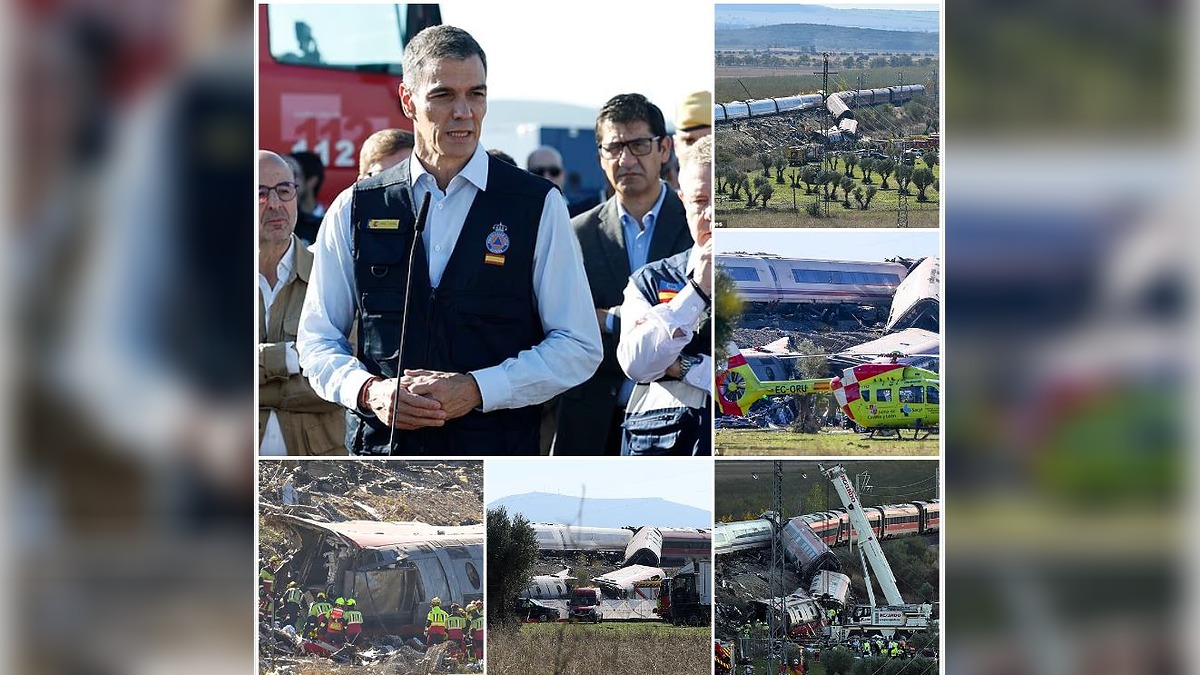
At least 68 people have died and more than 100 others have been injured after two trains collided in Spain, with authorities warning that the death toll could increase as rescue operations continue.
The crash occurred shortly before 9am on Wednesday near Toledo, south of Madrid, when a train travelling from Madrid to Seville struck a stationary Iryo train on the same route. Three carriages were derailed in the collision, leaving several severely damaged.
Emergency crews worked among the wreckage as survivors described scenes of destruction. One carriage caught fire, while smoke continued to rise from the damaged trains after responders arrived.
Transport Minister Points to Control Centre Decision
Spain’s Transport Minister, Oscar Puente, said an order issued by a central command unit was responsible for allowing a train to resume its journey after a security system malfunction.
According to Puente, trains along a 63-kilometre stretch of track had been stopped because of a computer problem. However, the central control centre instructed a Renfe train to continue without speed restrictions before the system had been restored.
The collision occurred at 8.53am, a little more than 20 minutes after the train was authorised to resume its journey. The train struck the rear of the stationary Iryo service, destroying and derailing carriages.
Puente said the control centre had sufficient time to identify and correct the error but failed to do so.
“The decision to resume traffic, while that system had not been restored, belongs to the control centre,” he said.
He described the order as inexplicable, adding that investigators would need to establish how the decision was made and why trains were permitted to move while the security system remained unavailable.
Survivors Describe Devastation Inside the Carriages
Passengers who survived the collision recounted being thrown around the carriages as the trains struck each other.
Sebastian Herrero, 46, who was travelling on the Iryo train, said the impact threw him against the seats and left him suspended in the air for several seconds.
He described the damage to the rear carriages as extensive, saying emergency workers were removing bodies from the wreckage.
Herrero said the destroyed carriages resembled a twisted mass of metal, adding that the scene was “apocalyptic”.
Another survivor, identified as Jesus, said he saw a boy with an amputated arm walking away from the wreckage.
Architect Joaquín Torres recounted trying to help a severely injured woman who told him she was cold. He said she died in his arms.
Other passengers described the force of the collision, with one saying his carriage had been completely destroyed. He added that another man fell on top of him during the impact, but they managed to help the man.




A female passenger said she was left spinning on the floor as the train was struck.
Bystanders Join Emergency Response
David Gomez, a construction worker who was nearby with his brother and a colleague, said they rushed to the scene after hearing the crash.
He said passengers were attempting to escape through windows, prompting the group to cut through fences to reach the damaged trains.
Gomez and the others used first-aid kits to assist injured passengers.
He described trying to pull a young woman from the wreckage when he encountered part of a severed leg.
Photographs from the scene showed passengers climbing out of damaged carriages and emergency workers moving among the wreckage. One image showed a long steel rail piercing a carriage, passing through the floor and emerging through the roof.
Former Spanish Minister Among Those Killed
Fatima Banez, Spain’s former employment minister, was among those reported dead in the crash.
Emergency services continued working at the site as authorities assessed the damage and sought to account for passengers who had been on the two trains.
Rail operator Adif said the collision occurred between the towns of Mora and Orgaz, in the province of Toledo.
Prime Minister Announces Three Days of Mourning
Spanish Prime Minister Pedro Sanchez visited the crash site and said the country was mourning the victims.
“The whole of Spain is grieving,” Sanchez said.
He pledged that authorities would establish the cause of the accident and take action if evidence of wrongdoing emerged.
“If there has been negligence, it will be known,” he said.
Sanchez also announced three days of national mourning beginning on Thursday.
Opposition leader Alberto Nunez Feijoo suspended campaigning following the disaster and called for answers about the state of Spain’s infrastructure.
He said the public had the right to know what was happening with the country’s transport infrastructure.
Previous Fatal Rail Crash Raised Safety Concerns
The latest collision occurred less than a year after a separate rail disaster in southern Spain killed 46 people in January. That incident involved a train that left the tracks and struck an approaching train.
The earlier crash prompted widespread concern about railway safety in the country.
Following Wednesday’s collision, Sanchez described the situation as unacceptable and said the investigation would determine whether failures or negligence contributed to the deaths.
Train Drivers’ Union Had Raised Safety Concerns
The collision occurred one day before a planned 24-hour work stoppage by Renfe train drivers, organised by Spain’s largest train drivers’ union.
Earlier in October, the union called for changes to improve the safety and reliability of the country’s trains.
It said its objective was to secure effective technical solutions to problems that had affected railway equipment and operations.
The investigation into Wednesday’s crash is expected to examine the computer malfunction, the security system failure and the decision to allow a train to resume its journey before the system had been restored.

