
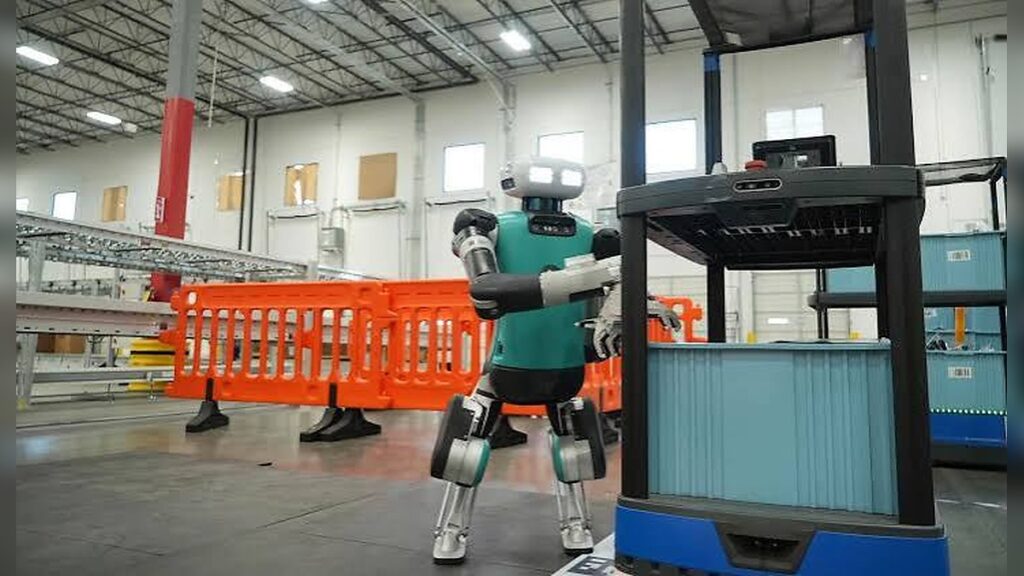
As Silicon Valley pours billions into “embodied AI” and the dream of robots capable of performing almost any task, one robotics company is taking a very different path.
Rather than building a universal robot brain from the outset, Nomagic is focusing on creating AI systems that excel at specific jobs before expanding their capabilities over time.
The company believes mastering individual tasks in real-world environments is a more practical route to achieving truly intelligent robots than chasing broad, general-purpose models that still struggle with reliability.
A Different Vision for Embodied AI
The robotics industry has increasingly shifted toward developing artificial intelligence capable of controlling physical machines in the real world.
These so-called embodied AI systems aim to allow robots to understand their surroundings, interpret human instructions and perform a wide variety of tasks with minimal programming.
Many startups are pursuing general-purpose AI models that can be installed in different robots and adapted to countless applications.
The expectation is that these systems can quickly learn new jobs with only limited additional training.
However, today’s general AI-powered robots often perform well below human accuracy when first deployed, making them unsuitable for demanding commercial environments without further customization.
Nomagic Focuses on Mastering One Job at a Time
Nomagic has adopted a contrasting strategy.
Instead of prioritizing versatility, the company develops AI models that are designed to perform particular warehouse tasks with high accuracy from the moment they are installed.
Its long-term goal remains the same as many competitors—building increasingly capable robot intelligence—but executives believe dependable performance in real operations must come before broad flexibility.
The company operates from headquarters in Warsaw, Poland, with its U.S. base located in Sandy Springs, Georgia.
New AI System Moves Beyond the Research Lab
Earlier this year, Nomagic strengthened its research ambitions by establishing a dedicated AI laboratory led by Markus Wulfmeier, a former robotics researcher at Google DeepMind who now serves as the company’s chief scientist.
The company has now deployed its first Vision-Language-Action (VLA) model for paying customers.
Unlike conventional AI, a VLA model allows robots to recognize objects, understand written instructions and carry out physical actions based on those commands.
Nomagic says it is among the first companies to operate this type of AI in live commercial warehouse environments rather than limiting demonstrations to laboratories or controlled testing.
Warehouse Performance Shows Early Gains
The first commercial deployment has produced encouraging results.
Nomagic says the AI has significantly reduced the number of situations in which warehouse robots become confused and require human assistance.




By concentrating on these relatively uncommon but disruptive “edge cases,” the company reports that human interventions caused by robot errors have been cut by roughly half during live warehouse operations.
While the improvements may not appear dramatic to consumers, they can have a substantial impact on warehouse productivity and operating costs.
Swiss Retailer Sees Operational Benefits
One of the first businesses to adopt the new technology is Brack.
Alltron, Switzerland’s second-largest e-commerce platform.
The retailer already uses Nomagic robots for picking and packing customer orders inside its warehouses.
According to founder Roland Brack, the introduction of the new AI has transformed the robots’ capabilities, allowing them to better understand their surroundings and operate with far greater independence.
He said the technology now enables autonomous warehouse shifts overnight and on Sundays, helping the company meet demand without placing additional pressure on employees.
Reliability Remains the Biggest Challenge
Despite the progress, Nomagic acknowledges that its AI has not yet reached the near-perfect reliability required for fully autonomous warehouse operations.
The company says no commercially deployed VLA system currently achieves success rates approaching 99.9 percent on its own.
To bridge that gap, Nomagic combines its latest AI with traditional robotics software that monitors performance, catches mistakes and enforces safety rules whenever the AI encounters uncertainty.
This layered approach allows customers to benefit from AI improvements while maintaining the reliability required for commercial use.
Real-World Data Drives Better AI
A key advantage for Nomagic comes from the large amount of operational data collected from robots already working inside customer warehouses.
Every month, the company’s fleet completes millions of successful package picks, including around two million monthly picks for fashion retailer Zalando alone.
Rather than relying primarily on computer simulations or remotely controlled robots for training, Nomagic feeds this real-world operational data back into its AI models.
The company believes exposure to genuine warehouse conditions provides richer learning opportunities than artificial environments.
Why Edge Cases Matter
According to Wulfmeier, the greatest obstacle facing robotics is not handling ordinary situations but preparing for the countless rare events that occur during everyday operations.
Unexpected package positions, damaged boxes or unusual item arrangements can all confuse robotic systems.
Similar challenges have slowed the rollout of self-driving vehicles, which must also learn how to respond safely to an enormous range of unpredictable circumstances.
While simulation remains an important training tool, Wulfmeier believes it cannot fully replace experience gathered from actual commercial deployments.
Award-Winning Warehouse Innovation
Nomagic’s practical approach has already earned industry recognition.
The company recently received the 2026 International Intralogistics and Forklift Truck of the Year (IFOY) Award for its Shoebox Picker system.
The technology impressed judges by reliably handling one of warehouse automation’s most difficult challenges—moving two-piece shoeboxes without accidentally dislodging their lids.
The achievement highlights the company’s emphasis on solving highly specific operational problems rather than pursuing flashy demonstrations.
Building AI Through Real Business Problems
Nomagic’s leadership argues that its biggest strength lies in solving genuine customer challenges instead of creating technology in search of an application.
Executives say the company developed its robotics business first and allowed artificial intelligence capabilities to evolve naturally from real warehouse needs.
Rather than beginning inside research laboratories, Nomagic believes operating robots in live commercial settings provides the practical experience needed to eventually create more capable and adaptable AI systems.
As competition intensifies in the embodied AI sector, the company is betting that dependable performance—not ambitious promises—will ultimately determine which robotics platforms succeed in the real world.

