
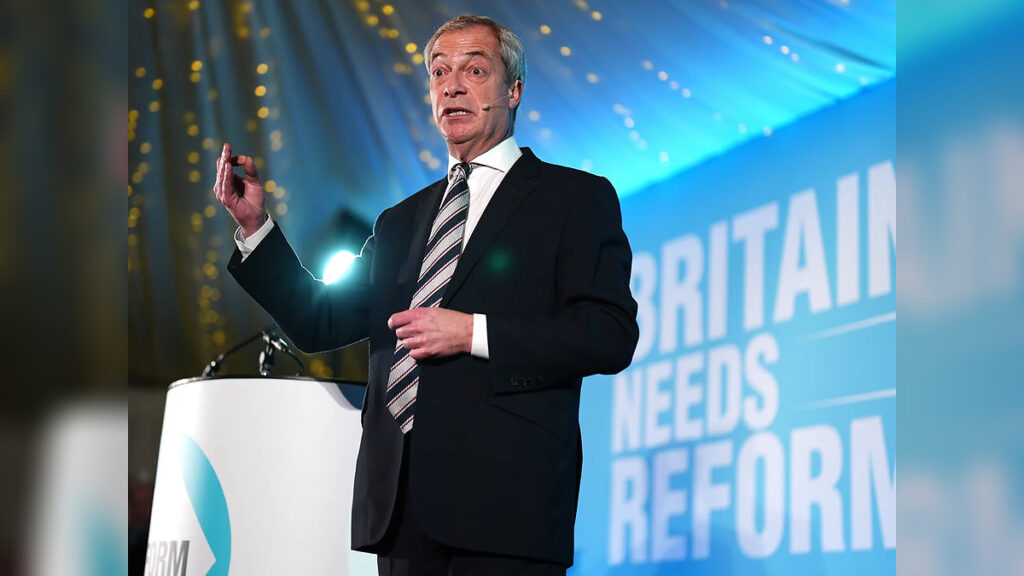
A new large-scale MRP poll has dramatically altered the projected landscape of British politics, suggesting that Reform UK could fall to third place at a general election despite previously leading many opinion surveys.
The research indicates that Labour has regained its position as the largest party, while the Conservatives have climbed into second place, creating a highly fragmented electoral picture with no party close to securing an outright majority.
Labour Emerges as Largest Party in Seat Projections
According to the latest Electoral Calculus analysis, Labour would win an estimated 217 seats if voters went to the polls immediately.
The Conservatives are projected to secure 151 seats, while Reform UK would finish with 127 MPs.
The projections represent a significant shift from earlier polling, when Nigel Farage’s party appeared to have a stronger advantage.
Although Labour remains the largest party under the latest estimates, it would still fall well short of the number of seats required to govern alone.
Restore Britain Makes an Immediate Impact
One of the most notable developments in the survey is the inclusion of Restore Britain for the first time.
Although Rupert Lowe’s newly formed party is forecast to win just a single parliamentary seat, researchers believe it is drawing meaningful support away from Reform UK.
The findings suggest that the emergence of Restore Britain is contributing to Reform’s decline in projected vote share, adding another challenge for Farage as he competes for support among voters on the political right.
Poll Suggests Tight Race in National Vote Share
Despite Labour leading in projected parliamentary seats, the national vote remains extremely competitive.




The survey places Labour and Reform level on 22% of the vote, while the Conservatives are close behind on 20%.
The Liberal Democrats are estimated at 11%, the Green Party at 10%, and Restore Britain at 7%.
Researchers also noted that Reform’s support has dropped sharply since January, when the party was measured at 31%.
Hung Parliament Still the Most Likely Outcome
Even with Labour leading the seat projections, the polling points to another hung parliament rather than a decisive election victory.
Analysts suggest the most realistic governing arrangement would involve Labour working alongside the Liberal Democrats and the Greens.
However, even such a three-party alliance could struggle to command a working majority, potentially leading to lengthy negotiations over policy priorities.
Such coalition discussions could give smaller parties considerable influence over issues such as electoral reform or constitutional changes, including renewed debate over another Scottish independence referendum.
Burnham’s Return Seen as Giving Labour Momentum
The polling was conducted between June 23 and June 30, shortly after Prime Minister Keir Starmer announced his resignation, and surveyed 5,545 adults across Britain.
Electoral Calculus founder Martin Baxter said the results indicate that Andy Burnham’s return to Westminster has provided Labour with an early boost, describing the effect as a potential “Burnham bounce.”
However, Baxter cautioned that Labour still faces the challenge of convincing voters that new leadership can deliver meaningful change rather than simply another change of occupants in Downing Street.
Tactical Voting Could Limit Reform’s Progress
The research was produced using the Multi-level Regression and Post-stratification (MRP) model, a polling method widely regarded for producing constituency-level forecasts.
In addition to demographic modelling, the projections also account for tactical voting.
Electoral Calculus argues that anti-Reform voters may increasingly back whichever rival candidate has the strongest chance of defeating Reform in individual constituencies, reducing the party’s ability to convert national vote share into parliamentary seats.
Analysts Say Election Remains Wide Open
Kevin Craig, founder and chief executive of communications agency PLMR, said the findings demonstrate that the next general election remains highly competitive despite Labour’s improved position.
He argued that while Andy Burnham has injected fresh energy into Labour, the party must now convert renewed optimism into tangible achievements if it hopes to maintain public confidence.
Craig added that whichever party can combine a convincing long-term vision with practical delivery will ultimately be best positioned to earn voters’ trust when the country next heads to the polls.
