
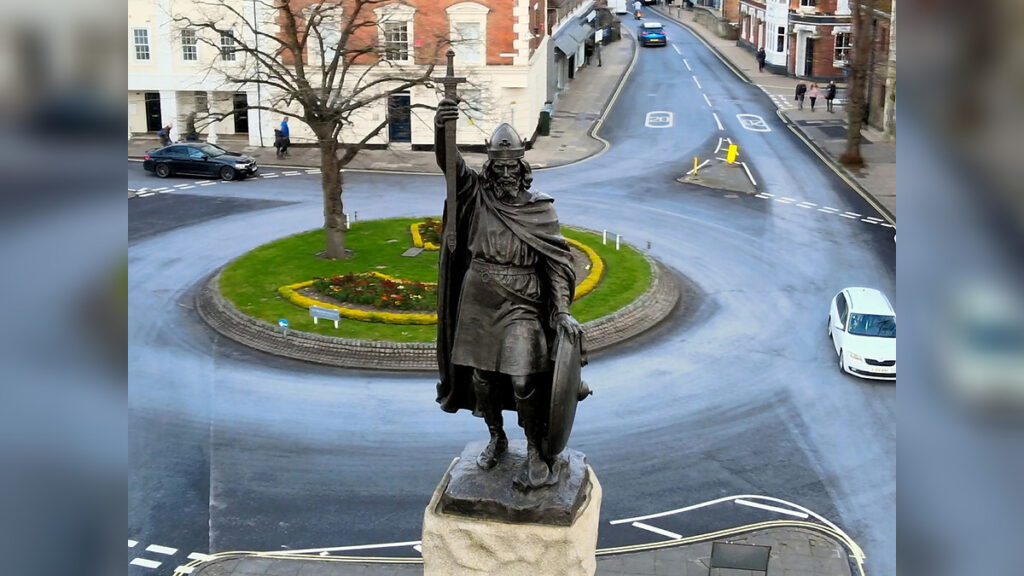
A British historian has claimed to have identified the long-lost burial place of King Alfred the Great, one of England’s most celebrated rulers, suggesting the Anglo-Saxon king’s remains are located beneath a car park in Winchester, Hampshire.
The announcement comes just days before England faces Norway in a FIFA World Cup quarter-final, prompting the researcher to describe the discovery as a symbolic boost for the national team.
A 13-Year Investigation Leads to New Claim
Historical researcher Graham Phillips says he has spent more than a decade investigating the mystery surrounding Alfred’s final resting place.
According to Phillips, he is convinced that the English king’s remains still lie beneath a modern car park in Winchester.
Phillips expressed complete confidence in his findings, stating that he believes the evidence points directly to the site where Alfred’s bones were ultimately relocated.
He also described the timing of the discovery as an encouraging sign ahead of England’s upcoming World Cup clash against Norway.
Echoes of the Richard III Discovery
The claim has drawn immediate comparisons with the remarkable discovery of King Richard III’s remains beneath a Leicester car park in 2012.
That archaeological breakthrough transformed understanding of the medieval monarch’s final resting place and became one of Britain’s most famous historical discoveries.
Phillips noted the striking similarity, calling it unusual that another English king may have ended up buried beneath a parking area centuries later.
Alfred’s Legacy as England’s Defender
Born in 849, Alfred ruled the Kingdom of Wessex from 871 until his death in 899 and remains one of the most influential Anglo-Saxon monarchs in British history.
He earned widespread recognition for defending his kingdom against Viking invasions while strengthening the foundations of what would eventually become a unified England.




His greatest military achievement came in 878 at the Battle of Edington, where his forces defeated the Vikings led by Guthrum.
The battle is believed to have involved as many as 6,000 combatants, with heavy casualties reported on both sides.
Following the victory, Guthrum converted to Christianity, marking a significant turning point in relations between the Anglo-Saxons and Viking settlers.
Centuries of Relocations Created a Historical Puzzle
Although Alfred’s historical importance has never been questioned, the location of his remains has puzzled historians for generations.
After his death in 899, Alfred was initially buried in Winchester before his remains were transferred in 1110 to Hyde Abbey.
There, he was laid to rest near the abbey’s high altar alongside members of his family.
The mystery deepened after Hyde Abbey was destroyed during the Dissolution of the Monasteries in 1539.
Over the centuries, repeated construction work and redevelopment of the area complicated efforts to identify exactly where the king’s remains had ended up.
Previous Searches Failed to Produce Conclusive Evidence
Attempts to locate Alfred’s grave have been made numerous times over the past century.
One notable excavation took place in 1866 when antiquarian John Mellor believed he had uncovered the king’s bones while work was underway on a new workhouse.
Subsequent analysis, however, concluded that the remains belonged to someone who lived roughly two centuries after Alfred’s death, leaving the mystery unresolved.
Phillips now argues that Alfred’s bones were moved again during construction of a prison on the site in 1788, leading them to the location he believes has finally been identified.
Discovery Coincides With England’s World Cup Quarter-Final
The timing of the announcement has attracted additional attention because England is preparing to meet Norway in a World Cup quarter-final in Miami.
The match will feature England against a Norwegian side led by star striker Erling Haaland, which reached the last eight after eliminating Brazil.
Phillips has suggested the apparent discovery of Alfred’s burial site could serve as a fortunate omen for England’s hopes of progressing further in the tournament.
Documentary Set to Reveal the Proposed Burial Location
Viewers will soon be able to examine the evidence behind the claim, as the precise location where Phillips believes Alfred is buried is scheduled to be revealed in a new episode of Weird Britain.
The programme is set to air on Blaze TV, offering the first public presentation of the historian’s findings and the years of research that led to his conclusion.
