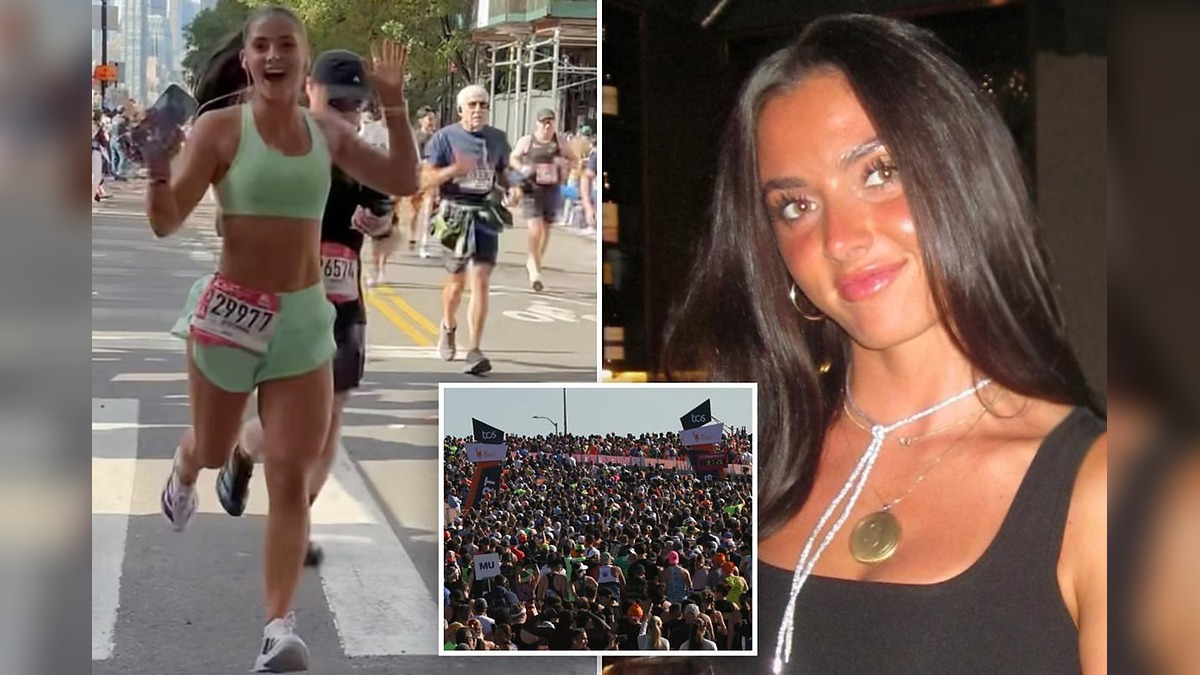
The final text messages sent by 24-year-old Rachel Apa to her father shortly before she collapsed during the New York City Marathon have been revealed.
Rachel, a former college field hockey player, died at a New York hospital after collapsing in Central Park on Sunday, close to the finish line of the race.
Her father, Steve Apa, told The New York Times that doctors attributed her death to rhabdomyolysis, a rare condition that can develop when intense physical exercise causes muscle tissue to break down.
Runner Reported Pain During First Marathon
Rachel had been communicating with her father throughout her first marathon, while he followed her progress from their home in Lewisberry, Pennsylvania.
Steve sent her encouraging messages at every mile as she made her way through the 26.2-mile course.
However, after reaching Mile 18, Rachel responded with a brief message: “Ow.”
Her condition appeared to worsen as she continued running.
At Mile 19, she sent another message to her father, writing: “Ow ow.”
Steve continued sending messages over the following three miles, but his daughter stopped responding.
When Rachel reached Mile 23, her father sent another message reassuring her that she was in the “final stretch”. However, he received no reply.
At approximately 1.30pm, Rachel collapsed while running through Central Park.
Emergency Teams Attempted to Save Her Life
A hospital social worker reportedly rushed to Rachel’s assistance but could not find a pulse.
Two doctors who were among the spectators also attempted to resuscitate her by performing CPR.
Medical personnel from the marathon subsequently arrived with a defibrillator, according to a statement released by race organiser New York Road Runners (NYRR).




Paramedics arrived shortly afterwards with an ambulance and transported Rachel to Mount Sinai Medical Center.
Doctors continued trying to save her life for six hours, but she was pronounced dead at 9.40pm.
Speaking about the loss of his daughter, Steve described the circumstances as unfathomable.
“It’s unfathomable,” he told The New York Times.
“Perfect health, perfect shape, 24 years old.”
Mother Arrived as Daughter Was Taken to Hospital
Rachel’s mother, Michelle, had been following her daughter’s participation in the marathon and recorded footage of her smiling at Mile 14.
She had planned to meet Rachel at Mile 25 but noticed through the marathon tracking application that her daughter was still further back in Central Park.
Michelle subsequently made her way to the location where Rachel had collapsed, arriving just as an ambulance was transporting her daughter to the hospital.
She followed in another ambulance shortly afterwards.
Marathon Organisers Confirm Runner’s Death
Following Rachel’s death, New York Road Runners released a statement expressing condolences to her family and the wider running community.
“We are deeply saddened by the death of one of our runners following yesterday’s race,” the organisation said.
“Our thoughts and sincere sympathies are with the runner’s family, friends, and the entire running community.”
NYRR also confirmed that Rachel was the first participant to die during the New York City Marathon since 2024.
What Is Rhabdomyolysis?
Rhabdomyolysis is a condition in which damaged muscle tissue breaks down and releases substances from muscle fibres into the bloodstream.
These substances can affect the kidneys and other parts of the body’s circulation system, potentially causing serious complications.
The condition is rare, affecting approximately 0.0076 per cent of the US population annually, and can be associated with excessive physical exertion without adequate rest.
Rachel Was Raising Money for Parkinson’s Foundation
Outside her running activities, Rachel worked as a product manager for an electrical component company and was pursuing an MBA at Charleston Southern University.
She had entered the New York City Marathon to raise funds for the Parkinson’s Foundation Champion in memory of her grandfather, who died in 2022.
In her fundraising message, Rachel explained the personal significance of the cause and how her grandfather’s illness had influenced her decision to support the organisation.
“I watched as the disease slowly took away the freedom to move that he once loved so much,” she wrote.
“He passed away in 2022, but the lessons he taught me continue to drive me forward.”
