
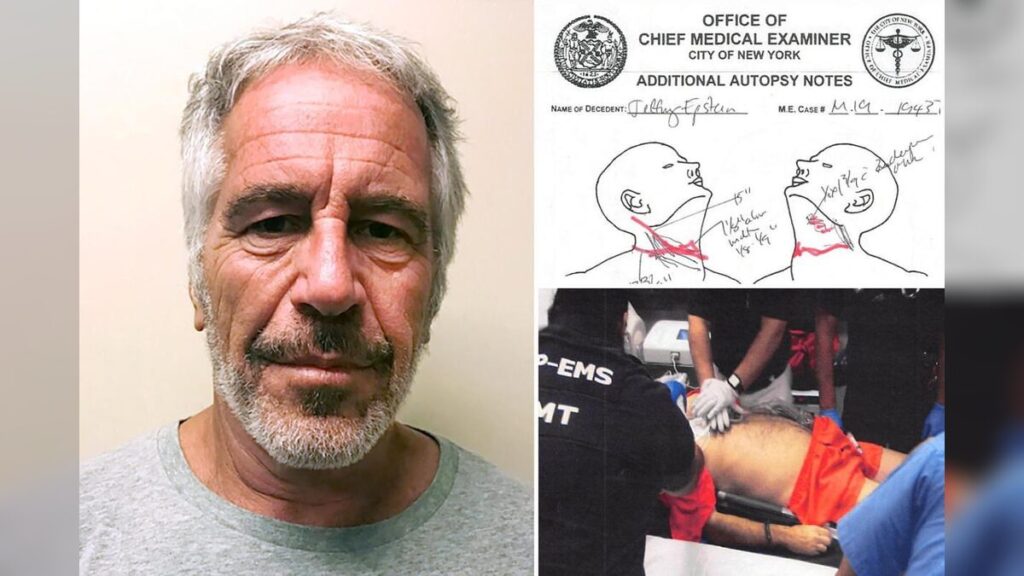
Dr. Kristin Roman, the New York City medical examiner who conducted Jeffrey Epstein’s autopsy, hesitated to immediately declare the billionaire financier’s death a suicide.
Newly released Department of Justice (DOJ) documents reveal that Roman’s caution stemmed from Epstein’s notoriety and the number of people who might have wanted him dead.
Roman told DOJ investigators that if Epstein had been a less prominent inmate, she likely would have ruled his death a hanging on the day of the autopsy.
“It was pretty clear cut,” she said, ultimately concluding suicide after examining photographs of Epstein’s cell at the Metropolitan Detention Center.
Autopsy Restrictions and Observations
Despite her review of cell photographs, Roman was unable to speak with correction officers or inspect the cell in person.
She emphasized that these limitations were not critical to her decision but would have added completeness.
Her focus was on understanding the mechanics of the hanging, including questions like, “Was he fully hanging? Where was he hanging?”
One challenge Roman faced was identifying which of the multiple nooses in Epstein’s cell might have been used.
Still, she concluded that either noose could have caused the ligature marks found on Epstein.
Baden Challenges Suicide Findings
Dr. Michael Baden, a pathologist hired by Epstein’s family, continues to dispute the NYC Medical Examiner’s conclusion.
Present at the autopsy as an observer, Baden argues that Epstein’s neck fractures are atypical for a suicide by hanging.
He stated that in his decades of experience overseeing prison deaths, only three fractures are typically observed in such cases, making Epstein’s injuries highly unusual.
Baden has repeatedly called for a reinvestigation, suggesting the death may have been a homicide.
“My opinion is that his death was most likely caused by strangulation pressure rather than hanging,” he told The Telegraph.
Conflicting Evidence and Surveillance Footage
DOJ documents released recently include over three million files shedding new light on the circumstances of Epstein’s death.




Among them is footage showing prison guards discovering Epstein at 6:30 a.m. on August 10, 2019, shortly after which he was declared dead.
Another intriguing detail from the files is an “orange flash” seen on CCTV the night before Epstein’s death.
Investigators debated whether it was an inmate being escorted or someone carrying prison linen.
The exact significance of this movement remains unclear, fueling further speculation.
Procedural Failures at the MCC
Records highlight multiple procedural lapses at the Metropolitan Correctional Center.
Guards missed scheduled overnight checks at 3 a.m. and 5 a.m., and at least two cameras near Epstein’s cell were malfunctioning.
These failures left investigators without a reliable timeline of the final moments, complicating efforts to confirm the cause of death.
Dr. Baden noted that the body was moved unusually before the post-mortem and that critical evidence might have been lost.
He also emphasized that no precise official time of death was established.
Alleged Deception During Body Removal
Newly released documents claim that prison staff staged a decoy removal of Epstein’s body to mislead reporters outside the facility.
Boxes and sheets were arranged to resemble a human body and loaded into a white vehicle followed by the media, while Epstein’s real body was quietly transported in a black vehicle.
This unusual handling was reportedly a response to the intense media presence at the prison.
Additionally, investigators documented a handwritten note found in Epstein’s cell that listed complaints about jail conditions.
The note was not considered a suicide note.
Impact and Consequences
The ongoing disputes over Epstein’s death highlight persistent gaps in oversight at federal detention facilities.
Conflicting expert opinions, procedural failures, and new evidence in the DOJ files have fueled public suspicion and conspiracy theories.
The case continues to challenge trust in the criminal justice system’s ability to safeguard high-profile inmates.
What’s Next?
Dr. Baden and Epstein’s family are advocating for a renewed investigation into the cause of death.
With over three million DOJ documents already released, additional analysis of the evidence, surveillance footage, and autopsy findings may reopen debates over whether Epstein’s death was a suicide or a homicide.
Summary
Dr. Kristin Roman ultimately ruled Jeffrey Epstein’s death a suicide but delayed her decision due to the financier’s high profile.
Dr. Michael Baden disputes this conclusion, citing unusual neck fractures and inconsistencies in autopsy and prison procedures.
Newly released DOJ files reveal procedural failures, suspicious CCTV footage, and a staged body removal, leaving lingering questions about the circumstances surrounding Epstein’s death.
Bulleted Takeaways
- Dr. Roman delayed declaring Epstein’s death a suicide due to his high profile and potential threats.
- Photographs of Epstein’s cell helped Roman conclude suicide, despite not visiting the cell or interviewing guards.
- Dr. Baden disputes the suicide ruling, citing unusual neck fractures and a possible homicide.
- DOJ files reveal procedural failures: missed guard rounds, malfunctioning cameras, and unclear timeline.
- Prison staff allegedly staged a decoy body removal to mislead reporters.
- Handwritten notes in Epstein’s cell indicated grievances about jail conditions, not suicide intent.
- Conflicting expert opinions and evidence gaps continue to fuel calls for reinvestigation.
