
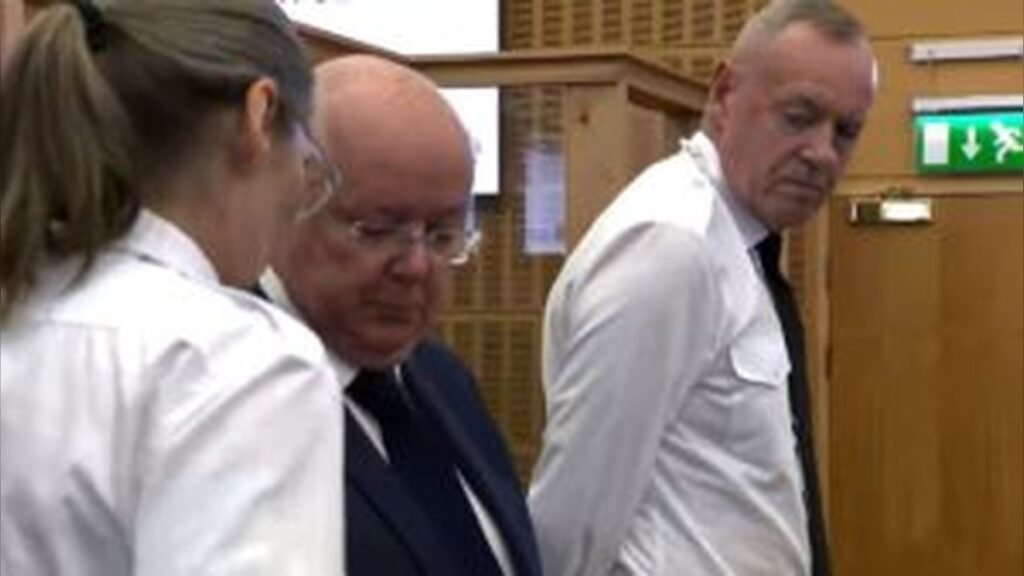
Scotland’s most senior judge rejected a request to film Peter Murrell’s reaction as his prison sentence was announced, citing concerns that the footage could be widely shared online in ways that would undermine the seriousness of the proceedings.
The decision meant cameras were allowed to record only limited parts of the sentencing hearing, excluding the moment Murrell learned the length of his prison term.
Concerns Raised Over Social Media Misuse
Internal correspondence released under freedom of information laws revealed that the trial judge, Lord Young, strongly opposed allowing broadcasters to capture Murrell’s facial expressions during sentencing.
He argued that any visible reaction—or even the absence of one—could be endlessly replayed on social media, transformed into memes or GIFs, and used to fuel public commentary about the case or the punishment imposed.
Lord Young also warned that expressions interpreted as indifference or relief could unfairly influence public perceptions of the justice system.
Lord President Backed the Restriction
The concerns were accepted by Lord Pentland, Scotland’s Lord President and head of the country’s judiciary.
Agreeing with Lord Young’s assessment, he ruled that filming Murrell during the reading of his sentence would be inappropriate.
Broadcasters were instead permitted to record him entering and leaving the dock, but not his reaction inside the courtroom.
The court also approved a request allowing a courtroom sketch artist to attend the proceedings.




Murrell Serving Prison Sentence for Embezzlement
Murrell, the former chief executive of the Scottish National Party and the estranged husband of former First Minister Nicola Sturgeon, was sentenced to five years and three months in prison after admitting to embezzling more than £400,000 from the party.
His sentencing hearing attracted significant public attention because of his prominent political role and his long association with one of Scotland’s most influential political figures.
Legal Expert Says Decision Reflects Cautious Approach
Legal academic Dr Nick McKerrell said the ruling highlighted Scotland’s traditionally cautious approach to introducing cameras into criminal courts.
He noted that while broadcasting legal arguments has become increasingly common in civil proceedings, filming defendants, jurors or witnesses remains a far more sensitive issue that raises questions about fairness and privacy.
According to McKerrell, the concerns expressed by the judges demonstrate why the expansion of courtroom broadcasting in criminal cases has progressed slowly.
Judiciary Defends Existing Filming Rules
The Judicial Office for Scotland said the country’s courts have supported open justice for decades, allowing cameras under carefully controlled conditions since the early 1990s.
Officials explained that judges routinely permit filming of sentencing statements delivered by the court, but those recordings are limited to the judge alone.
Defendants have not previously been filmed during sentencing for news broadcasts, with every application assessed individually to ensure fairness and avoid sensationalising court proceedings.
The office added that discussions with broadcasters continue as the courts balance transparency with protecting the integrity of the justice process.
Sturgeon Speaks Publicly About Betrayal
The controversy comes as Nicola Sturgeon publicly reflected on Murrell’s conviction in the upcoming paperback edition of her memoir.
She described feeling deeply betrayed by his actions, saying the crimes had not only transformed their personal lives but had also exposed her to public suspicion, humiliation and sustained criticism.
Sturgeon wrote that many people had wrongly directed blame toward her during the lengthy investigation, despite having no involvement in the offences.
Former First Minister Reflects on Difficult Years
Although she admitted she initially felt sympathy for Murrell during the years-long police investigation because he had become increasingly withdrawn and isolated, Sturgeon said those feelings had now faded.
She concluded that his actions showed little regard for the impact they would have on her, leaving her determined to move on from a chapter she described as one of the most painful periods of her life.

