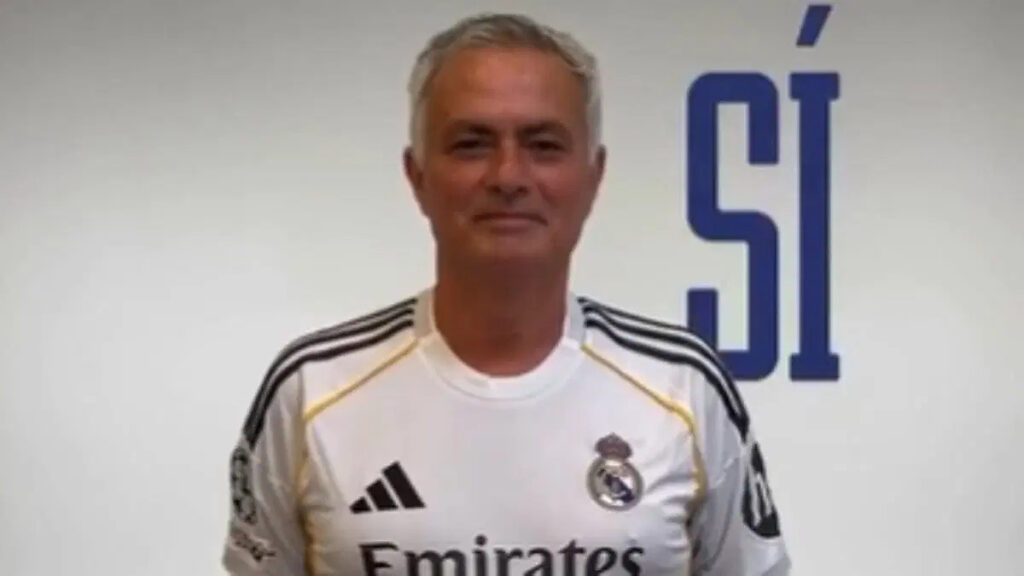
José Mourinho is officially set for a dramatic return to the Santiago Bernabéu after Florentino Pérez was re-elected as Real Madrid president, clearing the final hurdle for the Portuguese coach’s comeback and ushering in a new era of ambition and high-profile transfer targets.
Mourinho, 63, had already signed a three-year agreement last month to resume control of the team, but the deal hinged entirely on the outcome of the club’s presidential election. With Pérez’s victory now confirmed, the path is clear for Mourinho’s formal reinstatement.
The former Real Madrid boss, who last left the club in 2013, reacted briefly to the outcome in a video message, stating: “Yes, Florentino Pérez won. Of course.”
Pérez Extends Grip on Power After Heated Election Battle
Florentino Pérez, who has now led Real Madrid for 23 years across two separate spells, secured yet another mandate after winning 65% of the vote in an election that drew significant tension inside the club’s membership base.
More than 33,000 socios participated in the vote at a club owned by roughly 100,000 members. Pérez’s nearest challenger, 37-year-old entrepreneur Enrique Riquelme, finished with 35%.
The final result was delayed after disputes emerged over the validity of around 1,000 postal ballots, with more than 400 ultimately disqualified following review.
Pérez’s victory extends a presidency that has already produced five consecutive uncontested wins and reinforces his long-standing control over the club’s sporting direction.
Election Promises, Financial Claims and Competing Visions
The campaign itself had been marked by sharp disagreements over the club’s financial health and future structure.
Riquelme accused the current administration of pushing Real Madrid toward a “serious financial crisis,” arguing that excessive spending had weakened stability.
He also raised concerns about alleged attempts to shift the club toward privatization.
In contrast, Pérez campaigned on continued dominance in the transfer market, reportedly preparing a €150 million move for an unnamed “Galáctico,” widely believed to be Bayern Munich winger Michael Olise.
Riquelme, meanwhile, presented his own ambitious footballing blueprint, suggesting he would attempt to bring in manager Jürgen Klopp and appoint club legend Raúl González Blanco as sporting director.
He also claimed confidence in signing elite stars such as Erling Haaland and Rodri from Manchester City.




Mourinho’s Second Era Begins After 13-Year Absence
With the political uncertainty resolved, attention now shifts to the dugout, where Mourinho returns to Madrid more than a decade after his first spell ended in 2013.
During his initial tenure, he delivered La Liga, the Copa del Rey and the Spanish Super Cup, before departing for Chelsea.
His return marks one of the most high-profile managerial comebacks in recent club history.
The final administrative step involves the activation of his release clause at Benfica, reportedly valued at €15 million (£13 million), though the delay caused by the election has reportedly pushed the cost higher.
Fulham manager Marco Silva is expected to take over at Benfica once the move is completed.
New ‘Galácticos’ Strategy as Transfer Overhaul Begins
Mourinho is expected to oversee a sweeping summer rebuild, with the club already linked to major arrivals and departures.
Defensively, Ibrahima Konaté and Denzel Dumfries have already been signed, while Dani Carvajal and David Alaba are set to move on. Dani Ceballos is also expected to leave as part of the restructuring.
In attack, Michael Olise remains a key target, with additional signings reportedly under consideration.
Young talents such as Nico Paz, Jacobo Ramón and Víctor Muñoz are also being monitored as part of a broader squad refresh.
Club insiders suggest the plan could include three or more additional marquee additions, reinforcing Pérez’s familiar “Galáctico” philosophy under Mourinho’s more pragmatic tactical control.
Mourinho Tasked With Restoring Order in a Fractured Dressing Room
Beyond transfers, Mourinho’s most immediate challenge will be stabilising a squad that has been rocked by internal tensions throughout the season.
A physical altercation last month between Federico Valverde and Aurélien Tchouaméni highlighted growing unrest within the dressing room.
Valverde later required hospital treatment for a head injury, though both players denied the incident amounted to a full fight.
Both were later fined £432,000 (€500,000) following an internal disciplinary hearing.
The club has also been grappling with wider structural issues, including repeated injury crises.
Reports indicate 58 injuries and 20 players sidelined in the previous season alone, raising concerns about conditioning and medical performance.
Those issues had already contributed to friction within the coaching structure, including tensions involving Xabi Alonso earlier in the campaign.
A High-Stakes Rebuild Under Renewed Leadership
With Pérez firmly back in control and Mourinho installed as head coach, Real Madrid now enters a pivotal rebuilding phase defined by high expectations, elite recruitment, and immediate pressure to deliver trophies.
The coming weeks are expected to confirm the final details of Mourinho’s appointment, along with the first wave of transfer activity shaping what could become one of the most closely watched rebuilds in European football.
