
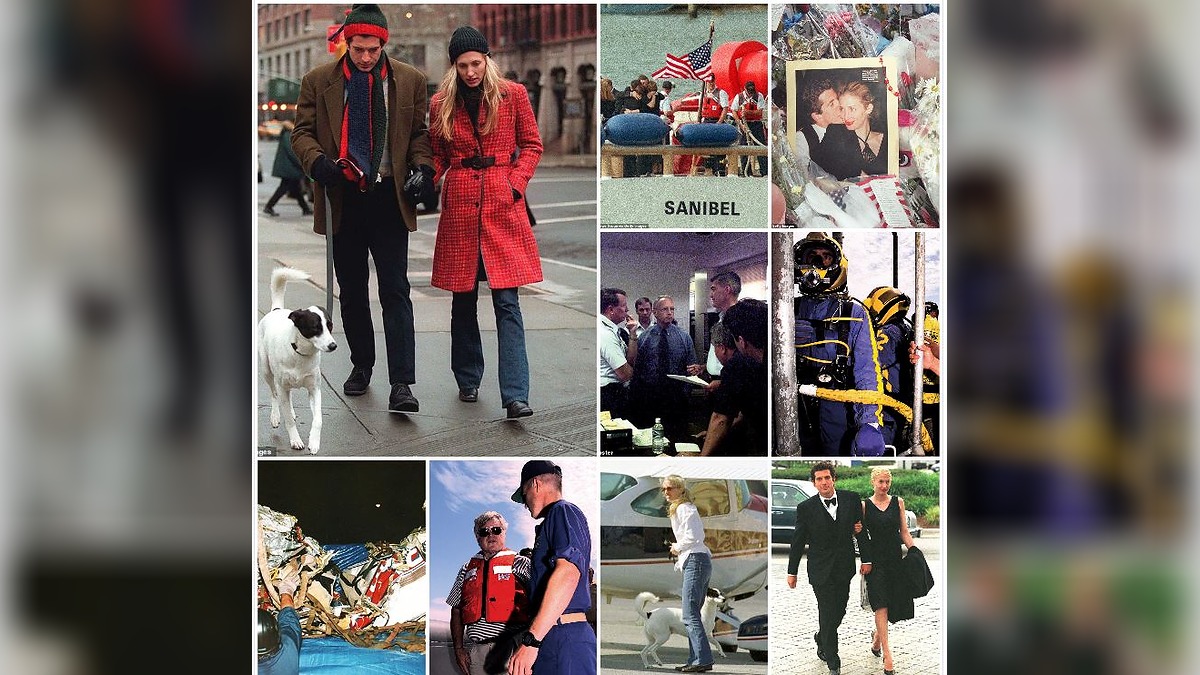
A new account of the search and recovery operation following the 1999 plane crash that killed John F. Kennedy Jr, his wife Carolyn Bessette Kennedy and her sister Lauren Bessette has detailed the efforts of rescuers to locate and recover the three victims.
Captain W. Russell “Russ” Webster, who was Coast Guard Commander of Group Woods Hole at the time, coordinated operations after Kennedy’s aircraft disappeared over the Atlantic Ocean.
Webster’s account appears in The Last Flight: The Untold Story of the Search for JFK Jr and the Race Against the Atlantic, written with his wife, historian Theresa Mitchell Webster.
The book describes how the Coast Guard, the National Oceanic and Atmospheric Administration and the US Navy worked together to locate the wreckage and recover the victims during a five-day operation.
Kennedy’s Aircraft Disappeared During Flight to Massachusetts
On the night of July 16, 1999, Kennedy, 38, piloted his Piper Saratoga II from Essex County Airport in New Jersey.
He was travelling with his wife, Carolyn, 33, to a wedding in Hyannis Port, Massachusetts, and planned to drop off Carolyn’s sister Lauren, 34, on Martha’s Vineyard.
Approximately an hour after take-off, Kennedy became disoriented and lost control of the aircraft, which entered what aviation experts describe as a “graveyard spiral”.
The plane crashed into the Atlantic Ocean about seven and a quarter miles off the southwestern tip of Martha’s Vineyard. All three occupants were killed on impact, and the wreckage settled approximately 116 feet below the surface.
Senator Ted Kennedy Requested That All Three Victims Be Recovered Together
As the recovery operation progressed, Senator Ted Kennedy, John F. Kennedy Jr’s uncle, watched proceedings aboard the Navy salvage ship USS Grasp.
According to Webster’s account, Ted Kennedy insisted that divers recover John, Carolyn and Lauren together rather than raising his nephew separately.
The request was intended to ensure that none of the three victims appeared to receive preferential treatment during the recovery.
Navy divers descended to the wreck site, where visibility was limited and movement across the seabed stirred up sand and silt. The team worked carefully within the available dive time as it attempted to retrieve the victims.
Divers Recover the Three Victims From the Wreckage
The divers located Kennedy’s remains on the ocean floor near the wrecked aircraft and transferred them to a body bag secured to the Navy’s salvage basket.
They then moved towards the fuselage to recover the Bessette sisters, whose seats had been damaged by the force of the impact.
The divers carefully moved the seats, cut the seat belts and removed the women from the wreckage. They identified the sisters by their hair colour, with Lauren being a brunette and Carolyn a blonde.
Both women were placed in body bags before the divers secured all three victims in the salvage basket.




The basket was then brought to the surface, fulfilling Ted Kennedy’s request that his nephew and the two sisters be recovered together.
Conflicting Accounts Emerge Over Condition of Kennedy’s Remains
The recovery operation was followed by differing accounts of the condition of Kennedy’s body.
Retired Navy diver Josh Benjamins recalled being told that Kennedy’s legs were missing when the first recovery team brought the remains to the surface.
Benjamins later participated in a second dive, during which he and another diver were tasked with recovering the aircraft’s fuselage and engine. He said they were also informally instructed to search for the missing limbs.
According to Benjamins, the divers searched the seabed but did not find them. He maintained that the information communicated to him at the time was that only Kennedy’s upper body had been recovered.
However, Frank Ciaccio, a forensic anthropologist with the National Transportation Safety Board who witnessed the autopsies, disputed that account.
Ciaccio said reports that Kennedy’s legs had been severed were false. He explained that the legs had sustained severe damage but remained attached by tendons and muscles.
Eric Anderson, the commanding officer of the USS Grasp, also recalled being told that Kennedy’s body had been compressed by the impact, with the remains still present but severely damaged.
The accounts differ over what the divers initially observed and how the condition of Kennedy’s remains was subsequently described.
Autopsies Confirmed Fatal Traumatic Injuries
The victims’ remains were taken to the medical examiner’s office at Barnstable County Hospital in Pocasset, Massachusetts.
The autopsies were conducted by a pathologist, a Massachusetts State Police photographer and Ciaccio. The examinations lasted approximately four hours.
The medical examiner determined that Kennedy, Carolyn and Lauren had died instantly from multiple traumatic injuries sustained when the aircraft struck the Atlantic Ocean.
Toxicology testing on Kennedy found no evidence of alcohol or drug use.
Ciaccio later described the examination as one of the most solemn experiences of his career, recalling the emotional weight of working on a case involving a member of the Kennedy family.
Navy Divers Continue Searching the Wreck Site
Following the recovery of the three victims, Navy divers returned to the wreck site to retrieve the aircraft’s fuselage, engine and other items.
Benjamins recalled that the team worked from Tuesday through Thursday, collecting larger pieces of wreckage before searching the seabed for smaller objects.
Among the items recovered were parts of the aircraft’s wings, watchbands, compact discs and hats.
During one dive, rescuers also reported finding a piece of scalp with long blonde hair wrapped around a diver’s communications hose.
Benjamins said the discovery was relayed to a senior diver, after which the tissue was untangled from the hose and released into the ocean currents.
According to his account, the remains were allowed to return to the sea on the same day Carolyn’s ashes were committed to the nearby waters.
Five-Day Operation Concludes After Recovery Efforts
The search and recovery mission involved coordination between the Coast Guard, NOAA and the Navy, with Webster serving as Incident Commander for Operations.
The operation was among the largest search-and-rescue efforts in US history involving a private citizen’s small-aircraft crash.
The newly published account documents the challenges faced by rescuers, including poor underwater visibility, changing tides and weather conditions, as well as the difficult task of recovering the victims and aircraft wreckage.
The account is drawn from The Last Flight, written by Russ Webster and Theresa Mitchell Webster and published with permission of Harper Select, an imprint of HarperCollins Focus.
