
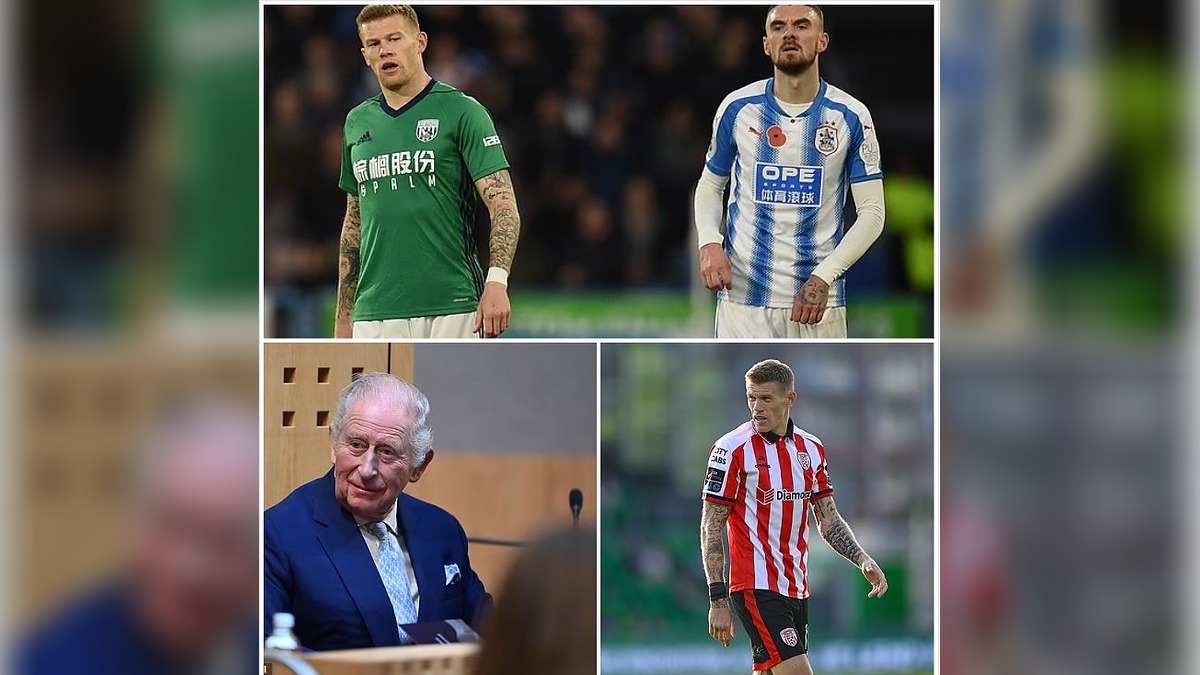
Former Republic of Ireland international James McClean has discussed his refusal to wear a Remembrance Day poppy, describing how growing up in a staunch Republican community in Northern Ireland shaped his views on British military history.
The 37-year-old, who earned 103 caps for the Republic of Ireland between 2012 and 2023, has played for several English clubs, including Stoke City, Sunderland, West Bromwich Albion and Wigan Athletic.
His decision not to wear a poppy on Remembrance weekend has repeatedly attracted attention. McClean has also frequently stood apart from teammates during pre-match commemorations.
He has explained that his objection is linked to the poppy’s association with British military personnel who served in Northern Ireland during the Troubles. He has said he would have no objection to the symbol if it commemorated only those who died in the First and Second World Wars.
Childhood in Creggan Shaped His Views on the Conflict
McClean grew up on the Creggan estate in Londonderry, a Republican stronghold with a history closely connected to the Troubles.
The area was directly affected by Bloody Sunday on January 30, 1972, when British soldiers shot 26 unarmed civilians during a civil rights march. Fourteen people died.
Born in 1989, McClean did not experience the massacre himself, but he said he grew up hearing accounts from people who had lived through the conflict and its aftermath.
Speaking to the Irish Independent, he described the environment in which he was raised, including political messages displayed around the neighbourhood.
“Walk around and you’ll see it on every second wall: ‘Join the IRA… Free Prisoners of War… RUC f***ing out’. So you’re surrounded by it,” he said.
Addressing suggestions that his poppy stance was based solely on an event that happened before his birth, McClean said the consequences of the Troubles continued to affect the community.
“No, I didn’t. And I didn’t have the Troubles either, but I grew up in the aftermath and the pain was still there,” he said.
McClean also revealed that he grew up in the house where Daniel Hegarty, a 15-year-old who was killed during a British Army operation in 1972, had previously lived.

Footballer Addresses His Views on the IRA
McClean’s relationship with the history of Irish Republicanism is also discussed in his forthcoming biography, The Walls.
A passage from the book states that he supported the IRA’s original objective, while acknowledging that not every action carried out by the organisation was justified.
Asked about those comments during his interview, McClean said hearing accounts of the conflict while growing up had influenced his perspective.
“When you grow up listening to the stories there’s a part of you thinking: ‘These are heroes. I wish I was part of that or born a decade earlier’. I’d be a hypocrite if I sat here and said I didn’t support their cause,” he said.
He added that he did not believe innocent people deserved to be killed, acknowledging that the conflict had resulted in casualties on both sides.
“Unfortunately, it was a dirty war, and there were a lot of casualties on both sides,” McClean said.
McClean Condemns IRA Killing of Jean McConville
During the interview, McClean was asked about the killing of Jean McConville, a 38-year-old widowed mother of ten who was abducted and murdered by the IRA before her body was secretly buried.
The organisation had wrongly suspected her of informing for the British Army.
McClean said he did not support what happened to McConville, distinguishing his support for the IRA’s cause from approval of every action committed in its name.
“Do I agree with that? Absolutely not,” he said.
“I support the IRA’s cause. Do I support what happened to people like Jean McConville? No, because not everything the IRA did was justifiable.”
He also referred to his relationship with former Sinn Féin leader Martin McGuinness, saying he disagreed with McGuinness meeting the Queen.
“Do I believe that him meeting the Queen was right? Absolutely not,” McClean added.
McClean Reveals His Reaction to the British National Anthem
The footballer also discussed his opposition to British national symbols and recalled facing criticism when he refused to look towards the flag while God Save the Queen was played before a pre-season friendly in the United States during his time at West Bromwich Albion.
He said his response to the anthem remained unchanged when watching football on television.
“When I’m watching England matches, or the FA Cup final, I’ll mute the TV when the national anthem comes on,” McClean said.
He added that his reaction was shared by others in Londonderry, saying he was not alone in choosing not to listen to the anthem.

