
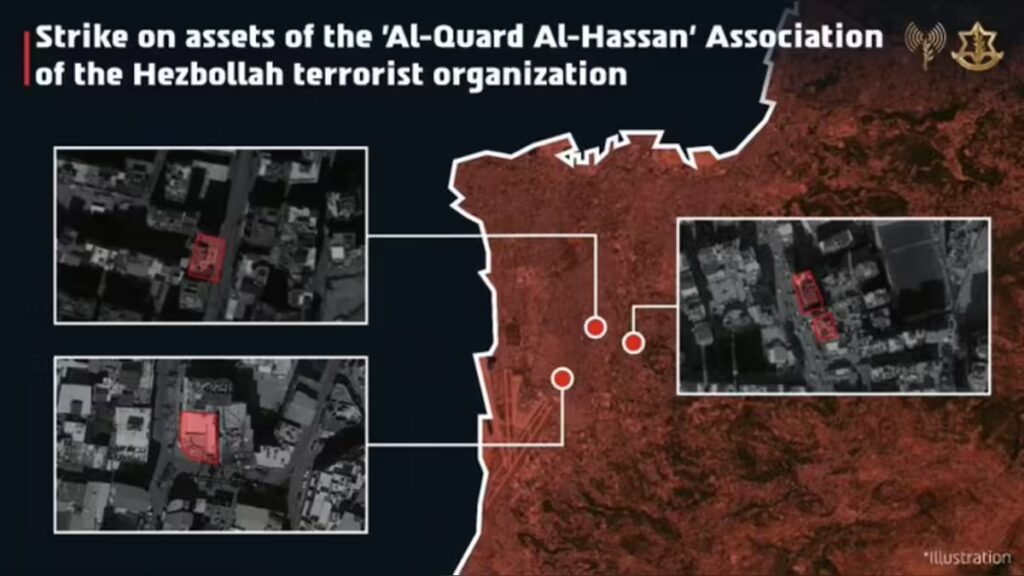
The Israeli military has launched another round of airstrikes in Lebanon, focusing on locations tied to the Hezbollah-linked financial organization known as Al‑Quard Al‑Hassan Association.
According to the Israel Defense Forces, the strikes targeted infrastructure and storage facilities believed to be part of the group’s financial network.
Israeli officials say the organization is used to fund weapons purchases and distribute payments to militants associated with Hezbollah.
Military leaders said the latest operation forms part of ongoing efforts to weaken Hezbollah’s operational capabilities and disrupt the financial channels that sustain its military activities.
Focus on Funding Channels
Israeli defense officials argue that organizations such as Al-Quard Al-Hassan play a critical role in supporting Hezbollah’s operations.
The group is widely known in Lebanon as a financial cooperative that provides loans and financial services.
However, Israeli authorities claim the system is also used to move funds that ultimately support militant operations, including the purchase of weapons and the payment of fighters.




By targeting warehouses and facilities tied to the organization, the Israeli military says it aims to cut off resources that help sustain Hezbollah’s armed wing.
Part of a Wider Military Campaign
The strikes are part of a broader campaign by the Israel Defense Forces to weaken Hezbollah’s military infrastructure.
In recent months, Israel has repeatedly targeted locations in Lebanon it says are connected to Hezbollah’s weapons storage, command systems, and financial operations. Officials describe the strategy as an attempt to limit the group’s ability to arm and pay its fighters.
Israeli military statements indicate that operations will continue as long as they believe Hezbollah’s capabilities remain a threat.
Impact and Consequences
The strikes could have several significant effects across the region:
- Disruption of funding networks: Targeting financial infrastructure could hinder Hezbollah’s ability to purchase weapons and compensate militants.
- Increased regional tensions: Airstrikes in Lebanon often raise concerns about broader escalation between Israel and Hezbollah.
- Economic ripple effects: Financial institutions linked to the group also serve civilians, meaning disruptions could affect ordinary Lebanese customers.
- Security implications: The strikes highlight the ongoing shadow conflict between Israel and Hezbollah that has persisted for years.
What’s Next
Analysts say the situation could unfold in several ways:
- Israel may continue targeting financial and logistical networks linked to Hezbollah.
- Hezbollah could respond with retaliatory actions or escalate tensions along the border.
- Diplomatic efforts by regional and international actors may attempt to prevent further escalation.
For now, Israeli officials maintain that their operations are aimed specifically at degrading Hezbollah’s military capabilities.
Summary
The Israeli military carried out another wave of airstrikes in Lebanon aimed at infrastructure tied to the Hezbollah-linked Al-Quard Al-Hassan Association.
Israeli officials say the facilities were used to finance weapons purchases and militant salaries, making them key targets in the broader effort to weaken Hezbollah’s operational strength.
The strikes underscore the continuing tensions between Israel and Hezbollah and highlight the growing focus on financial networks that support militant groups.
Bulleted Takeaways
- The Israel Defense Forces conducted airstrikes targeting facilities linked to the Al-Quard Al-Hassan Association in Lebanon.
- Israel claims the organization helps finance Hezbollah’s weapons purchases and militant salaries.
- The strikes are part of a broader strategy to weaken Hezbollah’s military capabilities.
- Targeting financial infrastructure may disrupt funding but could also affect civilians using the services.
- The situation raises concerns about potential escalation in the Israel-Hezbollah conflict.
