
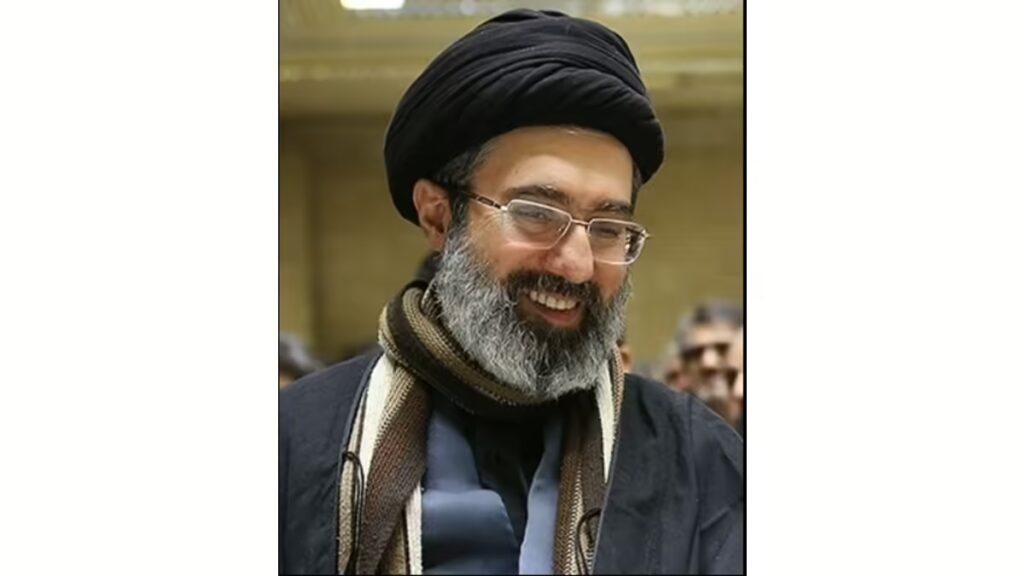
In a move that has shocked the region, Iran announced Mojtaba Khamenei, son of the late Supreme Leader Ali Khamenei, as the country’s new Supreme Leader on Sunday.
The appointment, confirmed by Iran’s 88-member Assembly of Experts, came amid ongoing violence in the Middle East and signals a hardline shift in the nation’s leadership.
Large crowds in Tehran celebrated the announcement, waving Iranian flags and chanting, “Allahu Akbar, Khamenei Rahbar” (“God is great, Khamenei is the leader”).
Early reports indicate the new leader’s appointment was heavily influenced by the Iranian Revolutionary Guard Corps (IRGC), a powerful military and political institution.
Immediate Military Posture and Threats
Within hours of Mojtaba Khamenei’s succession, Iran escalated missile and drone attacks across the Gulf region.
Officials in Israel, Saudi Arabia, Kuwait, and the UAE reported new threats and interceptions.
In Israel, sirens sounded as Iranian strikes targeted energy infrastructure, just one day after Israeli air raids reportedly damaged Iranian oil reserves.
Ebrahim Zolfaghari, spokesperson for Iran’s central military command, warned that the country would respond decisively to any further attacks, emphasizing that oil prices above $200 per barrel could be a consequence if hostilities continue.


Escalation Across the Region
The conflict’s expansion was swift. Tehran experienced dramatic overnight strikes, igniting fires across the city and destroying multiple oil and fuel depots. Videos circulated showing huge fireballs over the skyline, while residents reported a persistent burning smell.
Israel’s Defense Forces claimed responsibility for targeting Abu al-Qassem Baba’iyan, head of Iran’s Military Office and Chief of Staff of Khatam al-Anbiya Central Headquarters. He is the latest senior Iranian military figure eliminated in Israeli operations.
Meanwhile, Saudi Arabia intercepted missiles and drones targeting Prince Sultan Air Base and Riyadh.
Bahrain accused Iran of indiscriminately hitting civilian sites, including a desalination plant, though water and electricity services reportedly remained operational.
Reports also emerged of attacks near Oman and Kuwait, illustrating the conflict’s rapid geographic spread.
A Controversial Succession
Mojtaba Khamenei’s rise breaks with Iran’s historical norms. Traditionally, the Supreme Leader role has avoided direct father-to-son succession. Ali Khamenei himself reportedly opposed Mojtaba’s candidacy, noting parallels to the hereditary rule of the Shah before the 1979 Revolution.
Despite his relative lack of political office, Mojtaba has long served as a behind-the-scenes power player, maintaining close ties with the IRGC and the Basij volunteer paramilitary force. He has also held stakes in significant investment holdings abroad, including properties in London, Switzerland, and the UAE.
International Reactions
The United States and Israel have both expressed concern over Mojtaba’s appointment. US President Donald Trump stated that the new leader would need approval from Washington to maintain legitimacy, while Israel pledged to neutralize any threats posed by the new regime.
Diplomatic personnel in Saudi Arabia were ordered to leave amid regional missile attacks, and ongoing violence has fueled fears of a broader Middle East escalation.
Impact and Consequences
- The appointment of Mojtaba Khamenei consolidates hardline control in Iran.
- Increased Iranian missile and drone activity is already straining regional security.
- Energy markets have reacted sharply, with oil prices spiking to levels unseen since 2022.
- Civilian infrastructure across multiple Gulf states faces significant risk.
- Diplomatic relations between the US, Israel, and Gulf nations may deteriorate further.
What’s Next?
- Heightened military alert in Israel, Saudi Arabia, Kuwait, Bahrain, and UAE.
- Potential new sanctions or military actions by international actors.
- Increased risk of targeted strikes against Iranian military leadership and assets.
- Escalation of regional oil market volatility, affecting global energy prices.
- Close monitoring of Iranian domestic stability under the new leadership.
Summary
Mojtaba Khamenei’s elevation as Iran’s Supreme Leader marks a decisive turn toward militarized governance, with immediate consequences for regional stability.
The announcement follows the decimation of Iran’s top brass in recent strikes, amplifying his influence and signaling an era of intensified conflict in the Middle East.
Neighboring states, along with the US and Israel, face an unpredictable and volatile security landscape as tensions escalate.
Bulleted Takeaways
- Mojtaba Khamenei appointed Supreme Leader of Iran, succeeding his father.
- Hardline Iranian factions celebrate, promising increased missile attacks.
- Tehran and multiple Gulf countries face immediate military threats.
- Israel and the US launch counter-strikes, targeting Iranian military officials.
- Regional oil prices surge, hitting $100 per barrel.
- Diplomatic missions in Saudi Arabia and neighboring states operate under high alert.
- Succession breaks traditional norms, consolidating IRGC influence.
- Global observers remain cautious of further Middle East escalation.
