
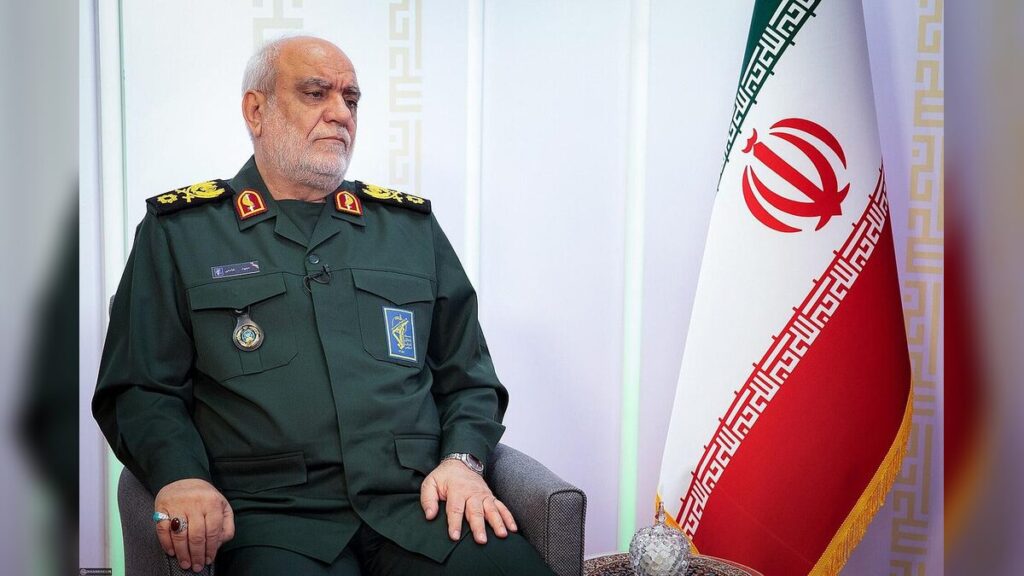
Tensions in the Middle East escalated sharply after Iran’s Islamic Revolutionary Guard Corps (IRGC) confirmed that its intelligence chief, Majid Khademi, was killed in an Israeli airstrike.
The killing marks another high-profile loss for Tehran as Israel continues a campaign targeting senior Iranian figures.
According to the IRGC, Khademi had served in the role since June last year after replacing Mohammed Kazemi, who was also killed in an earlier Israeli strike during the ongoing conflict.
Israel Expands Its Campaign Against Iranian Leadership
Israel has not only claimed responsibility for the strike but is also doubling down on its strategy.
Israeli Defence Minister Israel Katz has made clear that senior Iranian leaders are being actively targeted, warning that they will be pursued “one by one.”
Prime Minister Benjamin Netanyahu also described Khademi’s killing as a major blow to Iran’s internal security structure, stating that it “severs another central arm” of the regime’s operations.
Israel further claimed additional strikes eliminated other key figures linked to Iran’s external operations.
Wider Military Strikes Hit Tehran and Beyond
The latest wave of Israeli operations reportedly included airstrikes on three airports in Tehran.
Military officials said these sites were used by Iran’s elite Quds Force, the external operations arm of the IRGC.
Targets included runways, control towers, and a facility believed to manufacture drones.
Israel has described the attacks as part of a broader effort to dismantle what it calls “regime targets.”
Meanwhile, strikes have also extended to Lebanon.
In Beirut’s southern suburbs—an area linked to Hezbollah—Israeli forces carried out fresh bombardments after issuing evacuation warnings.
Lebanese authorities confirmed fatalities and injuries in earlier strikes on residential areas.
Iran Vows Resistance Amid Pressure and Deadlines
Tehran has responded defiantly to increasing international pressure.
Iranian officials have rejected any attempt to force deadlines in negotiations, especially as US President Donald Trump has threatened further action, including strikes on Iranian infrastructure if demands are not met.



Iran has also made it clear it will not agree to reopen the Strait of Hormuz—a critical global oil route—as part of any temporary ceasefire with the United States.
Officials insist they are not willing to negotiate under pressure.
Diplomatic Efforts Attempt to Halt the Conflict
Despite the intensifying violence, diplomatic efforts are underway.
Pakistan has reportedly presented a proposal known as the “Islamabad Accord,” which calls for an immediate ceasefire between Iran and its adversaries.
Under the proposal, the Strait of Hormuz would be reopened, and both sides would have 15 to 20 days to negotiate a broader peace settlement.
However, Iran has said it is still reviewing the plan and has not committed to any terms.
Regional Fallout and Civilian Impact
The conflict continues to affect civilians across the region.
In Israel, a missile strike narrowly missed a woman in the city of Petah Tikva, leaving her seriously injured but alive.
The footage of the incident has highlighted the close calls faced by civilians amid the ongoing attacks.
Elsewhere, Iranian-linked strikes have reportedly caused damage in Kuwait, where debris from intercepted missiles injured several people in residential areas.
Military bases in the region have also been targeted in escalating exchanges.
Global Ripples: Travel, Trade, and Energy Disruption
The war is also having wider economic consequences.
Airlines such as AirAsia X have begun cutting routes and increasing ticket prices due to rising fuel costs and instability in global air corridors.
The Strait of Hormuz, one of the world’s most important oil shipping lanes, remains at the center of the crisis.
Its partial or full closure has contributed to rising fuel prices and disruptions across international markets.
Impact and Consequences
The killing of Majid Khademi represents a significant escalation, intensifying direct confrontation between Israel and Iran.
It signals that high-ranking officials are now considered active targets, raising the stakes of the conflict dramatically.
The ongoing strikes are widening the war beyond Iran and Israel, pulling in neighboring countries like Lebanon and Kuwait, while also increasing risks to US forces and international shipping routes.
Economically, the instability is driving up oil prices, affecting global trade, and forcing airlines and businesses to adjust operations.
What’s Next?
Diplomatic efforts remain fragile, with the “Islamabad Accord” proposal offering a possible—but uncertain—path toward a ceasefire.
Much depends on whether Iran and its opponents can agree to temporary de-escalation terms.
At the same time, Israel appears committed to continuing targeted strikes, while Iran maintains its hardline stance on negotiations and regional leverage, particularly regarding the Strait of Hormuz.
The coming days are expected to be critical in determining whether the conflict expands further or moves toward a temporary pause.
Summary
The killing of Iran’s IRGC intelligence chief has deepened an already volatile conflict, with Israel escalating its targeted strikes and Iran refusing to yield on key demands.
While diplomatic proposals are being explored, military actions continue to shape the trajectory of the war, leaving the region on edge and the global economy increasingly affected.
Bulleted Takeaways
- IRGC confirmed the death of intelligence chief Majid Khademi in an Israeli airstrike
- Israel says it is targeting senior Iranian officials “one by one”
- Strikes have expanded to Tehran, Beirut, and other strategic locations
- Iran refuses to reopen the Strait of Hormuz under pressure
- Diplomatic “Islamabad Accord” proposal seeks ceasefire but remains uncertain
- Civilian injuries reported in Israel, Kuwait, and Lebanon
- Global travel and oil markets are being disrupted by the conflict
- The war is intensifying with no clear end in sight
