
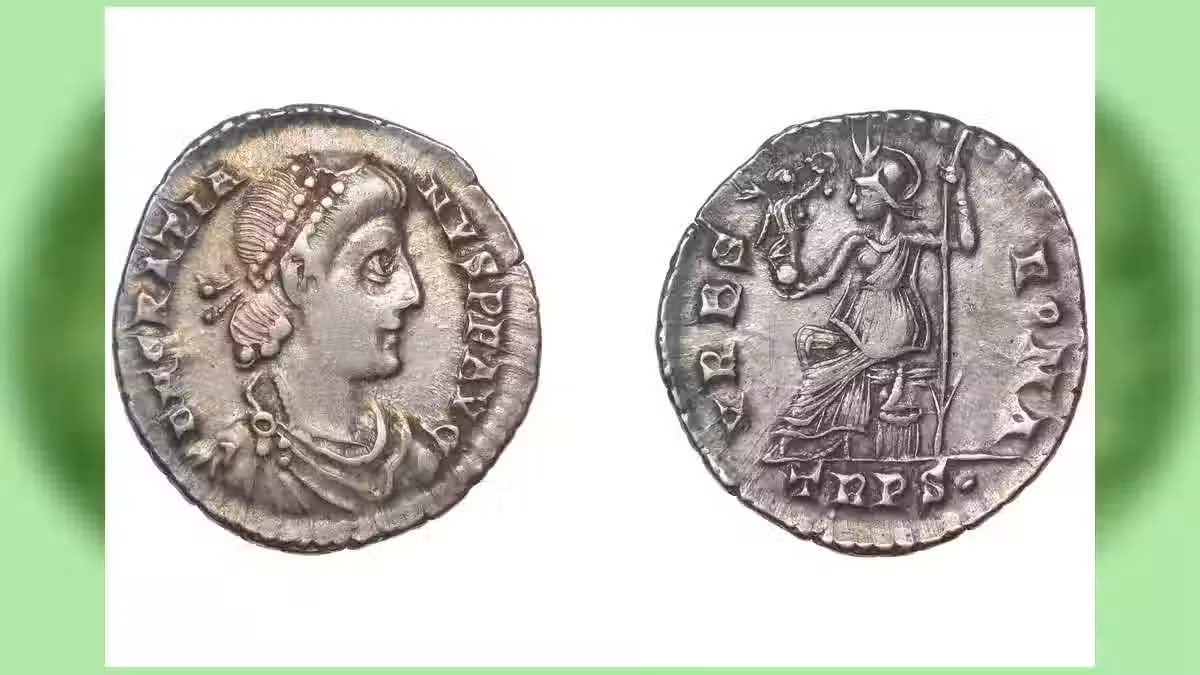
A collection of Roman silver coins buried for more than 1,500 years has sold for £23,240 at auction, more than its original estimate, following its discovery during road construction in Kent.
The treasure, known as the Springhead Hoard, was uncovered in 1964 when workers widening the A2 came across the ancient coins.
The collection is believed to have been buried around AD 388, during a period marked by raids and rebellions in the Roman Empire. Its owner is thought to have disappeared without returning to recover the valuables.
A total of 447 coins were eventually recovered, with volunteers from the Gravesend Historical Society playing a significant role in the search.
Historical Society Members Recall the Discovery
Alan Ridgers and Victor Smith, believed to be the last surviving members of the society involved in recovering the coins, have recalled the work that followed the initial discovery.
Smith described how volunteers searched the ground on their knees, moving in parallel lines marked out with strings while large earth-moving machines operated nearby.
He said he was part of the final search line and found only two coins during the operation.
The collection remained in the possession of the local historical society for decades before the decision was made to sell part of it.




First 114 Coins Sell Above Auction Estimate
The first portion of the hoard, consisting of 114 silver siliquae, was sold by auction house Noonans on November 10.
The coins had been estimated to fetch £15,000, but competitive bidding pushed the final sale price to £23,240.
The remaining coins are expected to be offered for sale in spring 2027.
Among the coins included in the first auction were examples from the reigns of Magnus Maximus and Gratian, both rulers during the second half of the fourth century. Other pieces dated to the reign of Valentinian II.
Unusually Well-Preserved Roman Coins
Bradley Hopper, head of the coin department at Noonans, said the Springhead Hoard was particularly significant because the coins had remained together underground rather than being dispersed or damaged by agricultural activity.
He said many of the coins had remarkably fresh surfaces, with some retaining traces of their original shine.
The collection’s condition and historical origins contributed to its appeal among collectors.
Auction Proceeds to Support Local Historical Records
Money raised from the sale will be used to store, conserve and digitise the Gravesend Historical Society’s extensive archive.
The records include historical photographs, excavation documents and other archaeological material connected to the area’s past.
Richard Taylor, the society’s honorary secretary, said the coins were being allowed to circulate again after six decades.
He added that people purchasing the pieces would also be contributing towards the preservation of Gravesend’s history for future generations.

