
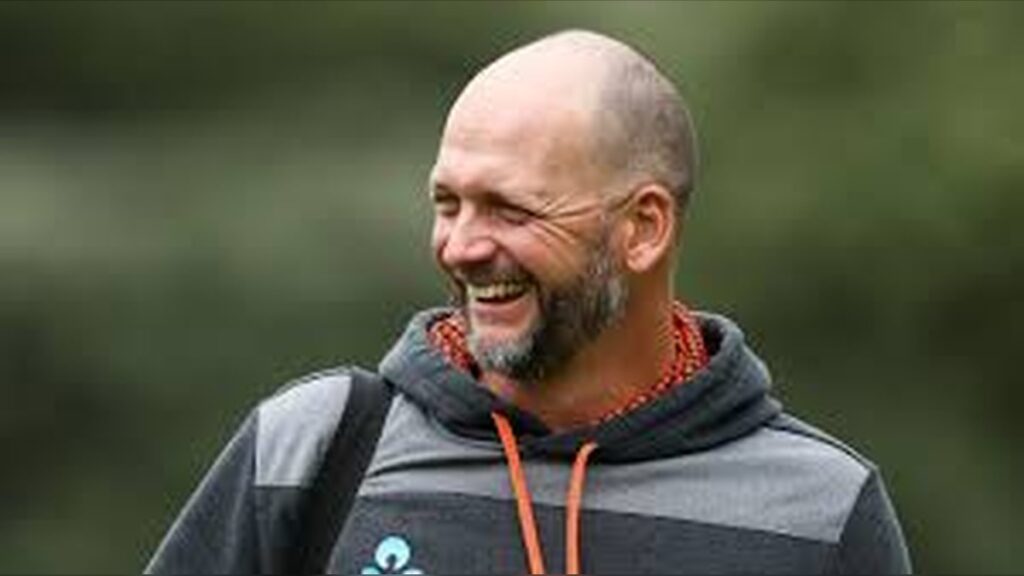
A former New Zealand bowling mentor has cautioned England about the danger posed by a young fast bowler he describes with a chilling nickname, warning that facing him can quickly turn uncomfortable for even the most experienced batters.
Shane Jurgensen, who spent two separate spells shaping the Black Caps’ bowling attack over a decade, believes England could be drawn into a physical and psychological battle if they underestimate rising seamer Will O’Rourke.
Now working as head coach of Wellington and on secondment as a bowling consultant with Gloucestershire, Jurgensen drew on years of experience developing elite pace attacks to explain why O’Rourke stands out as a uniquely difficult opponent.
The Rise of a Bowler Known as “Nasty”
Jurgensen has given O’Rourke an uncompromising nickname—“Nasty”—not as a criticism of character, but as a reflection of the discomfort he can generate with the ball in hand.
He describes the 6ft 5in pacer as a “gentle giant” off the field, but insists his on-field presence is far more intimidating, especially on lively pitches.
According to Jurgensen, the reaction from domestic batters facing O’Rourke in Wellington has often been immediate surprise at the steep bounce and aggressive carry he generates.
The coach explained that his pace, combined with a high release point and awkward angle, makes him particularly difficult to line up, even before factoring in his natural movement through the air.
A Rare Blend of Bounce, Pace and Angle
O’Rourke’s bowling threat, Jurgensen says, lies in a combination of attributes rather than a single standout skill.
His height allows him to release the ball from an unusually steep angle, meaning the ball climbs quickly off the pitch and often follows the batter in a visually unsettling trajectory.
He also brings in movement towards right-handed batters while maintaining high speed, creating a dual challenge of lateral movement and bounce.
That combination, Jurgensen argues, is what made him especially effective during New Zealand’s strong Test performances abroad, including a dominant series against India.
Breakthrough Performances and Setbacks
One of O’Rourke’s most notable contributions came during New Zealand’s series win in India, where the team achieved a rare 3–0 Test victory.
In the opening match in Bengaluru, India were dismissed for just 46, their lowest-ever home Test total, with O’Rourke playing a significant role by taking seven wickets.




Across his early Test career, the young bowler has taken 39 wickets in 11 matches, including a productive series against England at home, where he claimed 10 wickets across three Tests.
However, his progress has been slowed by recurring back problems, limiting his appearances and preventing sustained continuity at international level.
He has also been carefully managed in domestic cricket, including restricted County Championship involvement with Yorkshire.
New Zealand’s Managing of a Fragile Fast-Bowling Unit
O’Rourke is part of a wider group of New Zealand pacers whose workloads are being carefully monitored due to injury concerns, particularly stress-related back issues.
He has often been mentioned alongside fellow fast bowler Kyle Jamieson, another towering seamer who has faced similar physical setbacks.
Despite these challenges, New Zealand’s pace group—also featuring Matt Henry—remains central to their Test strategy, especially as players return from franchise commitments such as the Indian Premier League.
The Jurgensen Blueprint for Fast-Bowling Success
During his time with New Zealand cricket between 2008–2010 and 2016–2023, Jurgensen played a central role in building one of the most consistent Test bowling units in world cricket.
That era featured the highly successful trio of Tim Southee, Trent Boult, and Neil Wagner, who collectively formed a cornerstone of the Black Caps’ rise to becoming World Test Champions.
Jurgensen’s approach emphasized rotation, physical conditioning, and tactical adaptability—methods that allowed New Zealand to remain competitive across varying conditions and formats.
Building a Relentless Bowling Culture
Central to that success was a training culture that blended structure with competitive freedom.
Players often trained in shared environments where batters and bowlers would openly exchange tactical insights.
Figures such as Kane Williamson and Colin de Grandhomme were part of informal but intense sessions around Mount Maunganui, where competitive net battles mirrored match situations.
Jurgensen recalled how bowlers and batters would break down techniques in detail—discussing angles, lengths, and movement patterns with unusual specificity for training environments.
He also described improvised “backyard” style sessions at Bay Oval, where gym work and net practice blended into highly competitive mini-encounters designed to sharpen skills under pressure.
A System Built on Communication and Detail
One example highlighted by Jurgensen involved swing bowling discussions between Boult and Williamson, where subtle adjustments in release angle and seam movement were debated and refined in real time.
Rather than rigid coaching instructions, the environment encouraged players to collaborate on solutions, creating a shared understanding of what worked in different conditions.
That philosophy, he argues, helped New Zealand consistently develop bowlers capable of adapting quickly to international demands.
England Warned of a New-Type Challenge
With O’Rourke now emerging as part of New Zealand’s next generation of fast bowlers, Jurgensen believes England could soon face a more unpredictable and physically testing opponent than they expect.
While injuries have interrupted his progress, his underlying skill set and physical presence make him, in Jurgensen’s words, a bowler who can make batters instantly uncomfortable—especially in conditions that offer bounce and movement.

