
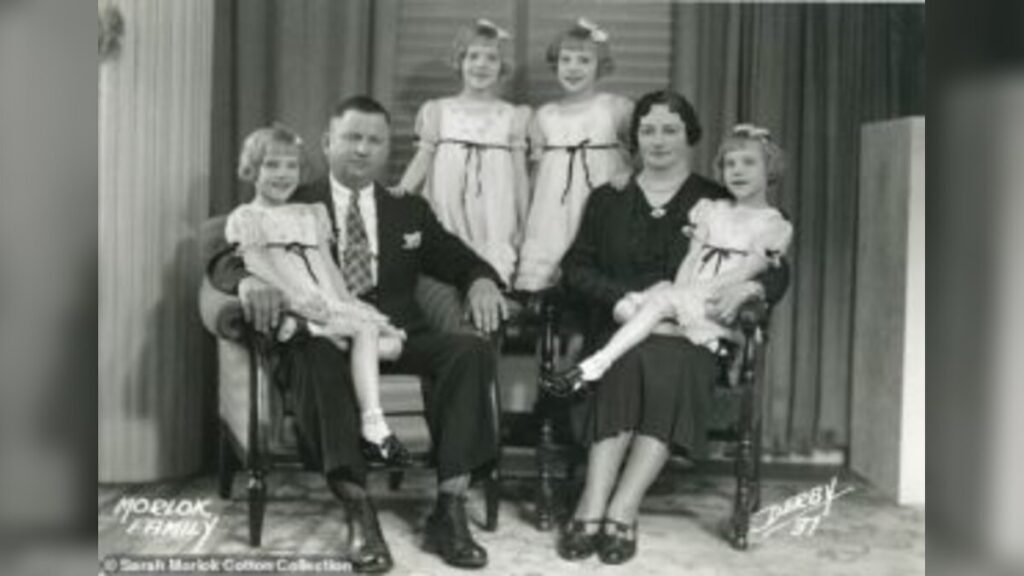
Long before modern scans and viral headlines, a remarkable birth in Lansing captured global attention.
On May 19, 1930, four identical baby girls arrived from a single egg—something so rare at the time it was treated as a medical marvel.
They didn’t even have names at first. Just “baby A,” “baby B,” “baby C,” and “baby D.”
But within days, their story had spread far beyond Michigan.
In the middle of the Great Depression, people were desperate for hope—and these four newborns became exactly that.
Fame Came Before They Could Walk
Their parents, Carl and Sadie, were suddenly at the center of a media frenzy.
What began as curiosity quickly turned into obsession.
Crowds gathered outside their home just to catch a glimpse of the babies.
A naming contest organized by a local newspaper brought in thousands of entries.
Eventually, the girls were named Edna, Wilma, Sarah, and Helen—each initial reflecting the hospital where they were born.
Businesses donated gifts, strangers opened bank accounts for them, and the city even stepped in to provide the family with a larger home. It seemed like a fairytale start.
But that illusion didn’t last.
A Home That Hid Something Dark
Behind the cheerful headlines, something far more disturbing was taking shape.
Their father, Carl, began turning their fame into profit—charging visitors a fee to see his daughters.
At first, it might have seemed like harmless opportunism.
But it quickly became clear that control—not care—was driving his actions.
After a near-kidnapping attempt early in the girls’ lives, Carl became obsessively protective, patrolling the house with weapons.
Yet this “protection” masked a deeper, more troubling reality—he was controlling every aspect of their existence.
Control Disguised as Parenting
As the girls grew older, their lives became tightly regulated.
Carl imposed strict rules: no friends, no social outings, no relationships, no independence.
Even basic freedoms most children take for granted were denied.
He pushed them into performing as a group, dressing alike and touring as entertainers while still very young. On stage, they were charming and synchronized.
Off stage, they were isolated and watched constantly.




The control extended into deeply personal boundaries. Privacy didn’t exist in their home.
Their father monitored their movements, decisions, and even their bodies with disturbing intensity.
The Psychological Toll Becomes Clear
By early adulthood, the emotional damage had taken hold.
Three of the sisters—Edna, Wilma, and Helen—began struggling with severe mental health issues and were eventually diagnosed with Schizophrenia.
They spent years moving in and out of psychiatric institutions, undergoing treatments that were common at the time but are now widely questioned.
Their condition also drew the attention of researchers.
A major study conducted in the 1950s followed their lives closely, attempting to understand the balance between genetics and environment in mental illness.
While the research was extensive, it failed to answer a simple question: what had these women actually endured?
Science Studied Them—But Didn’t Hear Them
For years, the sisters were treated as subjects rather than people.
They underwent repeated testing—spinal procedures, bloodwork, psychological evaluations—but their personal experiences were largely overlooked.
Researchers debated nature versus nurture, but for many observers, the answer seemed painfully obvious: a harsh environment had left lasting scars.
Their story became a case study, but not necessarily a story of healing.
One Sister Finds a Different Path
Amid the turmoil, one sister managed to carve out a different life.
Sarah, the last surviving of the four, eventually found some independence after their father’s death in 1957.
She built a modest career, got married, and had children—something her father had forbidden.
While her life was far from perfect, it was her own.
Years later, she reflected on her upbringing in a memoir, offering glimpses—but never the full depth—of what she had endured.
A Legacy That Refuses to Fade
The other sisters spent much of their lives institutionalized, passing away years before Sarah.
Yet the story didn’t end with them.
Even into the late 20th century, researchers revisited their case, continuing to analyze their lives long after the damage had been done.
Sarah herself lived into her 90s, carrying memories that she rarely fully shared.
Her passing marked the end of a chapter—but not the end of the questions surrounding their lives.
Impact and Consequences
The story of these quadruplets highlights the dangers of unchecked authority within families and the consequences of turning human lives into spectacle.
It also exposes how early scientific research often prioritized data over dignity.
The sisters were examined, tested, and documented—but rarely truly understood.
Their lives became a powerful example in discussions around mental health, ethics in research, and the long-term effects of childhood trauma.
What’s Next?
Today, stories like this are being revisited with a more critical lens.
Historians, psychologists, and writers are re-examining past cases to better understand how environment shapes mental health.
There’s also growing awareness about the ethical treatment of vulnerable individuals—both in families and in research settings.
As more personal accounts surface, the focus is shifting from analysis to empathy.
Summary
What began as a celebrated medical phenomenon quickly turned into a deeply troubling story of control, exploitation, and psychological harm.
The four sisters who once symbolized hope became victims of a rigid and oppressive environment.
While one found a measure of freedom, the others spent their lives battling the consequences of their upbringing.
Their story remains a sobering reminder that not all miracles come without a cost.
Bulleted Takeaways
- Four identical sisters born in 1930 became an international sensation
- Their early fame quickly turned into exploitation within their own home
- Their father imposed extreme control over every aspect of their lives
- Three of the sisters were diagnosed with schizophrenia and institutionalized
- Their lives became the subject of major psychological research studies
- One sister, Sarah, eventually found some independence after their father’s death
- Their story highlights the lasting impact of trauma and ethical concerns in research
- The legacy continues to shape conversations around mental health and human dignity

