
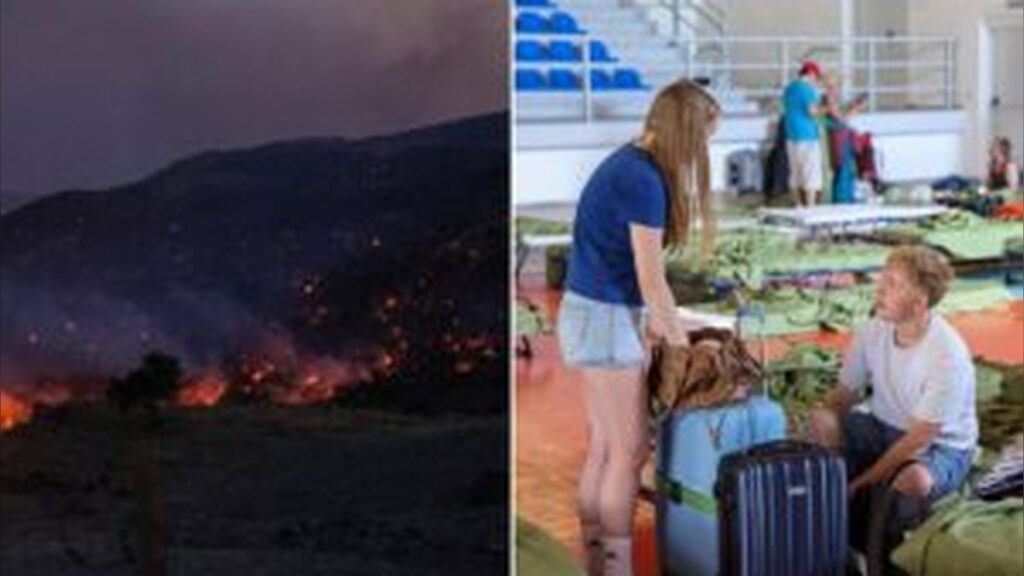
Deadly wildfires sweeping across southern Europe have forced thousands of people to flee their homes and holiday destinations, with Greece emerging as one of the hardest-hit countries.
Powerful winds, extreme heat and prolonged dry conditions have turned several regions into disaster zones, stretching emergency services as fires continue to spread.
Thousands Evacuated After Fires Threaten Greek Communities
Authorities in Greece ordered the evacuation of around 8,000 people from the resort village of Agia Galini on the island of Crete after flames advanced dangerously close to residential areas.
The fire, which erupted on Wednesday, changed direction as strong winds intensified, allowing residents to escape but leaving widespread destruction in its wake.
Officials say homes, agricultural buildings and livestock have likely been lost, although the full extent of the damage remains unclear because firefighters are still battling the blaze. Local authorities described the unfolding disaster as one of the darkest days the region has experienced.
Firefighters Lose Their Lives on the Front Line
The emergency response has come at a tragic cost.
Two firefighters lost their lives after becoming trapped on a mountain road near the village of Krya Vrysi while attempting to contain the fast-moving flames.
Elsewhere in Greece, another firefighter died after collapsing while responding to a separate wildfire near Gytheio in the Peloponnese, highlighting the immense dangers faced by emergency crews working in extreme weather conditions.
Ferocious Winds Hamper Firefighting Operations
More than 200 firefighters supported by dozens of fire engines have been deployed in the Rethymno region of Crete.
However, wind gusts exceeding 100 kilometres per hour have severely limited aerial firefighting efforts, preventing aircraft from effectively collecting seawater for water drops.



Officials say the fire front now stretches more than 15 kilometres, although they insist that populated areas are not currently facing an immediate threat.
Coastguard vessels remain stationed nearby to assist with further evacuations if conditions worsen.
Greek Government Issues Fresh Fire Warnings
Prime Minister Kyriakos Mitsotakis paid tribute to the firefighters who died while protecting communities, praising emergency workers and volunteers confronting increasingly destructive wildfire seasons.
The Greek Civil Protection Ministry has also placed several regions, including Crete, Athens, parts of the Peloponnese and much of the Aegean islands, under near-maximum wildfire alert as weather experts warn that powerful winds are expected to continue.
Wildfires Spread Across Popular European Destinations
The wildfire emergency extends well beyond Greece.
In Germany, emergency crews responded to a new blaze in the Chiemgau Alps, where hundreds of firefighters and rescue personnel were deployed while residents were advised to stay indoors and keep windows closed due to smoke.
Spain is also experiencing one of its worst wildfire seasons on record, with more than 207,000 hectares burned between January and July.
Massive fires near Madrid and in neighbouring provinces forced tens of thousands of people to evacuate, although many have since returned home.
Prime Minister Pedro Sanchez said firefighters had made encouraging progress but warned that the situation remained delicate.
France and Turkey Continue Massive Firefighting Efforts
France has recorded a record area of land destroyed by wildfires this year, with tens of thousands of hectares burned.
While officials reported improving conditions around Bordeaux, fresh fires erupted near the Mediterranean coast and in Burgundy, prompting new evacuations.
Turkey is facing multiple wildfires near its southern tourist destinations. Hundreds of firefighters, aircraft and helicopters have been deployed as fires spread from farmland into forests.
Authorities evacuated residents and hospital patients, while road closures and access restrictions were imposed around affected tourist areas.
Greek Islands Remain Under Pressure
The wildfire threat has also intensified on the Greek island of Paros, where authorities evacuated nine villages after flames spread rapidly through mountainous terrain.
Residents were directed towards beaches and safer communities as firefighters, helicopters and water-bombing aircraft worked continuously to contain the blaze.
Officials say strong winds have complicated rescue efforts, with some residents initially refusing to leave because they wanted to remain with their animals.

