
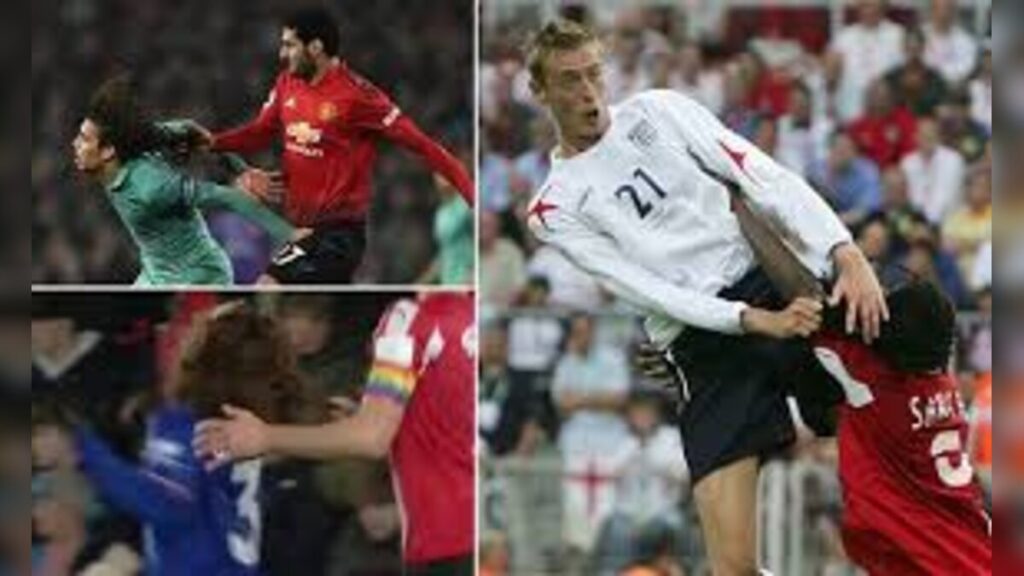
Football rarely runs short of controversy, but the latest flashpoint came during a heated FA Cup semi-final between Leeds and Chelsea at Wembley Stadium.
The spotlight landed on Dominic Calvert-Lewin after a moment involving Marc Cucurella that has since divided opinion across the Premier League fanbase.
In the first half, Calvert-Lewin appeared to grab Cucurella’s hair during a challenge.
The Chelsea defender went down immediately, prompting a VAR review.
After a brief check, play continued with no card issued.
That decision alone would have been enough to raise eyebrows. But context made it explode.
The Martinez Incident Still Haunts the Debate
Just weeks earlier, Lisandro Martínez had been sent off in a match against Leeds for a very similar-looking incident involving Calvert-Lewin.
That red card, issued after VAR intervention, had already stirred strong opinions about how strictly “hair-pulling” incidents are judged in modern football.
So when Calvert-Lewin escaped punishment in the FA Cup semi-final, fans immediately connected the dots—and not in a calm way.
Social Media Reacts: “Make It Make Sense”
Online reaction was instant and emotional.
Many supporters questioned how two seemingly similar actions could lead to completely different outcomes.
Some argued Martínez was harshly punished. Others insisted Calvert-Lewin should have faced at least a yellow card.
The inconsistency, more than the incidents themselves, became the main source of frustration.
A smaller group pushed back, saying VAR had already determined there was no clear contact in the Chelsea incident, suggesting the comparison was unfair.
What the Laws Actually Say About Hair Pulling
Interestingly, hair pulling is not separately defined in the official Laws of the Game.
Instead, it falls under the broader category of “violent conduct,” which gives referees wide discretion.




That flexibility is part of the problem.
Because decisions depend heavily on interpretation, VAR officials and referees can arrive at different conclusions for similar incidents—especially when slowed-down footage exaggerates contact.
It’s a grey area that continues to fuel debate season after season.
Old Trafford Red Card Still Fuels the Argument
The earlier controversy at Old Trafford remains central to this discussion.
In that match, Martínez’s dismissal came after VAR official John Brooks advised referee Paul Tierney to review the incident, leading to a straight red card.
The decision had a direct impact on the game, which Leeds went on to win 2–1, intensifying frustration from Manchester United’s side.
Managers and Pundits Clash Over Fairness
Manchester United boss Michael Carrick was furious after that match, describing the decision as one of the harshest he had ever seen.
He argued that the contact was accidental and exaggerated by VAR scrutiny.
Former midfielder Roy Keane, however, offered a different view in television analysis.
While acknowledging the decision felt harsh, he stressed that teams must adapt to VAR decisions, even when they don’t agree with them.
That contrast reflects the wider divide in how modern football interprets officiating consistency.
Why This Keeps Happening in Big Matches
Part of the issue is how VAR reshapes moments that happen in real time.
What looks minor at full speed can appear dramatic when slowed down frame by frame.
That distortion often leads to different interpretations between matches, referees, and competitions.
And in high-stakes games like FA Cup semi-finals, even small inconsistencies feel amplified.
Impact and Consequences
The immediate consequence is growing frustration among fans, who increasingly feel VAR lacks consistency in similar disciplinary situations.
For players, it creates uncertainty—what is a red card in one match might not even be a foul in another.
For referees, the pressure increases with every replay, especially when social media compares incidents side by side within minutes of them happening.
Long-term, repeated controversies like this risk damaging confidence in officiating standards.
What’s next?
Expect continued scrutiny of VAR protocols, especially around subjective offences like violent conduct.
Football authorities may eventually be pushed to clarify how contact-based incidents such as hair pulling should be judged to avoid repeated inconsistency.
There is also growing pressure for clearer guidelines so referees apply the same threshold across all competitions, rather than relying heavily on interpretation.
Summary
A disputed hair-pulling incident involving Dominic Calvert-Lewin and Marc Cucurella has reignited debate over VAR consistency, especially when compared to Lisandro Martínez’s earlier red card for a similar offence.
The controversy highlights ongoing uncertainty in how “violent conduct” is interpreted in modern football.
Bulleted Takeaways
- Dominic Calvert-Lewin avoided punishment after a hair-pull incident vs Chelsea at Wembley
- Lisandro Martínez was previously sent off for a similar incident involving Calvert-Lewin
- Fans and pundits are divided over perceived VAR inconsistency
- Hair pulling is judged under “violent conduct” but not explicitly defined in detail
- Manchester United’s earlier red card against Martínez remains a key reference point
- Michael Carrick criticised that earlier decision as overly harsh
- Roy Keane defended VAR consistency, saying teams must accept rulings
- Debate continues over whether refereeing standards are applied consistently in big matches

