
Banyana Banyana’s achievements have increasingly highlighted the gap between the performance of South Africa’s senior women’s national team and the structures supporting women’s football at grassroots level.
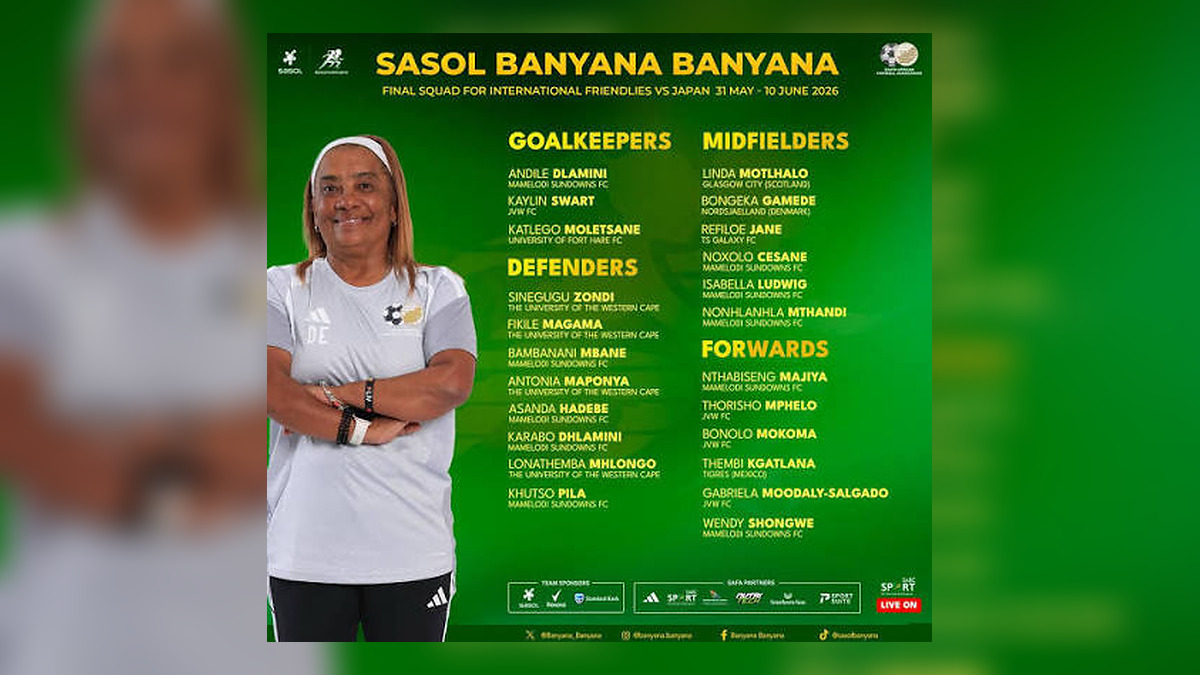
Coach Dr Desiree Ellis raised that issue while announcing her squad for the Olympic qualifying assignment against Madagascar, arguing that the national team needs a stronger domestic foundation if it is to continue progressing.
Her comments came as attention around South African football has largely centred on Bafana Bafana, particularly after their recent international campaign. For Ellis, however, the achievements of Banyana should also prompt a closer examination of what is happening below the national-team level.
Ellis Wants Development to Start at the Bottom
Speaking at SAFA House on 25 September, Ellis highlighted the need to develop women’s football from schools and grassroots structures upwards.
She identified the domestic league as an important part of that process because it remains one of the main sources of players for Banyana Banyana.
The coach nevertheless acknowledged that the league still has considerable room for improvement.
“We are not where we want to be with our league,” Ellis said, while also describing recent developments as a move in the right direction.
Her assessment points to a broader challenge: producing an internationally competitive national team requires a reliable pathway for young players to enter, develop and eventually compete for places at the highest level.
The Women’s League Faces a New Test
Changes planned for the domestic women’s league are expected to alter the competition structure from 2027.
According to SAFA, the Women’s Super League will adopt a new format, with teams divided into two streams and each side scheduled to play 14 matches.
Ellis questioned whether that structure would provide enough competitive football for players aspiring to reach the national team.
The issue is particularly important for Banyana because domestic competition provides the coaching staff with a regular pool from which to assess potential international players.
A stronger league could therefore have implications well beyond club football, potentially influencing the depth and consistency available to the national side.




Schools Could Hold the Key to Long-Term Growth
Ellis also pointed to school football as another area requiring greater attention.
Developing the women’s game at school level can create an earlier pathway into organised football, allowing talented players to receive coaching and competitive experience before reaching senior competitions.
The coach also highlighted the need for stronger structures around referees and other football officials.
For women’s football to grow sustainably, the requirement is not limited to producing more players. Coaching, refereeing, administration, facilities and competition structures all need to develop alongside the athletes.
Banyana Have Already Produced Major Results
The call for greater investment comes despite a record of significant achievements by Banyana Banyana.
South Africa won the Women’s Africa Cup of Nations in 2022, defeating hosts Morocco 2-1 in the final. The triumph marked the country’s first WAFCON title and secured qualification for the 2023 FIFA Women’s World Cup.
At the 2023 World Cup, Banyana progressed beyond the group stage and reached the last 16.
The team has also remained a major force in African women’s football, reaching the latter stages of successive continental competitions.
Those results have helped strengthen the case for greater attention to the structures supporting the women’s game.
Success Despite Structural Challenges
Ellis’s argument is essentially that Banyana’s international results should not obscure the limitations within the domestic system.
The national team has been able to compete against some of the strongest sides in Africa and establish itself as a regular presence at major international tournaments.
But maintaining that progress requires a steady supply of players capable of replacing established stars.
That is where grassroots football, schools and the domestic league become particularly important. Without a sufficiently broad development pipeline, the national team risks depending too heavily on a relatively small pool of experienced players.
World Cup Qualification Still Provides Another Target
Banyana’s immediate ambitions also extend beyond the Olympic qualification programme.
South Africa is set to compete in the FIFA Women’s World Cup 2027 play-off tournament, where Chinese Taipei, Ecuador, Papua New Guinea and Uzbekistan are among the teams involved in the preliminary phase. FIFA says each team in that phase will play three matches, with the leading sides progressing to the final phase in February.
The tournament provides another opportunity for Banyana to reach the global stage, but it also underlines the need for continued player development at home.
The Challenge Is Bigger Than One National Team
The debate surrounding Banyana Banyana is therefore not simply about whether the senior side can win more matches.
It is about whether South Africa can build a women’s football system capable of producing high-level players consistently over many years.
Ellis has made clear that progress at international level needs to be matched by development beneath the national team.
For Banyana, the achievements have already demonstrated what is possible. The next challenge is creating the domestic structures, school programmes, competitions and officials needed to ensure those achievements can be sustained by the generations that follow.

