
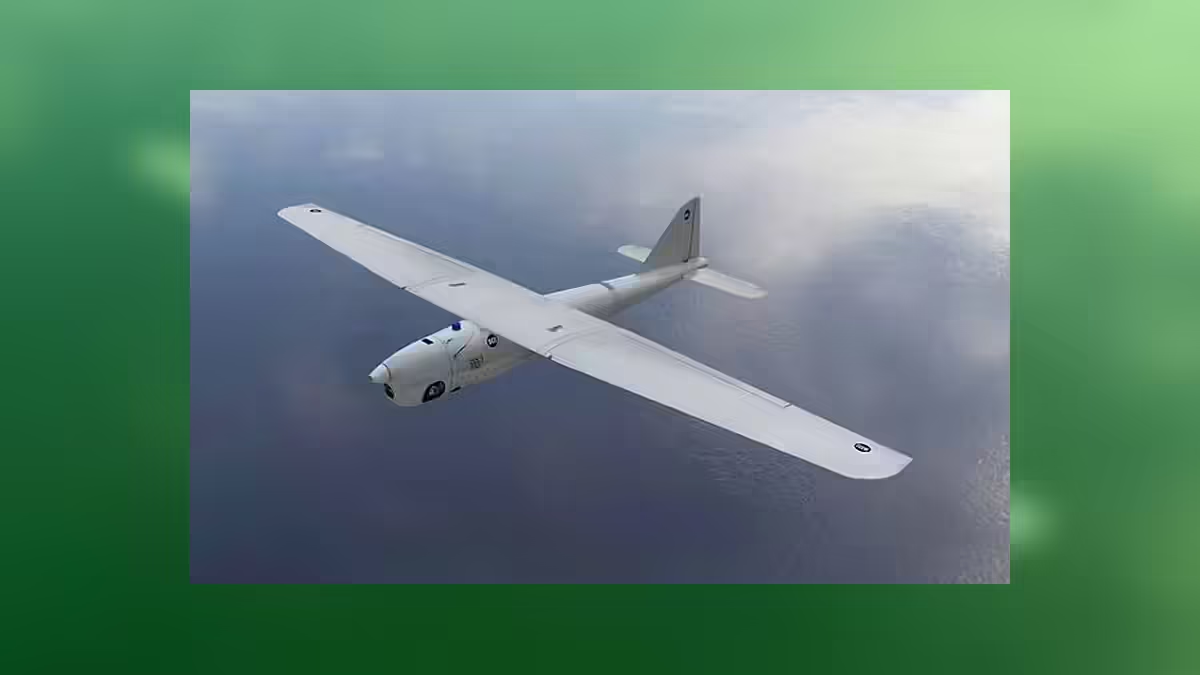
Britain is confronting a sharp rise in reported drone activity around nuclear facilities and other sensitive defence locations, with figures cited by the Ministry of Defence showing 100 sightings involving nuclear sites or nuclear-related assets between January and August 2026.
The reported total has already surpassed the figures recorded across the entirety of each of the previous two years, intensifying debate over whether some of the aircraft could be conducting hostile surveillance of critical British infrastructure.
UK Records 100 Drone Sightings Around Nuclear Assets
According to figures provided by the Ministry of Defence to the Mail on Sunday, 100 drone sightings were reported over nuclear facilities or nuclear-related objects, including submarines, during the first eight months of 2026.
That works out at roughly three reported incidents every week.
The figure compares with 69 incidents during all of 2025 and 47 in 2024. In 2020, the reported number stood at just 18.
The broader trend is consistent with official MOD figures showing a substantial increase in drone activity near British military installations. The government said 266 uncrewed aerial vehicle incidents were reported near defence sites during 2025, more than double the 126 recorded in 2024.
Security Expert Points to Possible Russian Surveillance
Professor Anthony Glees, a security specialist at the University of Buckingham, argued that Russia should be considered a potential explanation for the increased activity.
He suggested drones could be gathering intelligence about British nuclear and defence facilities that might prove useful during a future conflict.
However, the figures themselves do not establish who operated the drones, and no public evidence accompanying the statistics identifies Russia as responsible for the 2026 incidents.
Glees also raised China and Iran as other possible state actors that could have an interest in assessing Britain’s defensive capabilities.
Nuclear Bases Present Valuable Intelligence Targets
The sensitivity of the locations involved has heightened concerns about what unidentified drones could potentially observe.
Britain’s nuclear infrastructure includes facilities associated with its weapons programme, nuclear-powered submarines and civilian nuclear operations. HMNB Clyde, AWE Aldermaston and AWE Burghfield are among defence locations formally treated as particularly sensitive sites.
International Institute for Strategic Studies analysis has warned more broadly that unexplained drone flights around NATO nuclear infrastructure could serve several purposes, including monitoring security procedures, testing counter-drone systems or gathering detailed reconnaissance unavailable through conventional satellite imagery.
Hundreds of Drone Incidents Reported Near Defence Sites
The nuclear-related sightings form part of a significantly larger security problem.
According to the supplied figures, 340 drone security incidents were recorded at or close to Ministry of Defence sites across the UK in the period up to August 2026.
Military officials have declined to provide detailed breakdowns showing how many incidents occurred at individual categories of facilities or how many involved Scotland.
The government argues that releasing sufficiently detailed location information could create national-security risks.




That restriction is particularly relevant because Scotland hosts HMNB Clyde at Faslane, where Britain’s ballistic-missile submarines are based.
Previous Drone Activity Raised Alarm at US-Used British Bases
Concerns over unexplained drones around military facilities are not new.
RAF Lakenheath in Suffolk was among British bases where unusual drone activity was reported in November 2024. IISS analysis has subsequently highlighted Lakenheath while examining suspicious drone activity around nuclear-related NATO infrastructure.
The source material attributes a wider group of 2024 incidents involving Lakenheath, Mildenhall, Fairford and Feltwell to drones allegedly launched from a vessel described as the HAV Dolphin and linked to Russia.
Those specific allegations are not established by the official UK sources reviewed here, so responsibility for those incidents should not be treated as confirmed.
Fears Raised Over Drones Being Launched From Inside Britain
Glees also suggested that hostile states could potentially rely on individuals already inside the UK to operate drones.
He raised the possibility of paid agents rather than ideologically motivated supporters being recruited to launch aircraft near sensitive locations.
Again, that represents his assessment of how such operations could potentially be conducted rather than proof explaining the reported 2026 incidents.
The increasing availability and capability of commercial drones makes identifying operators particularly important because aircraft can potentially be launched from relatively short distances away.
Government Expands Restricted Airspace Around Defence Facilities
Britain has already responded to the broader drone threat by tightening restrictions around military installations.
New regulations that came into force in February 2026 prohibit unauthorised unmanned aircraft from flying over designated MOD facilities below specified altitudes, with the government explicitly citing national security as the reason for the restrictions.
The MOD also announced stronger powers allowing authorised defence personnel to defeat threatening drones around military sites without relying solely on police intervention.
Counter-Drone Technology Becomes Growing Defence Priority
The government has increasingly acknowledged that hostile drones present challenges extending beyond traditional military bases.
A UK Defence Innovation programme launched in 2026 specifically sought technology capable of countering drones used for surveillance and disruption around sensitive locations and critical national infrastructure.
Potential countermeasures can include detection systems, electronic interference and other technologies designed to stop unauthorised aircraft while limiting risks to surrounding areas.
The MOD said earlier this year that automated tracking and detection technology was already operating at multiple military sites to provide round-the-clock surveillance.
Experts Call for Tougher Response to Suspected Hostile Drones
Glees has argued that Britain should adopt a much more forceful approach if evidence establishes that foreign vessels are deliberately launching surveillance drones against sensitive British facilities.
He also suggested greater use of physical barriers such as anti-drone nets and electronic jamming technology.
Any response against suspected foreign vessels would, however, involve significant legal, military and diplomatic considerations and would require reliable attribution of the activity.
Determining who controls an unidentified drone can itself be difficult, particularly when authorities recover neither the aircraft nor its operator.
MOD Says Hostile Drone Threat Is Being Taken Seriously
The Ministry of Defence says the changing threat posed by drones has become a major security priority.
Official figures released in February showed that reported incidents near defence sites more than doubled between 2024 and 2025, prompting new legal powers and increased investment in counter-drone capabilities.
The government has also described hostile uncrewed aircraft used for surveillance near sensitive sites and critical infrastructure as a growing challenge.
The latest reported nuclear-site figures deepen those concerns.
With 100 sightings involving nuclear facilities or assets reported in only eight months, the number has already exceeded the totals cited for both 2024 and 2025 — leaving British authorities facing mounting pressure to determine who is behind the flights and what they are attempting to achieve.
