
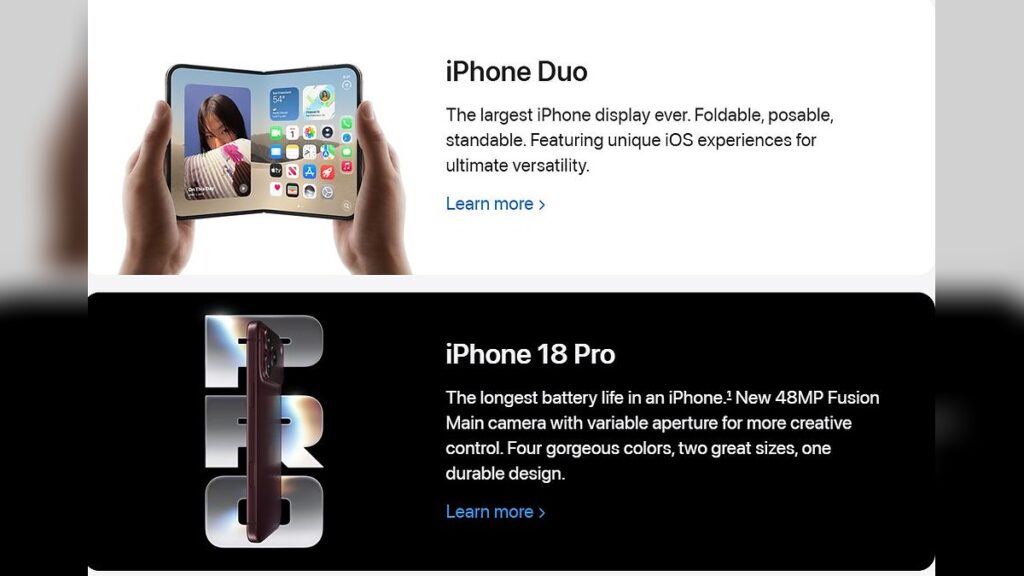
Apple has officially entered the foldable smartphone market with the unveiling of the iPhone Duo, marking the first time the company has introduced a folding device under its flagship iPhone brand.
The new smartphone was presented during an Apple event broadcast on the company’s website, introducing a substantially different form factor from the conventional iPhone designs that have defined the product line for years.
iPhone Duo Opens Horizontally Into a Wider Display
At the centre of the iPhone Duo’s design is a horizontal folding mechanism that allows the device to transform from a compact smartphone into a considerably wider screen.
When unfolded, the handset takes on proportions resembling a book or passport rather than the tall and narrow appearance commonly associated with many existing foldable smartphones.
The change gives the device characteristics closer to a small tablet, potentially expanding how users interact with applications, entertainment and productivity tools.
John Ternus Describes Device as More iPad-Like
Apple chief John Ternus highlighted the larger-screen experience during the presentation, describing the new foldable smartphone as more similar to an iPad when opened.
The approach suggests Apple is positioning the iPhone Duo as more than simply a traditional smartphone with a folding display. Instead, the device appears designed to bridge some of the functionality and viewing experience associated with the iPhone and iPad.
Asymmetrical Design Sets Folded iPhone Apart
The iPhone Duo also adopts an unusual physical appearance when closed. Apple has opted for an asymmetrical body rather than maintaining identical dimensions across the folded handset.




Its wider display has also forced the company to reconsider the positioning of some physical controls, with several functions relocated to the side of the device.
The design represents one of Apple’s most significant departures from the familiar rectangular iPhone format since the smartphone line was introduced.
Titanium Frame Helps Deliver Apple’s Thinnest Smartphone
Despite incorporating the additional engineering required for a folding mechanism, Apple says the iPhone Duo is its thinnest smartphone to date.
The handset features a titanium frame, combining a lightweight construction with the structural requirements of a device designed to be repeatedly opened and closed.
Achieving a thinner profile could prove particularly important for the Duo because foldable smartphones can become considerably thicker than conventional handsets when their two sections are closed together.
Face ID Dropped in Favour of Side Fingerprint Sensor
Another major change is the absence of Face ID, the facial-recognition system that has become standard across Apple’s premium smartphones.
Instead, Apple has placed a fingerprint scanner on the side of the iPhone Duo, giving users biometric authentication without relying on facial recognition.
The decision represents a notable shift in Apple’s authentication strategy for the new model and appears closely connected to the engineering demands and unconventional dimensions of the foldable design.
Foldable iPhone Opens a New Chapter for Apple
The arrival of the iPhone Duo brings Apple into a smartphone category that other manufacturers have been developing for several years.
Rather than simply adopting the established elongated foldable format, Apple has chosen a wider, book-like approach while introducing significant changes to familiar iPhone features, including biometric authentication and control placement.
With its titanium construction, ultra-thin profile and tablet-like unfolded display, the iPhone Duo represents Apple’s attempt to establish its own interpretation of what a foldable smartphone should look and feel like.
