
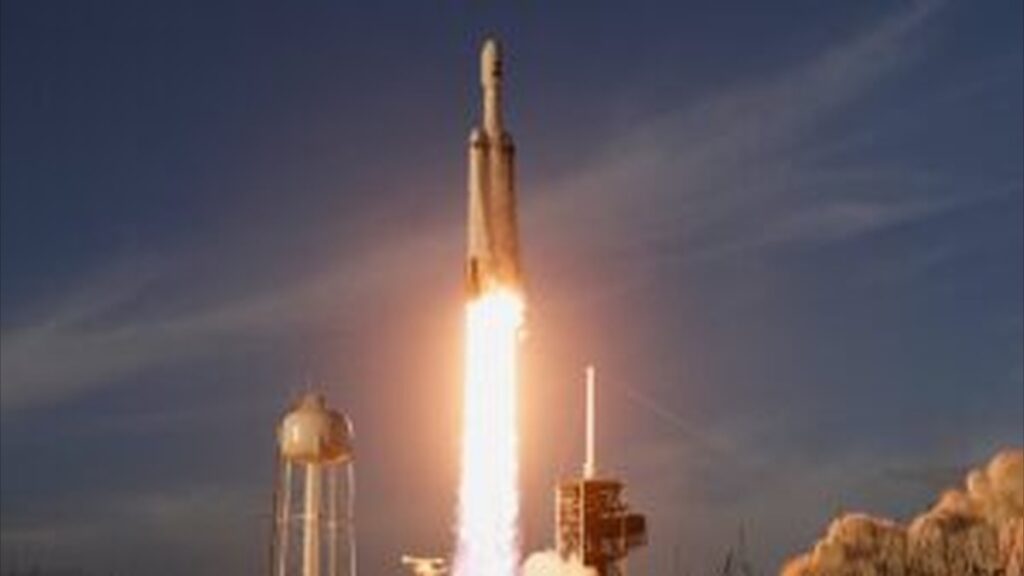
NASA has launched the Nancy Grace Roman Space Telescope, sending one of its most ambitious observatories into space on a mission that could reshape scientists’ understanding of the universe.
The telescope lifted off from Florida’s Kennedy Space Center at 7:26 a.m. aboard a SpaceX Falcon Heavy rocket.
Its journey marks the beginning of a multi-year campaign to survey enormous portions of the cosmos and investigate some of physics’ most difficult unanswered questions.
At more than 12 metres tall, the observatory represents more than a decade of development and an investment exceeding $4 billion.
A Telescope Named After a NASA Pioneer
The observatory is named after Nancy Grace Roman, the pioneering astronomer who played a major role in establishing NASA’s space astronomy programme and became widely known as the “Mother of Hubble.”
Roman is designed to complement, rather than replace, NASA’s Hubble Space Telescope and James Webb Space Telescope.
While Hubble transformed scientists’ understanding of the universe by revealing that its expansion was accelerating, the new observatory will take a much broader view of the cosmos.
US President Donald Trump described the mission as an important step in understanding the universe during remarks at NASA headquarters in Houston, Texas.
Roman Will Survey an Enormous Portion of the Sky
The telescope’s biggest advantage is its extraordinarily wide field of view.
Roman will be capable of observing an area of the sky more than 100 times wider than Hubble can capture in a single observation.
Its field of view will also be substantially broader than that of the James Webb Space Telescope.
Rather than focusing primarily on individual objects with extreme detail, Roman is designed to conduct enormous surveys, creating a vast astronomical catalogue from its position roughly 930,000 miles from Earth.
The spacecraft is expected to take about 100 days to reach its destination.
Scientists Expect an Unprecedented Cosmic Catalogue
One of Roman’s central goals will be to identify huge numbers of astronomical objects across the universe.
Researchers expect the telescope to find thousands of exoplanets and tens of thousands of supernovae, the dramatic explosions associated with the deaths of stars.
Dave Content, Roman’s technical manager, has described the mission as potentially producing the largest catalogue of astronomical objects ever assembled.
That information could help scientists determine how common planetary systems similar to our own may be and provide a much clearer picture of how galaxies and other structures have developed over cosmic time.
The Search for Dark Matter and Dark Energy
Beyond discovering distant planets and exploding stars, Roman has a much bigger scientific target: understanding what actually makes up the universe.
Dark matter and dark energy remain among the greatest mysteries in modern physics.
Scientists believe they collectively account for roughly 95 percent of the universe, yet their fundamental nature remains unknown.
Dark matter is thought to provide much of the gravitational structure that holds galaxies and larger cosmic formations together.
Dark energy, meanwhile, is associated with the accelerating expansion of the universe.
Roman’s observations could provide some of the most detailed evidence yet about how these phenomena have influenced the cosmos.
Infrared Vision Will Allow Roman to Look Into the Past
Roman will observe the universe primarily through infrared light, giving scientists another way to study objects that are extremely distant and faint.




Because light takes time to travel across space, observing distant galaxies effectively means looking into the universe’s past.
Roman will therefore allow researchers to investigate how cosmic structures evolved over billions of years and examine conditions that existed much earlier in the history of the universe.
The telescope’s wide-field observations could prove particularly valuable when combined with the more detailed observations made by other major space and ground-based observatories.
Roman Will Work Alongside Webb and Other Observatories
NASA does not intend for Roman to operate in isolation.
Its findings will complement the work of the James Webb Space Telescope, which can examine selected objects in considerably greater detail.
Roman’s broad surveys can identify interesting targets, while Webb and other observatories can then investigate those targets more closely.
Roman will also work alongside the Vera C. Rubin Observatory in Chile and the European Space Agency’s Euclid mission.
Together, these observatories are expected to provide scientists with complementary measurements of galaxies, stars, planets and the large-scale structure of the universe.
The Standard Model of the Universe Faces a Major Test
Perhaps the most consequential aspect of the mission is its potential to challenge existing theories.
Scientists have increasingly encountered observations that raise questions about whether current models fully explain the universe’s history and expansion.
Julie McEnery, Roman’s senior project scientist, said recent findings have raised the possibility that scientists’ existing picture of the early universe could be incomplete.
Roman is expected to provide measurements precise enough to determine whether the standard cosmological model continues to hold up or whether researchers need to consider fundamentally different explanations.
A Possible Scientific Surprise
Researchers are not simply looking for confirmation of what they already believe.
McEnery said she expects some of Roman’s most important discoveries could be completely unexpected.
Such findings could generate new questions and influence the direction of future space missions.
That possibility is one of the reasons scientists are particularly excited about the observatory.
A discovery that contradicts established assumptions could potentially be more scientifically valuable than one that simply confirms existing theories.
The Data Challenge Could Be Almost as Extraordinary
Roman’s scientific power comes with a major technological challenge: the sheer quantity of information it will produce.
The telescope is expected to generate approximately 1.3 terabytes of data every day.
That volume is so substantial that researchers say conventional personal computers will not be capable of simply downloading and handling the complete dataset.
Scientists and members of the public will nevertheless have access to Roman’s observations, opening the door to collaboration across the global astronomical community.
A New Map of the Universe Takes Shape
NASA administrator Jared Isaacman previously described Roman as a telescope capable of giving humanity a new atlas of the universe.
Its mission combines an enormous field of view with sensitive infrared observations, allowing scientists to investigate everything from distant planets and supernovae to the mysterious forces governing cosmic expansion.
The telescope’s value will ultimately depend not only on how much it observes, but on whether those observations expose weaknesses in humanity’s current understanding of the cosmos.
What’s Next?
Following its launch, Roman will spend roughly 100 days travelling to its operating position before preparations for its scientific programme can fully begin.
Scientists will then calibrate the observatory and its instruments before large-scale surveys get underway.
Once operational, researchers will begin processing the enormous volume of information generated by the telescope and combining it with observations from Webb, Rubin, Euclid and other facilities.
Impact and Consequences
The Roman Space Telescope could become one of the most important astronomical missions of the coming years if its observations uncover evidence that challenges existing cosmological theories.
Its wide-field surveys could dramatically expand the number of known exoplanets and supernovae while providing scientists with unprecedented data on the evolution of galaxies and the large-scale structure of the universe.
Most significantly, Roman could help determine whether current explanations for dark matter, dark energy and the universe’s expansion are fundamentally correct—or whether physics will need a major rethink.
Summary
NASA has launched the Nancy Grace Roman Space Telescope aboard a SpaceX Falcon Heavy, beginning a mission designed to create an unprecedented survey of the cosmos.
The more than $4 billion observatory will operate alongside Hubble, Webb, Rubin and ESA’s Euclid mission, combining wide-field observations with detailed studies of distant astronomical objects.
Roman is expected to discover thousands of exoplanets and tens of thousands of supernovae while investigating dark matter, dark energy and the evolution of the universe.
With the potential to generate about 1.3 terabytes of data each day, the mission will also create an enormous scientific resource.
For researchers, its greatest success may ultimately be an unexpected discovery that forces humanity to rethink how the universe works.

