
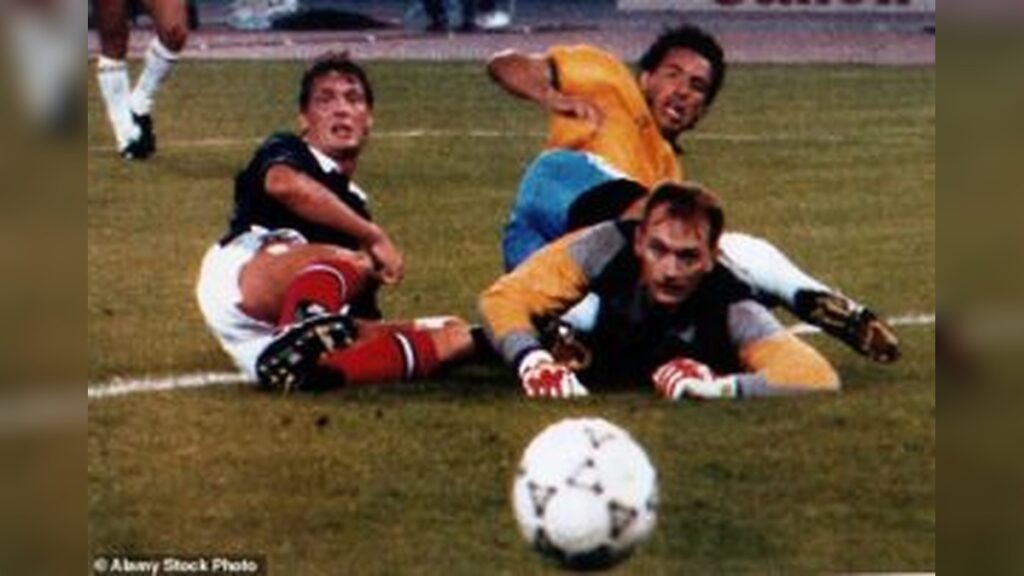
For decades, Scotland have chased a result that has continually slipped through their grasp whenever Brazil stood on the opposite side of the pitch.
While memorable encounters between the two nations have produced moments of drama, Scotland have never managed to defeat the five-time world champions on football’s biggest stage.
Yet according to South American football expert Tim Vickery, Scotland’s closest brush with victory over Brazil may never have happened on the field at all.
Instead, it emerged from a remarkable debate inside the Brazilian camp during the 1990 FIFA World Cup.
The World Cup Match Brazil Considered Losing
Ahead of the final Group C fixture in Italy 1990, Brazil found themselves in an unusual position.
Victory over Scotland would secure top spot in the group, but it could also create a potentially dangerous path through the knockout rounds.
Vickery reveals that senior figures within the Brazilian camp seriously discussed whether defeat against Scotland might actually be beneficial.
Finishing second behind Costa Rica would have helped Brazil avoid an early clash with their fierce South American rivals, Argentina.
The proposal was ultimately dismissed. Brazil chose to pursue victory and secured it through a late goal, ending Scotland’s hopes and preserving their perfect record against the Scots.
A Decision That Backfired
While Brazil escaped Scotland, they could not escape Argentina forever.
After advancing from the group stage, Brazil eventually found themselves facing Diego Maradona’s side in the Round of 16.
Despite dominating much of the contest, the Brazilians were punished by a single moment of brilliance.
Maradona’s perfectly timed pass released Claudio Caniggia, who scored the decisive goal and eliminated Brazil from the tournament.
Scotland had already departed the competition by then, unaware that their opponents had once considered deliberately losing to them.
How Brazil Sees Scotland
When asked how Scotland are viewed within Brazilian football circles, Vickery offers a blunt assessment.
In Brazil, Scotland rarely features prominently in football discussions.
While Scottish football traditions are generally respected in neighbouring Argentina, Brazilians tend to focus overwhelmingly on their own achievements and shortcomings rather than on nations like Scotland.
This attitude persists despite Scotland’s historic connection to Brazilian football through Thomas Donohue, the Scottish immigrant widely credited with helping introduce the sport to Brazil.
According to Vickery, Brazil often judges other footballing nations from a position of confidence, and Scotland has traditionally fallen outside the country’s main footballing concerns.
The Debate Around Brazil’s Greatest Teams
Even among Brazilian supporters, football history remains a subject of endless argument.
One example is the celebrated Brazil team of 1982, often described as one of the finest sides never to win a World Cup.
While many regard the squad as legendary, critics point out that it failed to defeat any truly elite opposition before being knocked out by Italy.
That same tendency to downplay opponents extends to Scotland.
Brazil defeated the Scots during that era despite Scotland boasting stars such as Kenny Dalglish, Graeme Souness, Alan Hansen, Gordon Strachan and Andy Robertson’s predecessors in a highly respected generation.




Yet many Brazilian observers still dismiss Scotland’s quality during those years.
A Nation Swinging Between Hope and Doubt
As another World Cup campaign unfolds, Brazil’s mood remains as unpredictable as ever.
Vickery describes the national psyche as constantly shifting between extremes.
One day supporters fear disaster; the next they are convinced another world title is inevitable.
A disappointing draw against Morocco has already sparked criticism and anxiety among fans, but such reactions are hardly unusual in a country where expectations are permanently set at championship level.
The pressure remains immense because, in Brazil, anything short of lifting the World Cup trophy is generally considered failure.
Carlo Ancelotti’s Brazilian Challenge
New head coach Carlo Ancelotti appears to have settled comfortably into one of football’s most demanding jobs.
Rather than attempting to impose a radical new philosophy, the experienced Italian has chosen a pragmatic approach.
He has largely maintained the structure inherited from his predecessor while adapting his tactics to suit the players available.
Vickery believes that flexibility is precisely why Ancelotti has been embraced so quickly.
Instead of acting as an outsider determined to transform Brazilian football, he has focused on maximising the strengths already present within the squad.
The veteran coach is also said to be enjoying the passion Brazilian players display for international football.
Why Playing for Brazil Still Means Everything
Unlike many European internationals who sometimes view national team commitments as interruptions to club football, Brazilian players continue to place enormous value on representing their country.
For many stars based in Europe, international duty offers more than competition.
It provides an opportunity to reconnect with their culture, language and identity alongside teammates who share similar backgrounds.
Vickery argues that this emotional connection remains one of South American football’s defining characteristics.
Former Real Madrid full-back Marcelo once famously suggested he would exchange all of his Champions League medals for a single World Cup triumph with Brazil, highlighting the unique importance attached to the yellow shirt.
An Attack-Minded Blueprint
Ancelotti’s squad is packed with attacking talent, and he appears determined to build his World Cup strategy around that strength.
With players such as Vinicius Junior, Raphinha, Gabriel Martinelli and Rodrygo available, Brazil possess one of the tournament’s most explosive collections of wide forwards.
Reports suggest Ancelotti is prepared to deploy an adventurous four-man attack, a tactic that excites supporters but also carries significant risks.
Questions remain over whether an ageing midfield, including Casemiro, can provide sufficient balance behind such an aggressive setup.
The coach has already reminded his players that individual awards and personal accolades must take a back seat to collective effort if Brazil are to succeed.
Exploring the World Cup Through a South American Lens
Away from the touchline, Vickery has turned his extensive knowledge of South American football into a new book, Mundiales, co-written with academic Mark Biram.
The publication examines how South American nations helped shape the World Cup and how football has influenced politics, culture and identity across the continent.
Rather than relying on familiar myths and clichés, the book challenges widely held assumptions about national football styles and famous teams.
It also revisits some of the sport’s most controversial moments, including debates surrounding Pelé, Diego Maradona and the contentious 1966 World Cup.
Paraguay and Colombia Catch the Eye
Although Brazil remain one of the favourites, Vickery believes other South American nations could make an impact.
He highlights Colombia as a country with significant long-term potential after recent success at youth level, suggesting they possess the foundations to become future world champions.
Paraguay, meanwhile, earns his admiration for very different reasons.
Their appeal lies not in flair but in resilience, determination and team spirit.
Vickery recalls inspirational speeches from coach Gustavo Alfaro, who encouraged players to remember the sacrifices made during their childhood journeys to professional football.
However, after a heavy opening defeat to the United States, Paraguay face an uphill battle to progress.
A New Chapter Awaits Scotland
Scotland’s upcoming encounter with Brazil offers another opportunity to challenge history.
Previous generations have come close, whether through missed chances, stubborn defensive displays or circumstances beyond their control.
Yet the breakthrough result has never arrived.
Now Steve Clarke’s side have the chance to achieve something no Scottish team has ever accomplished: defeating Brazil on football’s grandest stage.
Should they succeed, it would rank among the most significant victories in the nation’s footballing history and finally rewrite a rivalry that has long belonged to the Brazilians.

