
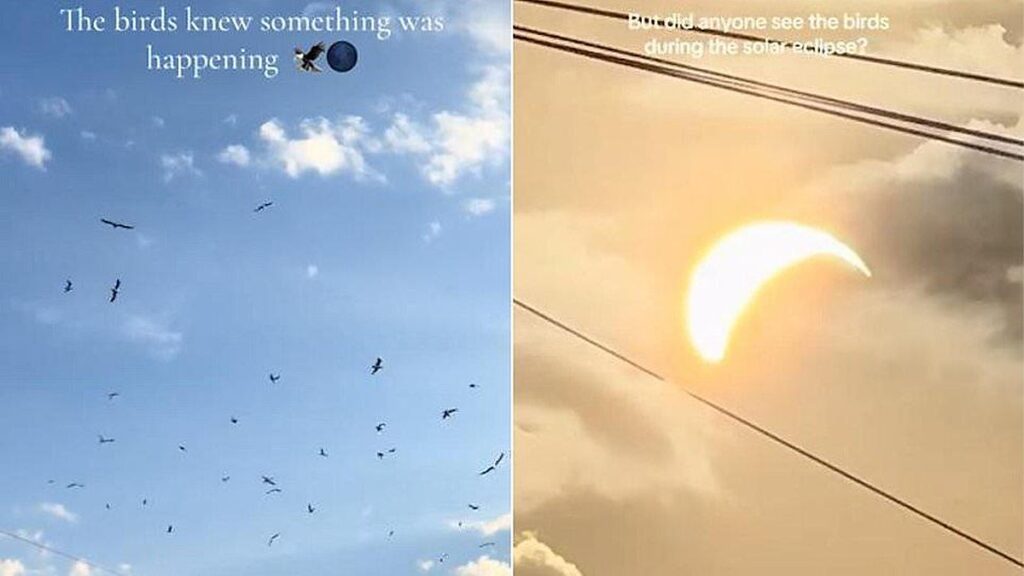
Britons watching Wednesday’s rare solar eclipse were treated to an unexpected spectacle as birds appeared to react dramatically to the sudden disappearance of daylight.
As the Moon moved across the Sun, videos shared online appeared to show large flocks taking to the skies in seemingly erratic patterns.
In other locations, observers reported an almost complete silence from birds as the daylight rapidly faded.
The unusual scenes quickly attracted attention online, with viewers questioning whether the animals understood that something extraordinary was happening.
Social Media Users Spot Unusual Behaviour
Footage posted during the eclipse prompted a wave of reactions from people who said birds in their areas appeared unusually unsettled.
“The birds knew something was happening,” one viewer wrote while sharing a video showing birds flying in apparently random directions.
Others described seeing unusually large groups of birds in the sky.
One social media user asked whether anyone else had noticed birds “acting strangely”, while another reported seeing a “massive flock of crows”.
A viewer from Cornwall said the birds were “definitely spooked”, while another claimed the eclipse had left birds in their local area “PANICKED”.
The reports varied from frantic movement to complete stillness, creating an eerie atmosphere as millions of people watched the celestial event.
Why the Eclipse Affects Birds
Although the behaviour may have seemed mysterious, scientists have long known that birds are particularly sensitive to changes in their environment.
Light plays an important role in regulating the daily biological rhythms of many birds.
Changes in daylight influence when they feed, communicate, move and settle down for the night.
Dr Kristina Paradowski, a clinical assistant professor at the Texas A&M School of Veterinary Medicine and Biomedical Sciences, has explained that some animals rely especially heavily on light cues, with birds among the clearest examples.




The eclipse created an unusually rapid transition from bright daylight towards darkness, potentially confusing birds that use natural light as a signal for their daily routines.
Darkness Arrives in the Middle of the Day
During the eclipse, the Moon moved across the Sun and blocked more than 90 per cent of its light from London at the event’s peak.
The sudden reduction in sunlight was accompanied by a noticeable change in conditions across parts of Britain.
As temperatures had climbed during the country’s fifth heatwave of the year, some areas experienced a welcome drop in temperature as the Moon covered the Sun.
For birds, however, the abrupt darkness may have been interpreted as a signal that night was approaching.
Experts have previously recorded daytime birds reducing or stopping their calls, changing their flight behaviour and settling down during solar eclipses.
Birds Can Mistake an Eclipse for Nightfall
Scientists believe the behaviour is largely caused by environmental changes rather than birds somehow recognising that an eclipse is taking place.
The rapid loss of sunlight can disrupt the cues that normally tell birds whether it is daytime or nighttime.
A sudden drop in temperature may also contribute to the disruption.
Essentially, the eclipse can act like nature’s alarm clock going off at the wrong time: daylight disappears unexpectedly, prompting some animals to behave as though night has arrived.
That can explain why some birds appeared to panic while others became unusually quiet.
Earlier Research Found Widespread Changes
Evidence from previous eclipses supports the observations made by people watching the skies this week.
A study published in the journal Science found that more than half of wild bird species examined changed their behaviour during the 2024 solar eclipse.
Researchers observed birds responding to the sudden darkness as though nighttime had arrived.
In some cases, birds even began singing a dawn chorus once the eclipse had passed, despite the period of darkness lasting only a few minutes.
The findings indicate that a rapid disruption to natural light can temporarily interfere with birds’ normal biological rhythms.
A Rare Spectacle for Wildlife and Humans
While millions of people gathered to experience the eclipse as a spectacular astronomical event, the unusual reactions from wildlife provided another reminder of how closely animals respond to their surroundings.
For observers who noticed flocks suddenly changing direction or birds falling silent, the scenes may have seemed inexplicable.
Scientific evidence, however, suggests that the animals were responding to one of the most powerful environmental signals they experience each day: the sudden loss of daylight.
The eclipse may have lasted only a short time, but for birds relying on the Sun to guide their routines, those few minutes were enough to make an ordinary afternoon appear remarkably like night.
