
Clacton-on-Sea has spent decades wrestling with the decline of the traditional British holiday resort.
Once a hugely popular destination for families, the Essex town has more recently become associated with empty shops, ageing hotels and a struggling high street.
It was ranked the UK’s worst seaside town by Which? magazine in both 2019 and 2023.
Yet this summer, Clacton has found itself at the centre of national attention for an entirely different reason, with the August 13 by-election turning the resort into an unlikely stage for a political contest involving Reform UK leader Nigel Farage and satirical candidate Count Binface.
A resort with plenty of character
First impressions can be deceptive. Driving towards Clacton, visitors might expect a landscape dominated by political banners and St George’s flags.
Instead, the town initially offers little sign of the electoral drama unfolding around it.
There is, however, no disguising the resort’s faded edges.
Old amusement arcades, tired hotels and lively seafront bars give parts of Clacton an unmistakably old-fashioned atmosphere.
For some visitors, that is precisely the attraction.
Founded in 1871 on the north Essex coast, Clacton became one of Britain’s great working-class holiday destinations during the 20th century.
London families flocked here for traditional seaside pleasures, while the town’s Butlin’s holiday camp welcomed visitors from 1938 until its closure in 1983.
At its height, Clacton was sometimes dubbed the “Barbados of Britain”.
But the arrival of cheap package holidays to continental Europe during the 1970s dealt a major blow to resorts such as Clacton, beginning a long period of decline.
The pier remains Clacton’s showpiece
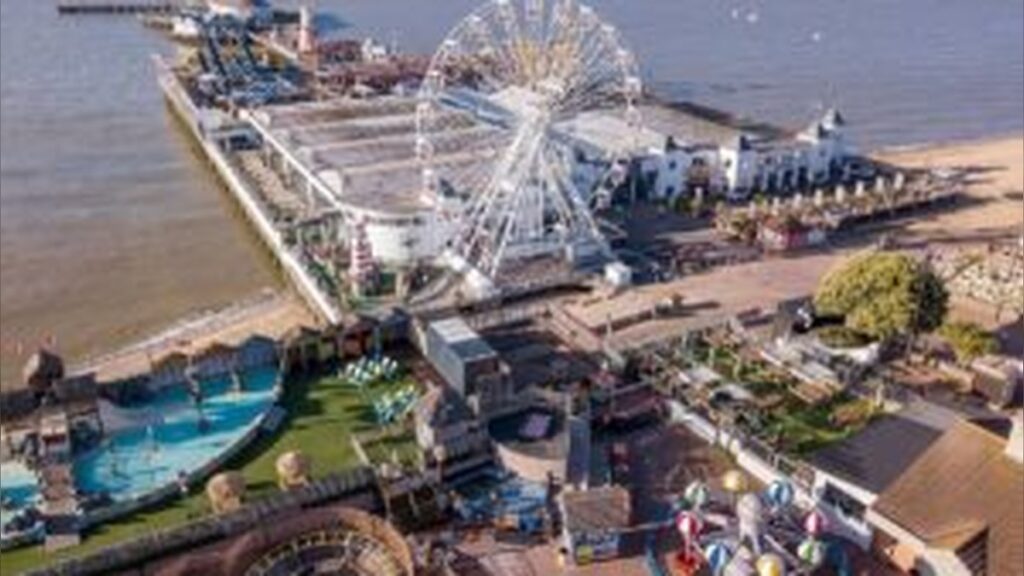
For all its problems, Clacton still possesses one of the great attractions of the British seaside: its pier.
Clacton Pier, which recently marked its 155th birthday, remains a major draw for families.
It describes itself as Europe’s biggest pleasure pier, although Southend Pier holds the record for the world’s longest pleasure pier.
Entry to the pier is free, while individual rides start at £2.50. For families planning to spend several hours there, the Big Day Out wristband offers access to 16 attractions from £22.50.
Among the rides are the Looping Star rollercoaster, log flume and helter-skelter, alongside the Clacton Wheel.


Visitors can also try Adventure Golf, Jurassic Pier and a 4D dinosaur experience.
The combination of rides, arcades and traditional seaside food makes the pier feel like a surviving piece of holiday nostalgia.
Its appeal has not gone unnoticed: it has been shortlisted for Best Seaside Theme Park at the 2026 UK Theme Park Awards, alongside Skegness Pleasure Beach and Dreamland Margate.
Beaches that still deliver
Clacton’s greatest asset may be something considerably simpler than its amusements: the beach.
The resort’s beaches have Blue Flag status and, even during a busy summer day, can feel surprisingly spacious.
From the top of the Clacton Wheel, the coastline stretches towards Holland-on-Sea and Frinton-on-Sea.
The King Charles III England Coast Path provides a particularly pleasant way to explore the area, with walkers able to follow the coastline for around two miles towards Holland-on-Sea and continue beyond.
Frinton, about three miles farther along the coast, provides a striking contrast.
Its beaches are backed by pastel-coloured beach huts and elegant Art Deco houses, creating a considerably quieter and more polished atmosphere than Clacton.
Beyond the seafront
The contrast becomes sharper away from the coast.
Clacton’s less prosperous side is visible in its boarded-up premises and struggling shopping streets, where charity shops, vape stores and specialist fishing outlets are among the businesses still trading.
The town nevertheless has a surprisingly varied collection of pubs and nightlife venues, from the Brace of Pistols and the Klub to the unusually named Never Say Die.
More traditional drinking spots include the Ship Inn in Great Clacton village and the Robin Hood, while seafood lovers can head to Salts by the Sea at Clacton Pavilion, where the food comes with expansive views across the coast.
And, naturally, no visit to Clacton would be complete without fish and chips.
A recommendation from a local leads to John’s Fish Bar on Rosemary Road.
A resort trying to reinvent itself
Clacton is not simply accepting its decline. Major investment is beginning to reshape parts of the town.
A £30 million Civic Quarter redevelopment is under way, while there are also plans to give the roughly 200-year-old Martello Tower a new life as an arts venue.
Such projects suggest that the town’s future need not depend solely on nostalgia for its heyday.
Its broad beaches, historic attractions and distinctive seaside identity provide a foundation on which a more modern resort could be built.
Why Clacton still matters
It is easy to focus on the peeling paint, shuttered businesses and political theatre.
But spend time beside the sea and a different Clacton emerges.
Families still paddle in the water. The pier remains full of noise and colour.
The beaches offer space, the gardens retain their Victorian charm and occasional palm trees provide an appropriately eccentric flourish.
Clacton may no longer resemble the glamorous holiday resort of its mid-century heyday, but that does not make it without merit.
Its mixture of faded grandeur, traditional entertainment and genuine seaside pleasures is part of its character.
And with the town once again dominating the headlines ahead of the August 13 by-election, Clacton has been given something it has not enjoyed for years: the country’s undivided attention.
For a resort built on traditional British escapism, there could hardly be a more fitting backdrop for a political pantomime.

