
Thousands of reported Bigfoot encounters across the United States have prompted a fresh examination of claims that the mysterious creature may venture far beyond remote forests and into populated areas after dark.
Independent researcher and retired police officer Bruce Champagne analysed 5,834 reports from 14 states before identifying 25 accounts that he considered particularly significant. His research focused on alleged encounters deep inside towns and cities, where witnesses claimed to have seen large, ape-like figures moving through urban areas at night.
Although the findings suggest recurring patterns in the accounts, there remains no publicly presented physical evidence that scientists have confirmed as proof of Bigfoot’s existence.
Researcher Identifies 25 Accounts of Alleged Urban Encounters
Champagne narrowed his investigation to reports describing sightings at least a quarter of a mile inside densely populated areas. For the purposes of the study, these locations had at least 1,600 residents per square kilometre.
The 25 selected accounts involved alleged encounters with large, ape-like creatures in towns and cities. Champagne assessed the reports using several factors, including the number of witnesses, their perceived credibility, the distance between observers and the creature, and the duration of each encounter.
The accounts were drawn from three databases: Oregonbigfoot.com, the Green Archive and the Bigfoot Field Researchers Organization, commonly known as BFRO.
Champagne’s analysis sought to establish whether the reports showed recurring characteristics rather than representing unrelated sightings near the edges of wooded areas.
Sightings Allegedly Followed Quiet Routes Into Towns
One of the most notable patterns identified in the research involved the routes witnesses said the creatures used. Reports frequently described alleged Bigfoot figures moving along drainage ditches, railway lines and other relatively secluded corridors.
The creatures were also reported to travel an average of 1.75 miles into towns and cities. In one account, an alleged Bigfoot was said to have ventured almost eight miles into a populated area, although the report did not disclose the precise date or location.
Champagne characterised the behaviour described in the accounts as potentially deliberate, rather than the result of chance encounters at the boundary between settlements and wilderness.
He described the alleged movements as “a pattern of rare, apparently intentional, largely solitary, nocturnal, corridor-based incursions that may be consistent with flexible decision-making.”
However, these conclusions are based on eyewitness reports and do not independently establish that an unknown species was responsible for the encounters.
Winter Nights Emerge as a Recurring Feature
The timing of the reported encounters was another central element of Champagne’s analysis. Witnesses most frequently described seeing the alleged creatures during the night, particularly between midnight and 3am local time.
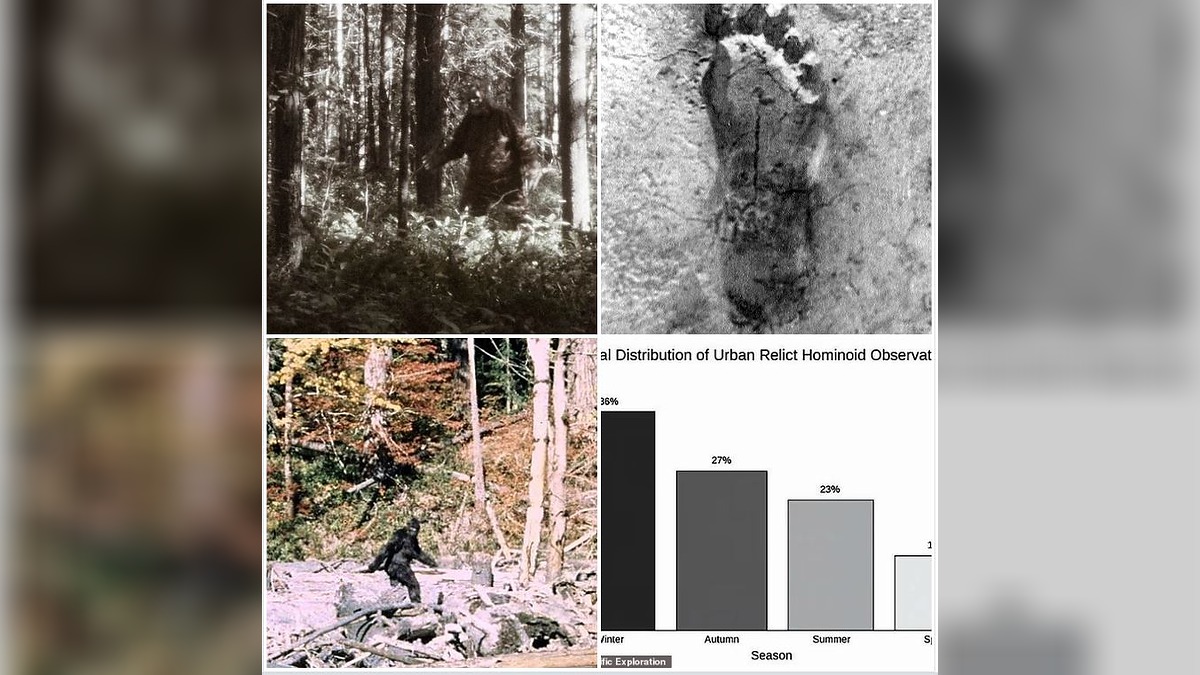
Winter accounted for 36 per cent of the encounters examined, making it the most frequently reported season. Autumn followed with 27 per cent, while summer accounted for 23 per cent and spring for 14 per cent.




Champagne suggested that the seasonal pattern could have a possible explanation if the reports involved an animal whose food sources became less available during colder months.
Wild animals sometimes move closer to human settlements when environmental pressures make food harder to find. Champagne proposed that a similar explanation might account for the reported winter encounters, although the theory remains speculative in the absence of verified evidence of Bigfoot.
Illinois, Ohio and Three Other States Record More Reports
The 25 urban-incursion accounts were spread across 14 states, with Illinois, Ohio, Utah, New Jersey and Colorado recording the highest concentrations in the research.
The reports also appeared to cluster within a particular period. According to Champagne’s analysis, sightings of this kind peaked between 2006 and 2015.
The wider BFRO database contains reports dating back to 1904. Its records list Washington state as the location with the most reported Bigfoot encounters, with more than 700 accounts, followed by California with nearly 500.
These figures represent reported sightings rather than confirmed encounters. The number of reports recorded in a state does not, by itself, demonstrate that Bigfoot exists or establish the accuracy of individual claims.
Witnesses Describe Creatures of Different Sizes
Descriptions of Bigfoot varied considerably across the accounts reviewed. Around 40 per cent of witnesses described the alleged creature as “massive”, while approximately one in five characterised it as lightly built.
Some reports portrayed the creature as standing as tall as 15 feet, with footprints measuring up to 24 inches long and eight inches wide.
Such descriptions have long featured in Bigfoot folklore, but witness estimates of an animal’s height and footprint dimensions can be difficult to verify without reliable physical evidence. The research does not establish that the reported measurements correspond to a known or unknown species.
Champagne’s approach attempted to distinguish accounts using factors such as proximity, duration and the presence of multiple witnesses, but these criteria cannot independently confirm the identity of a creature described in a sighting.
Bigfoot’s Modern Story Began in California
Bigfoot is commonly described in North American folklore as a large, hairy, ape-like creature that walks upright and inhabits remote forests.
The modern wave of public interest can be traced in part to 1958, when Humboldt Times journalist Andrew Genzoli published a reader’s letter describing enormous, unexplained footprints near a logging site at Bluff Creek, California.
Interest in the creature grew through subsequent eyewitness accounts, photographs and claims of unusually large footprints. One frequently discussed example is the 1967 Patterson-Gimlin film, which appears to show a large, upright, hair-covered figure moving through the Bluff Creek area.
The film and other alleged evidence have remained subjects of debate, but none has resulted in publicly available physical evidence that scientists have accepted as proof of Bigfoot’s existence.
Claims of Intelligent Behaviour Remain Unproven
Champagne compared the patterns described in the reports with the behaviour of intelligent animals, including great apes, when they encounter people.
He argued that the alleged creatures’ reported preference for moving through urban areas at night could indicate an avoidance of the risks associated with daytime activity around humans.
In his conclusion, Champagne wrote that “urban incursions, while uncommon, are behaviorally structured events that merit further comparative and field-based investigation.”
The statement reflects his interpretation of the reports rather than a scientific confirmation that an unidentified animal is deliberately entering populated areas. Establishing such a claim would require independently verifiable evidence and further field research.
Thousands of Sightings Have Yet to Establish Bigfoot’s Existence
Bigfoot remains a subject of enduring public fascination, supported by a large collection of reported sightings across the United States. The latest analysis adds a specific focus on accounts describing alleged encounters inside towns and cities, particularly during winter nights.
Champagne’s research identifies recurring features in the reports, including secluded travel routes, late-night sightings and claims of long distances travelled into populated areas.
Nevertheless, eyewitness accounts, photographs and footprint claims have not produced publicly accepted scientific proof of the species. Until evidence can be independently examined and verified, the possibility that Bigfoot is moving through American communities remains an unconfirmed claim rather than an established scientific finding.

