
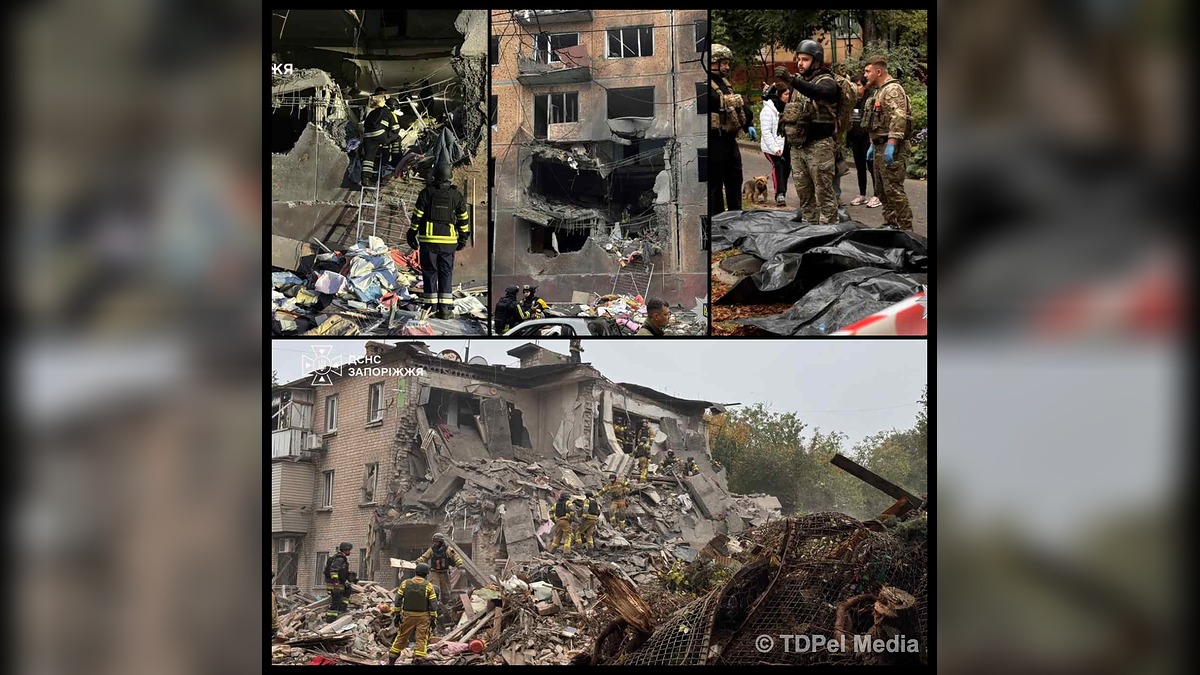
Another 14 people were injured in the bombing, with two reported to be in critical condition as doctors worked to save their lives.
Ukrainian authorities were also attempting to establish the fate of 12 additional people believed to have been present in the affected area, raising concerns that the casualty figures could increase.
The reported attacks came amid renewed tensions over the easing of sanctions on diesel exports, with Ukraine arguing that reduced economic pressure on Moscow could encourage further military operations.
Emergency Workers Search Damaged Buildings for Survivors
Search-and-rescue teams were deployed to the affected residential buildings in Zaporizhzhia following the strikes, with emergency personnel continuing efforts to locate people who may have been trapped or otherwise unaccounted for.
The five glide bombs reportedly caused extensive damage to residential structures, leaving rescue workers facing the difficult task of searching affected areas while medical teams attended to the injured.
Of the 14 people reported wounded, two remained in critical condition, requiring urgent medical attention.
Authorities were still verifying information concerning 12 other individuals who may have been at the locations struck by the bombs.
The reported deaths of three children added to the civilian toll of the attack, while families awaited further information about missing relatives.
Overnight Russian Attacks Cause Damage Across 13 Ukrainian Regions
The bombing of Zaporizhzhia formed part of a broader overnight assault that reportedly affected 13 Ukrainian regions.
Residential buildings, infrastructure installations and railway facilities were among the structures damaged during the attacks.
The extent of the destruction across individual regions was not immediately detailed, and comprehensive information about additional casualties outside Zaporizhzhia was not provided in the initial statement.
The damage to railway facilities raised concerns about possible disruptions to transport services and logistics, although the operational consequences remained unclear.




Emergency services continued responding to affected locations as authorities assessed the destruction.
Diesel Export Sanctions Relief Sparks Renewed Dispute Over Pressure on Russia
The latest attacks have intensified criticism from Kyiv over decisions to ease sanctions affecting Russian diesel exports.
Ukrainian President Volodymyr Zelenskyy linked the bombing to the relaxation of economic restrictions, arguing that Moscow interprets reductions in international pressure as an opportunity to continue its military campaign.
Ukraine maintains that sanctions and other forms of economic pressure are necessary to influence Russia’s conduct and encourage an end to the conflict.
However, the reported timing of the bombing does not independently establish that the attack was caused by the sanctions decision.
The Ukrainian government has continued to advocate stronger international measures against Russia, including restrictions intended to limit resources available for its military operations.
Ukraine Signals Further Long-Range Military Responses
Following the overnight attacks, Ukrainian authorities indicated that further military responses against Russian targets would follow.
Long-range strike capabilities were identified as an important part of Ukraine’s strategy for imposing military and economic costs on Russia.
Kyiv argues that maintaining the ability to strike targets at considerable distances is necessary to counter continued Russian attacks on Ukrainian territory.
The government has also called for sustained international assistance to strengthen its defensive and offensive capabilities.
No specific targets or timetable for additional Ukrainian strikes were disclosed in the statement.
Civilian Casualties Renew Concerns Over Continuing Air Attacks
The reported deaths in Zaporizhzhia highlight the continuing danger faced by civilians as aerial attacks affect populated areas and essential infrastructure.
Residential buildings remain particularly vulnerable to the consequences of strikes in urban environments, where damage can leave people trapped beneath debris and complicate rescue operations.
The latest reported casualties also underscore the challenges facing emergency responders and medical personnel during large-scale overnight attacks.
As rescue operations continued in Zaporizhzhia, authorities were working to establish the full number of victims and assess damage across the other affected regions.
The casualty figures and damage assessments were based on Ukrainian official statements and had not been independently verified in the information provided.
With further military responses anticipated, the latest escalation has renewed attention on the effectiveness of international sanctions, the protection of civilian populations and the continuing absence of an agreement to end the war.
