
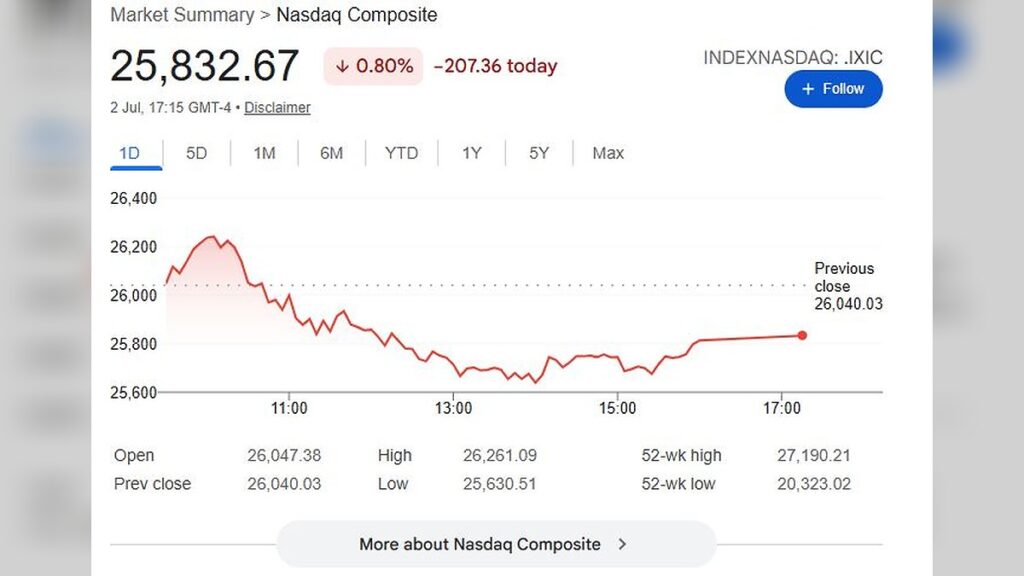
The S&P 500 has delivered one of its strongest performances in recent years, posting its best quarterly gain since 2020 and advancing roughly 9% since the start of 2026.
However, Bank of America believes the rally is approaching a turning point, warning that elevated valuations and speculative trading could lead to a market correction before year-end.
The investment bank has maintained its year-end target of 7,100 for the benchmark index, implying a decline of about 5% from its recent closing level.
Valuation Concerns Drive Bearish Outlook
In a research note released Tuesday, Bank of America said several indicators associated with previous market peaks have begun flashing warning signs.
Analysts pointed to sharp gains in high-valuation stocks, arguing that periods of intense speculation have historically been followed by declines as market valuations return to more sustainable levels.
The bank believes the current environment resembles earlier episodes when investor enthusiasm pushed stock prices significantly ahead of underlying fundamentals.
AI Spending Pressures Corporate Cash Flow
Another factor weighing on Bank of America’s outlook is the financial impact of the artificial intelligence investment boom.
According to the bank, many of the largest technology companies are generating less free cash flow relative to reported earnings because of enormous capital expenditures aimed at expanding AI infrastructure.
These “hyperscaler” companies continue to report strong profits, but the heavy spending required to support AI growth is reducing the amount of cash available after investment, raising questions about the sustainability of current valuations.
Expected Federal Reserve Rate Hikes Could Add Pressure
Bank of America also expects monetary policy to become less supportive for equities.




The bank recently forecast that the Federal Reserve will raise interest rates three times this year as policymakers continue battling inflation that remains above the central bank’s long-term 2% target.
Historically, stock markets have often continued rising for several months after the beginning of a rate-hiking cycle.
However, Bank of America argues that today’s market enters potential tightening from a much more expensive valuation level than in most previous cycles, with only the late-1990s technology boom providing a comparable example.
AI Stocks Continue to Lead Market Gains
Artificial intelligence remains the dominant force behind equity performance in 2026.
Semiconductor companies have posted particularly strong gains as demand for AI hardware continues to accelerate.
Micron Technology, for example, has surged more than 240% since the beginning of the year and approximately 700% over the past 12 months despite experiencing a recent pullback.
The concentration of market gains in a relatively small group of AI-related companies has intensified debate over whether current valuations can be maintained.
Market Volatility Raises Fresh Questions
Although the S&P 500 recently reached a record high of 7,621, the benchmark has experienced increased volatility in recent weeks.
Sharp swings have also affected international markets. South Korea’s Kospi index, heavily weighted toward technology companies including SK Hynix and Samsung, recently recorded one of its steepest daily declines after setting a new all-time high.
Capital Economics said similar bouts of volatility have historically occurred during major bear markets, including the Asian financial crisis, the dot-com collapse, and the global financial crisis, suggesting that investor optimism may have become excessive.
Wall Street Remains Divided on Outlook
Despite Bank of America’s cautious stance, several investment firms continue to expect further gains for US equities.
JPMorgan recently raised its year-end target for the S&P 500 to 7,800, citing resilient corporate earnings and expectations that the Federal Reserve will keep interest rates unchanged through the remainder of the year.
However, the bank also warned that concentrated positioning in momentum and speculative growth stocks could trigger a sudden “flash crash” if investor sentiment shifts.
Meanwhile, Yardeni Research remains among the most optimistic forecasters on Wall Street.
Company President Ed Yardeni increased his year-end target for the S&P 500 to 8,250, arguing that today’s rally is supported by strong corporate earnings rather than the speculative enthusiasm that characterized the dot-com era.
Yardeni contends that while the technology boom of the late 1990s was fueled by fear of missing out, the current market is being driven by what he describes as “fabulous earnings momentum,” reflecting stronger corporate fundamentals despite the rapid rise of artificial intelligence-related stocks.

